Human body is made up of trillions of cells. Some of these cells are specialised and connected together to form various organs.The cells that connect each other provides the structural support and maintain the organ shape and function. Traditionally these supporting cells were thought to have little functional role. Now it is well recognised these cells could be as important as the myocytes or hepatocyte . God has never created any of the human cells with out any purpose . They may have important paracrine function. Healthiness of these interstitial cells are vital for the intercellular communication, cell nutrition and it’s proper function . These cells are called by various names , the old terminology could be the connective tissue -the tissue that connects cells. Many times fibroblasts is the common name given to all interstitial cells . Interstitium is not only filled with some bizarre mesenchymal cells it is also a depot of sticky molecules. Now we have deeper knowledge about these , and identified various intercellular adhesion molecules, matrix metallo proteins , vitronectins, etc.
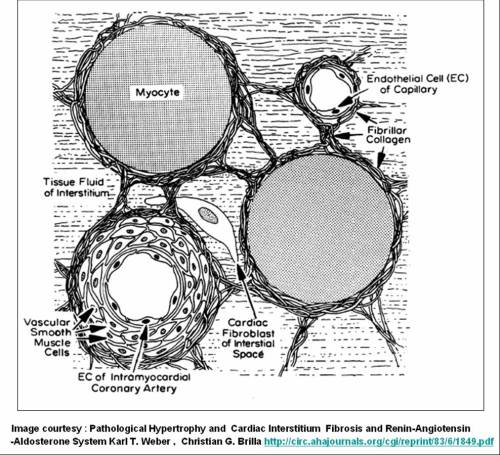
It is a great medical paradox the specialised the myocytes, hepatocytes, axonal cells are given due respect, while the role of cells and molecules that bind them together is least appreciated . In fact in any given organ the functional cells constitute only one third of it’s weight.In the heart myocytes form only 30% of it’s weight. It is a clear cut case of discriminating the majority !
Interstitial disorders and diseases
In the lung Interstitium becomes very much important because the gas exchange has to traverse the interstitium and enter the alveloar cells. So any abnormality here is immediate and profound.The diffusion capacity reduces .Patients develop progressive COPD.
In the kidneys , interstitium has a functional component as the absorbed fluid and electrolytes has to reach the blood circulation .Hence acute and chronic interstitial nephritis are distinct clinical entities .
In the brain dysfunctional inter neuronal cells can interfere with various CNS functions dementia the major disorder id thought mainly contributed by the interstitial fibrosis.
So when each of the vital organ has a potential to suffer from interstitial pathology How can heart alone escape ?
No, it does not . The currently popular entity , heart failure with normal ejection fraction could be nothing but chronic interstitial carditis. or chronic progressive interstitial fibrosis. Hypertensive heart disease is a major cause . CAD can also contribute .
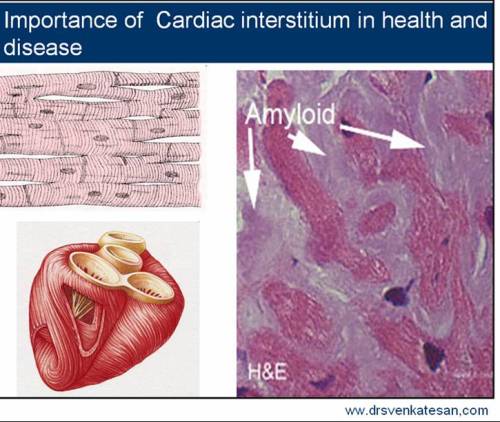
The interstitial fibrosis is also a feature of dilated and restrictive cardiomyopathies. (Classical amyloid heart disease ) .Initially these fibrosis do not affect the contractile function of myocyte .In later stages it encroach upon the contractile cells and impair the EF. This explains the natural history of many of the RCMs which go for dilatation and contractile dysfucntion in terminal state.
What is the difference between myocyte relaxtion and cardiac relaxation ?
- It is now recognised , cardiac interstitium has a big role in relaxation .
- Cardiac relaxation is not synonymous with myocardial or myocyte relaxation .
- For myocyte to relax , it has to eject back the calcium from the actin myosin complex into the sarcoplasmic reticulum where the calcium uptake protein phospholamban holds it till the next systole.
- As the myocyte relaxes it has the additional burden of stretching & relaxing the adjoining non myocytic cells , unfortunately this weighs 70% more than it’s own weight .One can imagine how much the heart is stressed during even diastole ! So as the sheets of myocytes feel the diastolic interstial stress the whole LV struggles to relax and LVED raises and diastolic dysfunction begins to set in.
- The interstitial l plasticity and elasticity is vital for cardiac chamber to reach it’s pre contractile state . It is now recognised the rate of LV relaxation (Negative dp/dt ) is directly proportional to the interstitial agility and turgor .
How to overcome interstitial fibrosis and stiffness ? Anti fibrotic drugs ? .
We are in search for such a universal anitifibrotic drug that can work in liver fibrosis ( Cirrhosis ) lung and myocardial fibrois. D penicillamine has showed some promise. How to make the interstitial interface more flexible ? Collagenolytic agents , elastase MMP inhibitors etc may become the future targets. A much established way to regress myocardial fibrotic process is , with ACEI and aldosternoe antogonists. (EPESUS, RALES study) .Some of the anti myocardial remodelling action of ACEI is attributable to it’s anti growth factor properties and can the resultant regression of interstitial fibrosis.
Apart from the look out for sophisticated drugs , applying common sense can do a “great deal of good “for the myocardium in diastolic cardiac failure . A stiff skeletal muscle need physiotherapy. A stiff cardiac muscle will also need exactly this. For cardiac muscle physiotherpy can not be administered by a therapist ! , we have to do it , regular exercises to make it contract and relax fast . So , it is important to recognise exercise prescription and training could be the most important modality for preventing progression of diastolic heart failure.
Clinical situations where cardiac interstitial pathology is relevant
- All forms of cardiac failure
- Some forms of myocarditis
- Myocardial interstitial edema ,Post MI/Reperusion
- Myocardial interstitial edema mediated no reflow following primary PCI
- Acute and cardiac transplant rejection
- Drug induced adrimycin carditis .
- Cardiac interstitium arrhythmias : Many of the cardiac arrhythmias are due to re entry circuits mediated by cardiac interstitial fibrotic substrates.
- Atrial fibrillation
- Post MI ventricular tachycardias
Final messge
Deep dissections of pathological hearts in pursuit of culprit cells has surprisingly , lead us not into myocytes and conducting cells but into inter cellular spaces” . There is big secret world over there within the cardiac interstitum.Young scientists and students argued to explore and unravel the mysteries !
Reference
A landmark article in Circulation 1991



 Dr.S.Venkatesan MD
Leave a comment