ST segment depression is the classical response to stress during excercise stress testing. (EST)Not all types of ST segment are pathological.The ST segment should depress atleast 1 mm below the isoelectric segment and it should be depressed for 80msec from the J point.
It must satisfy two criteria .
- The quantum of ST depression should be > 1mm at 80msec from J point.
- Slope of ST segment
Always pathological slopes
- Horizontal
- Down sloping
Most often pathological
- Slow up sloping
Non pathological slope
- Rapid up sloping with ST depression
- Rapid Up sloping depression of only the J point( The classical normal physiological response to excercise )
Horizontal or down sloping ST segment is easily recognised .When there is junctional ST depression with a ST segment that is climbing upwards , it is some times difficult to interpret.
How do you measure the slope of ST segment ?
We don’t have the trouble of measuring it as the computer does this job automatically. But a cardiology fellow need to know how it is measured !

A slow upsloping ST segment( <1.5mv.sec )can be a significant marker of ischemia.This is especially true in established CAD or individuals at high risk . For so slow up sloping a .5mm allowance is given to filter out false positive (ie to improve sensitivity) . So for slow up sloping ST segment , to be reported as positive it should depress atleast 1.5mm or some times 2mm.
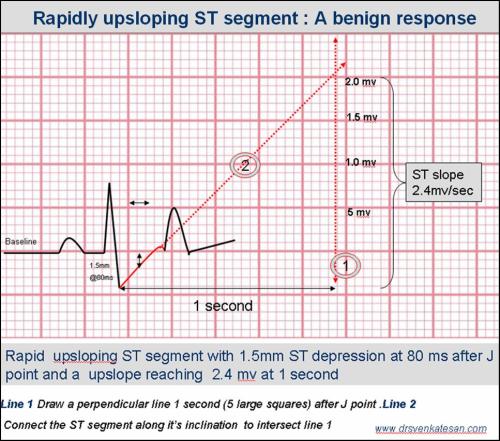
Available evidence suggest a rapidly upsloping ST segment (> 1.5mv /Sec) is a non ischemic response irrespective of the quantum of ST depression at 80msec. However , a rapidly upsloping ST is rarely depressed beyond 2mm .( This is because , the geometric hyperbolic curve of ST segment does not allow a situation of 3mm ST depression at 80msec with rapid upsloping )
What is the angiographic correlation of slow upsloping ST segment depression?
Few studies are availbale to address the issue. It is believed slow up sloping of ST depression is often associated with CAD but it is very rare to find a critical and proximally located CAD.Left main disease is almost never manifest with slow upsloping ST depression.
What is the significance of slow upsloping ST in clinical situations like unstable angina ?
It is rare for cardiologist to diagnose or “even look for” slow or rapid up sloping ECGs in coronary care units. But , a patient with stable CAD , sinus tachycardia , angina can exactly mimic a stress test situation .
Some of the low risk UA , mainly secondary UA due to increase demand situations manifest with slow upsloping ST depression , while classical thrombotic occlusions produce the typical horizontal or downsloping ST segment depression.



 Dr.S.Venkatesan MD