Feeds:
Posts
Comments

Posts Tagged ‘mitraclip’

The short answer is, Yes.

Detailed answer is also yes : Read further please.

The MitraClip procedure, is designed to reduce mitral regurgitation (MR) by approximating the mitral valve leaflets, can alter the direction or nature of residual MR, including potentially converting a central MR jet into an eccentric one . This possiblity depends on the pre-procedural anatomy, the placement of the clips, and the resulting changes in mitral valve dynamics.

Central MR in ischemic dilated cardiomyopathy (DCM) typically arises from functional MR, where symmetric annular dilation and leaflet tethering (due to LV remodeling) create a central regurgitant jet through a malcoapted valve. The MitraClip works by grasping the anterior and posterior leaflets, usually at the A2-P2 segments, to create a double-orifice valve, reducing the regurgitant orifice area. When successful, this diminishes the overall MR volume, often preserving the jet’s central nature if residual MR remains.

However, if the clip placement is asymmetri or if multiple clips are positioned unevenly, the geometry of the mitral valve can shift. This could redirect the residual regurgitant flow. For example, if the clip is placed more toward the medial or lateral commissure, or if it disproportionately restricts one leaflet’s motion (e.g., excessive tethering of the posterior leaflet), the remaining gap might produce an eccentric jet directed toward the opposite side of the left atrium.

Echocardiographic studies post-MitraClip occasionally report changes in jet direction. While the primary goal is MR reduction, not all procedures eliminate regurgitation entirely, and residual MR jets can appear eccentric depending on how the leaflets coapt after clipping. For instance, if the clip reduces central coaptation but leaves a smaller, off-center orifice, the jet might angle toward the atrial wall, resembling eccentric MR seen in organic valve disease (e.g., prolapse). This isn’t necessarily a conversion from central to eccentric in the classical sense but rather a modification of the residual flow pattern.

Clinical data doesn’t frequently highlight this as a major issue. In trials like COAPT and MITRA-FR, the focus is on MR severity reduction rather than jet direction, and eccentric jets aren’t systematically reported as a post-procedural phenomenon. However, case studies and operator experiences suggest that jet redirection can occur, particularly with suboptimal clip positioning or in complex anatomies.

Implication of new onset eccentric jet

1.Eccentric jet directed towards one of the pulmonary veins can cause unpredictable postural dyspnea.

2.Eccentric jets are difficult to quantify the exact post clip ERV.

3.Can Interfere with favorable remodelling of LA

4.Might Increase IE risk

Final message

Mitra-clip is an innovative catheter-based MR jet interrupter. However, it is not surprising this device could convert a central MR into an eccentric MR, considering the fact that it tampers with mitral valve orifice morphology almost blindly. Adding more complexity is that, the clip brings one more “Neo-regurgitation orifice”. Mitra-clip still can be useful in very selected patients, where it regresses the MR significantly. But, experience tells us the importance of precise clip deployment guided by meticulous imaging and expertise.

Postamble and a follow up question

Can mitraclip convert an eccentric jet into a central one ?

It would be great if this is possible .The problem here is , it need too much precision and overcoming the uncertainity of the iatogenic second jet morphology.

Read Full Post »

The mechanism of MR in ischemic /Functional is complex. Technically, pure ischemic MR should have a structurally normal leaflet and the subvalvular mechanism dominates But,the combination of the two is also prevalent. In fact, a degenerative component is added to this in many elderly patients.

Mechanism of Ischemic mitral regurgitation

Any of the following may contribute either alone or in in different combinations.

  • Global LV dilatation with or without annular dilatation
  • Spherical left ventricle
  • Altered inter papillary muscle distance (Degree and direction of  posterior vs apical displacement of pap muscle)
  • Chordal shortening /Lengthening/Abnormal tethering
  • Leaflet tenting distance and volume
  • Basal LV dysfunction and Local LV (Sub-mitral) remodeling

We have come a long way ,  since the days of  Carpentier and Duran who did pioneering work .It involved partial or complete mitral annular stabilization with surgical ring technology that  helped us to change the shape of the annulus. Advanced imaging, with 3 D printing will enable us to procure perfectly matched designer valve rings and (may be leaflets also) in the near future. Percutaneous mitral valve Interventions, with clips , valve, are going to dominate the mitral valve therapeutics.

Still, we are largely ignorant about Individual contribution from various components in the genesis of  ischemic /functional MR. This becomes important because the preservation of native valve is better on any day than replacing.  One thing is very clear, even though left ventricle forms part of mitral valve apparatus, the degree of LV dysfunction has no linear correlation with the severity of MR . Its a well-known fact, even severe LV dysfunction (Say < 25 % )may enjoy the company of a perfectly competent mitral valve. It’s interesting to note uniform global LV dysfunction cause more of central MR , while dispropotinate basalLV dysfunction especially the posteroinferior pap muscle cause eccentric jet. One more curiosity is mitral regurgitation improving with worsening disease as contractile force weakens.(Functional MR depends on LV function you know !)

We have witnessed at least two patients who had a significant MR following an inferior posterior MI which was managed medically, showed dramatic regression in the degree of MR  when he had anterior MI later*.The pleasant irony was apparently due balanced dysfunction of anterolateral pap muscle that happened in countering the original postero-medial pap muscle dysfunction.(*Allowing second MI to happen is of course a treatment failure !)

Image source -Christos G. Mihos  Journal of Thoracic disease Vol 8, No 1 (January 2016)

Mitral valve is essentially avascular structure, Still, ischemia affects this valve not by valve necrosis but by other sub valvular mechanisms .Note the MR here is due to poor motion of PML due to ischemic LV dysfunction.


Ischemic MR in early hours following STEMI (also NSTEMI) is still a nightmare. We realized in a harsh way, it’s rarely corrected fully even with a successful IRA plasty. (Especially LCX and posteromedial pap muscle that is in extreme distress) In fact , many of the mechanical complications that lead to flash pulmonary edema would need emergency CABG rather than primary PCI. (What to do for Ischemic MR ? An excellent review article( Elsayed Elmistekawy Curr Opin Cardiol 2013, 28:661–665) 

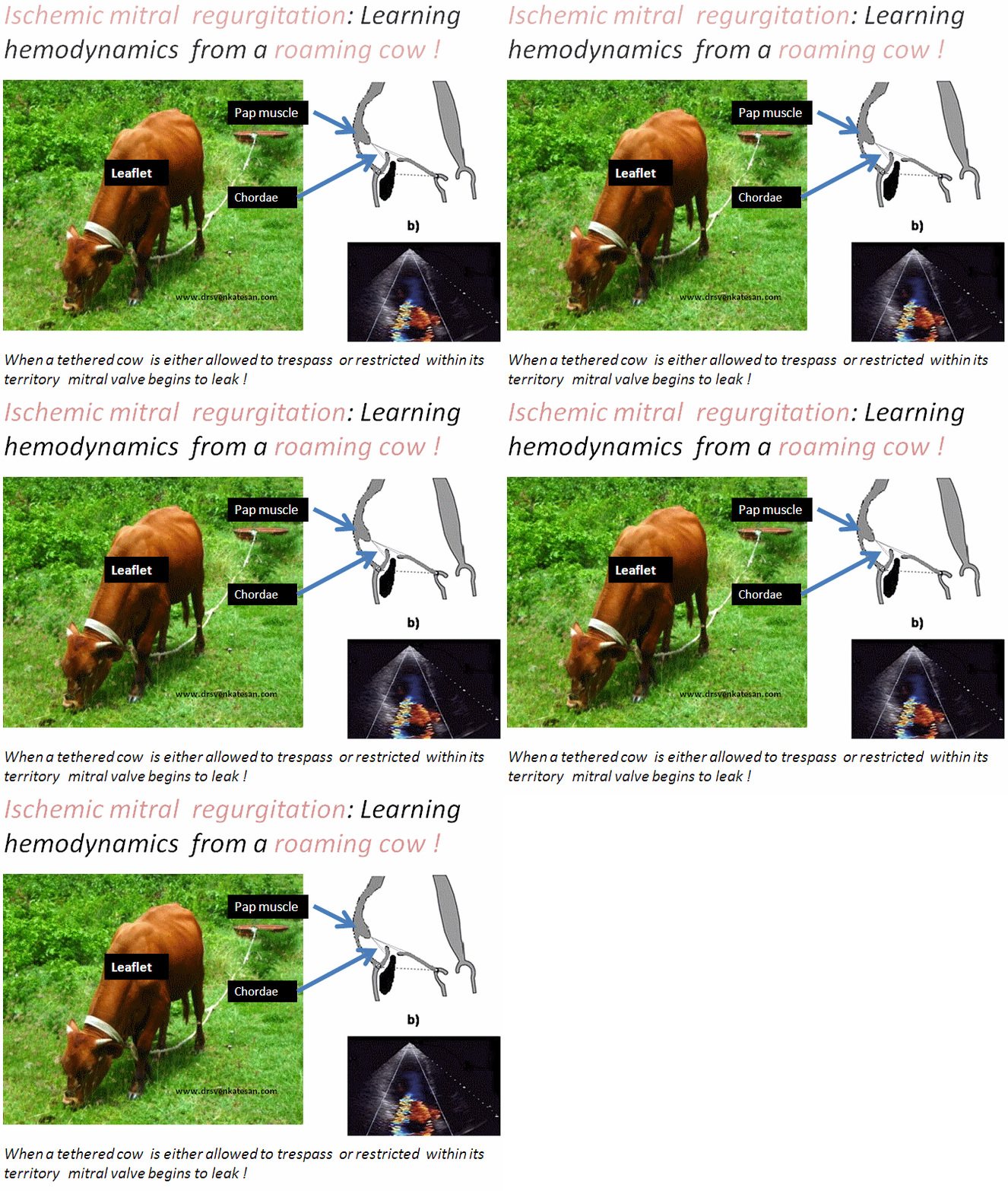
Mitral valve, though looks like an obedient, innocuous structure that  silently does its job , only in special times, it makes us realize, its the most critical part in the entire heart.(Guarding the lung against flooding when the left ventricle experiences turbulent ischemic times during ACS.) Note -Acute MR often kills , not the ACS as such.ischemic mitral regurgitation functional carpentier drsvenkatesan venkatesan madras medcial college 002The  mechanism of MR in various pathologies is comparable to the behavior of a cow grazing in an arc tethered to a poll. Normally its expected to follow a set pattern. If it behaves wayward, one may need to tighten the rope(Chordae), or loosen it, strengthen or move the poll(Pap muscle) . . . still more options like whipping (clipping ) the cow(Leaflet) may be tried. Of course ,ultimately one may need to replace the cow (MVR). EP guys do  have an electrical solution to tame this cow , called CRT to regress Ischemic MR .


Reference

1.Yiu S.F.,Enriquez-Sarano M.,Tribouilloy C.,Seward J.B.,Tajik A.J.Determinants of the degree of functional mitral regurgitation in patients with systolic left ventricular dysfunction: a quantitative clinical study. Circulation 2000;102:14001406

2.Mitral valve repair over five decades  Ann Cardiothorac Surg. 2015 Jul; 4(4): 322–334 

Read Full Post »