
Forget NEJM, Circulation, JACC, for some time. Hope & wish every one of us is aware of a journal called Blood, bringing stunning and dramatic discoveries week after week ,about the most crucial fluid that sustains our life. The journal Blood is published by the American Society of Hematology since 1949. Its impact factor is currently 20.8, celebrating its 75th year of existence .
We know, heart disease consistently tops the global mortality and morbidity charts . Without blood, heart is just a purposeless organ with four empty chambers. More than ninety percent of the cardiac mortality happens due to freezing and interruption of blood flow to the vital organs. Can any one dispute, heart is an Innocent bystander, when ACS happens due to an unscheduled pitched battle between blood and the coronary arterial wall ?
It is no surprise ,cardiologists spend most of their practicing time, fighting blood from freezing and trying to restore the flow. It is hard to believe there is absolutely little interaction between Hematologists and cardiologists dealing with the same organ.
Meanwhile, the drugs we use , pose a constant threat of bleeding elsewhere.As a clinician and cardiologist, anxious queries from our fellows such as this one are not infrequent. Sir, that lady with a prosthetic valve in room 306, is bleeding in gums . Should I stop the OAC ? She is also getting clopidogrel for the recent PCI. What shall we do?
Want answers to such questions ? Need to spend time guys. In an excellent review article, the prestigious journal talks about tackling bleeding patients and how to counter various drugs that can cause bleeding.
Reversal strategies in a bleeding patient
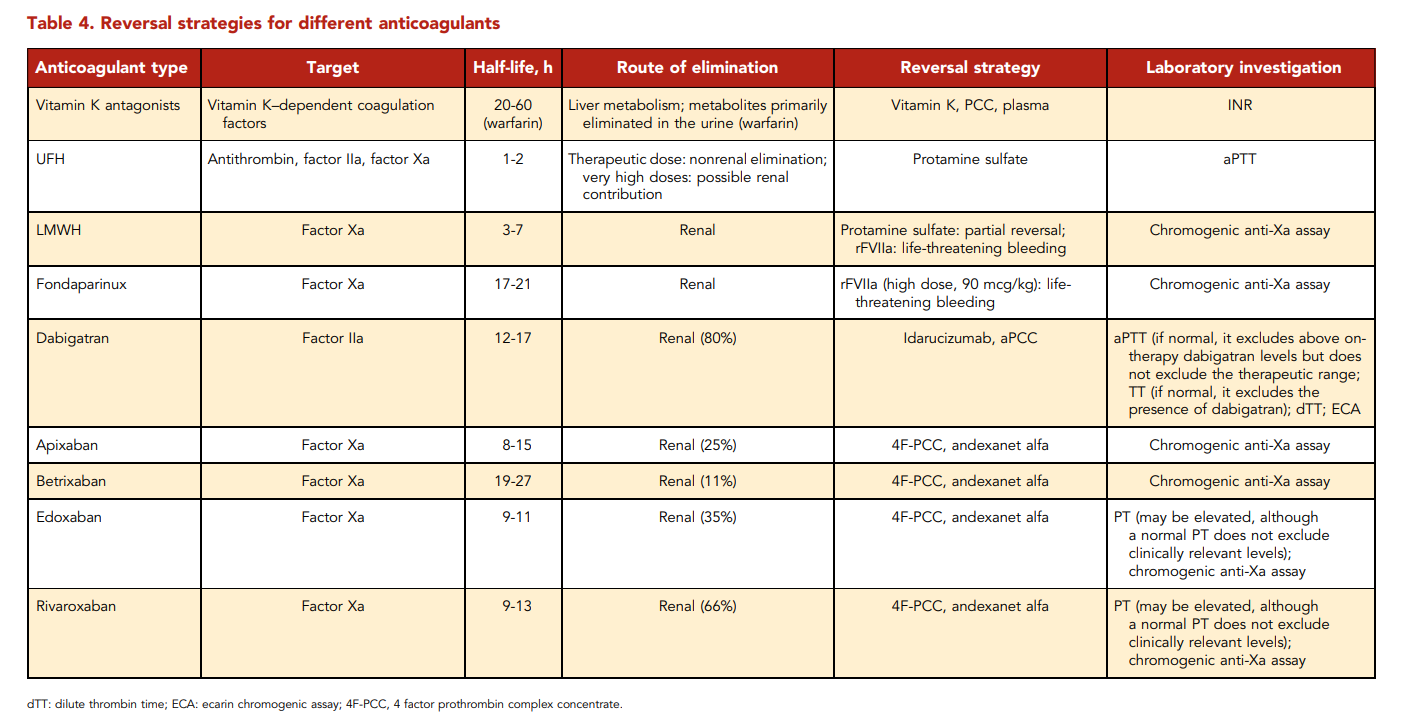
This table is just a sample from the paper. Thankfully full text is free in its site.
Final message
It seems , there are about 30,000 medical journals listed in Pubmed . Cross-specialty reading for relevant, up-to-date knowledge is always welcome. This will help us come out of the undesirable tag of super specialist or individual organ specialist.
Looking forward to the days when hematologists and cardiologists sit together frequently to discuss the strategies in unexplained ACSs, DVTs, other procoagulant (as well as pro-bleeding conditions)
With more and more metallic foreign bodies ,making heart as their residence, this type of Interactions will become all the more important.
Reference
Next thought
Trying to go deep into this journal, and find the truth behind Red and white clot , which I never understood right from the medical school days.



 Dr.S.Venkatesan MD