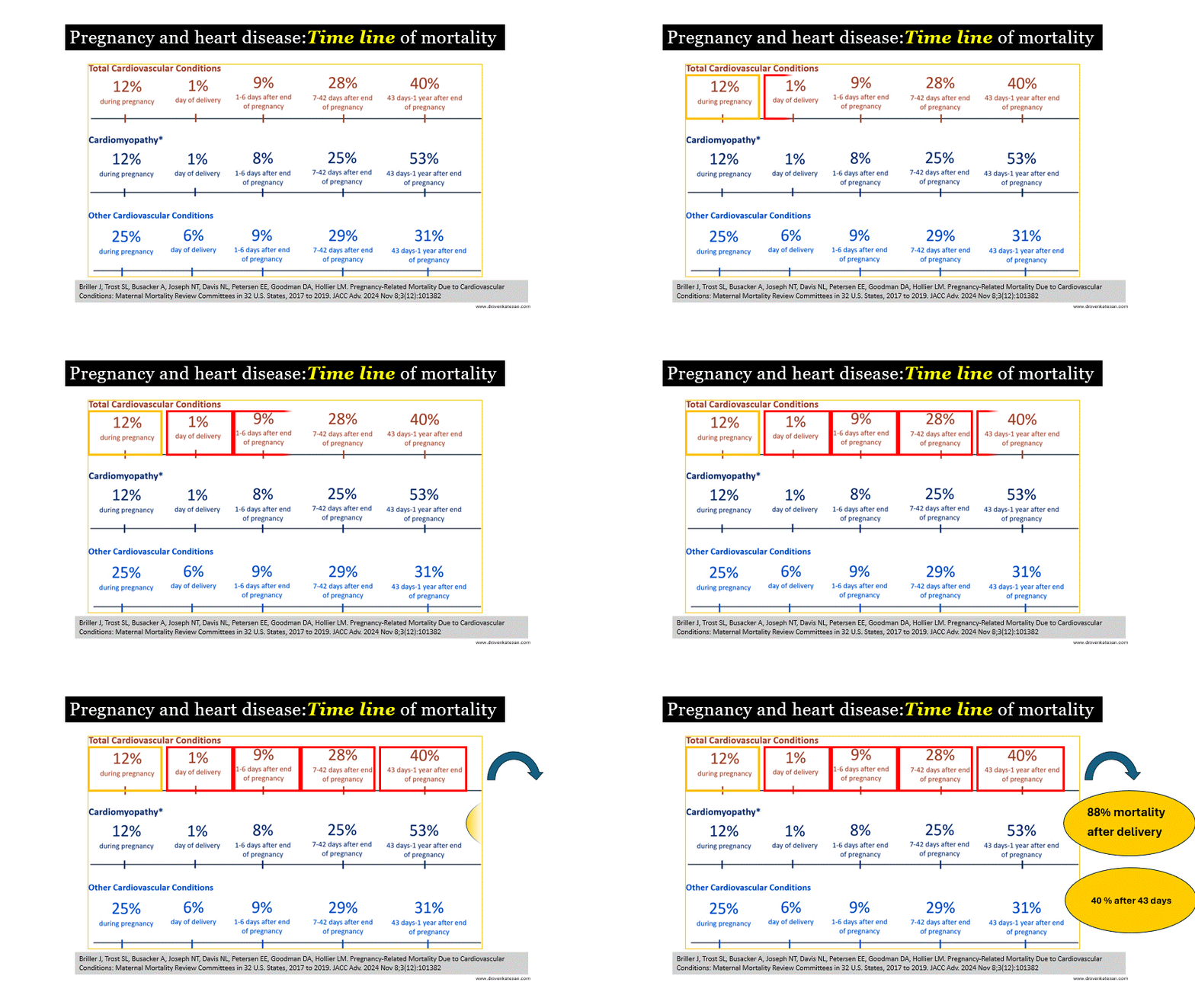
Heart disease in pregnancy is the third important cause for maternal mortality in most part of the world. (Apart from Bleeding, Infection and obstetrical complications) We know pregnancy is hemodynamic stress test for any mother and obviously it is a challenge in a compromised heart. Most heart disease encountered are mild and the mother has natural capability to walk through the pregnancy. It is the high risk subset that pose a real challenge. It is surprising ,even in the high risk, most women touch the finish line. The MMR review committee from USA has come out with clear data about the time line of mortality in various heart disease*.In this comprehensive analysis , the fact that 88% of mortality occur after delivery is too striking and is to be considered a core concept around which cardiac care of pregnant women should be addressed.
The figure shows the percentage of pregnancy-related deaths with an MMRC-identified underlying cause of death of cardiovascular conditions at 5 time periods from pregnancy to 1-year postpartum.(Ref 1) Note : The percentages are displayed for total cardiovascular conditions, and then for cardiomyopathy and other cardiovascular conditions individually. Percentages might not sum to 100 because of rounding.
Why this data is important ?
Though the peak hemodynamic stress happens around 24-28 weeks, it is the post partum period after the baby is out is very critical. In fact, nearly 40 to 50 % event happen up to one year. Some of them doesn’t even come under the definition of maternal mortality.
Is there any thing we can do during pregnancy , that can mitigate the post partum events?
Also, this delayed events give us a window of opportunity to act on these adversity.Postpartum care for patients with heart disease, including PIH, should be provided in a specialized unit at major hospitals that manage a high volume of pregnancies.
*We are not yet clear , whether PIH(Gestational HT) related cardio- vascular complications to be included in the heart disease basket. Logically and scientifically it should.
The fact that regurgitant lesions are well tolerated in pregnancy, by no -way means, women with stenotic lesions always fare badly. Valves do have reserve excess orifice. This means, it can handle the increased blood volume of pregnancy . A stenotic valve do elevate its gradient from the baseline. This increase in gradient is essentially due to augmented cardiac output and not reduction of orifice size.These elevated gradients sustain the required stroke volume and cardiac index, throughout the pregnancy.
Aortic stenosis in pregnancy
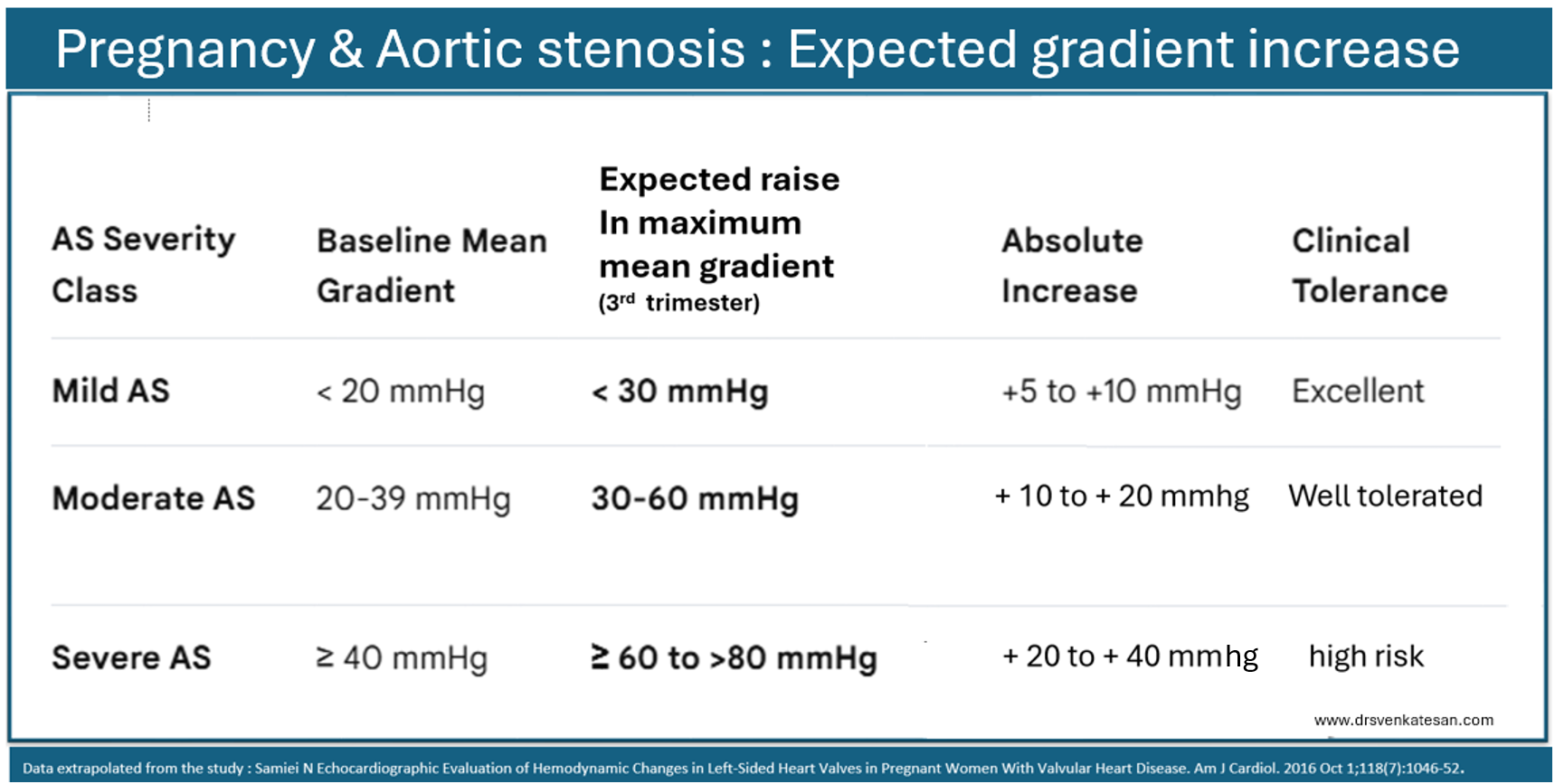
Since , most pregnant women are young, the LV function is good enough to sustain the high gradient. It is also possible, the increase in gradient can be spurious , as it is more to do with Doppler mathematics, as we convert velocity to pressure with a simplified Bernoulli equation.What we really bother about is the stroke volume
The folowing table gives a rough course of Aortic stenosis in pregnancy.
Pregnant women* with heart disease has to cross at-least three hemodynamic hot spots during the tenure. The first task comes around 20 to 24 weeks. The hemodynamic stress almost reaches 80% of maximum. If the mother doesn’t worsen at the end of 24 weeks, it is very likely she will pass through the rest of pregnancy. Another less stressful milestone is around 32 weeks where , she reaches the peak hemodynamic stress. Not to forget, the most critical period (48 hrs) is in the immediate postpartum, where the stress of labor and uterine involution infuses more than 500 ml into the maternal circulation. (*It is not clear whether the blood loss associated with either normal or cesarean section will negate the stress of volume overload. In fact, there is no study that has specifically addressed this issue in heart disease complicating pregnancy. However , PPH always harm the mother.)
Final message
Somehow, we are more obsessed with gradients than what really matters , ie the stroke volume and cardiac output. The fear of high mortality with increasing gradients is more of imaginary. In fact, it tells us about the reserve LV power.Most of the mild to moderate AS is well tolerated throughout pregnancy. Of course, severe AS requires intensive monitoring or a temporary balloon dilatation as we do pre-TAVI procedure. (Or full-fledged TAVI may be considered as a last resort.)
Ironically, in the current hyper-academic environment, more than the true hemodynamic stress of the mother, the Obstetrician’s mental stress is much, much higher when confronted with any heart disease with pregnancy. There are many untold stories, where obstetricians, (Influenced by of new-age cardiologists) are compelled to pursue risky interventions in pregnancy to fulfill protocols & guidelines.
What happens to trans mitral gradient during pregnancy in mitral stenosis ?
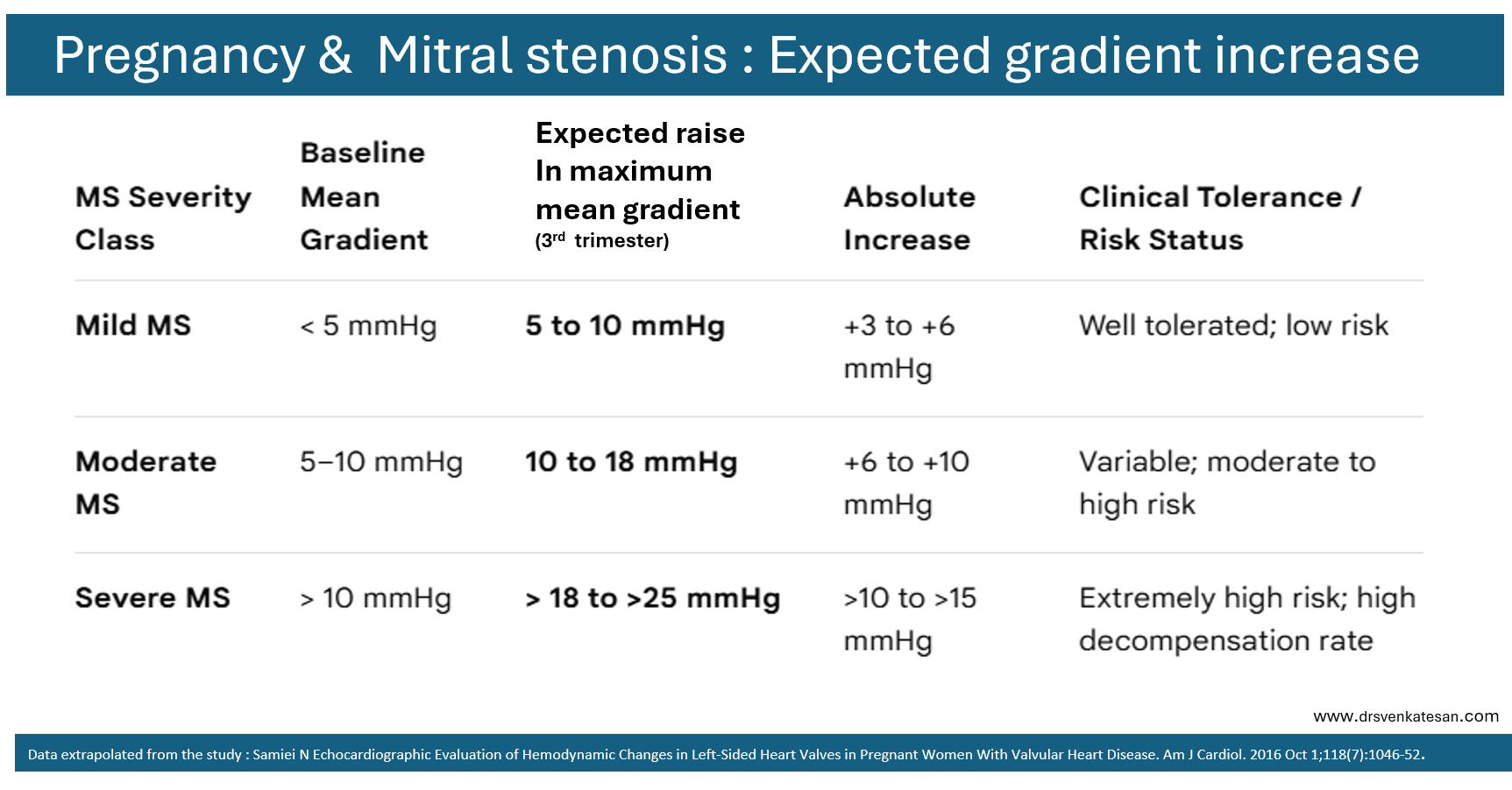
Natural history of gradients in mitral stenosis in pregnancy.
Unlike AS, where the most powerful cardiac chamber of the heart , ie LV is challenged, in mitral stenosis LA has to fight its battle alone, or with help of RV. The risk of acute pulmonary edema is many fold fold high in MS. In countries with rampant RHD, and severe MS, mortality can be high. Still, very selective use of PTMC is recommended in pregnancy even in severe MS .There are numerous case reports of mother and baby crossing the finish line successfully , with the support of experienced obstetrical team (Of course ,this will be called as more of luck though !) The reality is, the professional guilt & fear of not doing a PTMC, often exceeds our confidence, on the resilience and endurance of a young mother’s, compromised heart.
Cardiologists are often confronted with pregnant women in distress with heart disease. Obstetricians promptly refer them to cardiologists.
There is a tendency among cardiologists, to make fun of obstetricians who some times call them for frivolous cardiac problem at odd hours .(Say a VPD in the monitor or a systolic murmur of anemia etc)
Of course , this doesn’t mean in any way , cardiologists belong to a superior species ! The fact is , many cardiologists fare poorly in their knowledge about the hemodynamics of pregnancy (Let them prove this wrong !)
A small quiz . . . for all cardiologists
How much of blood enter the maternal circulation after each uterine contraction during active labor ?
Is the stress of normal delivery is greater than that of cesarean section under epidural anesthesia ?
What anesthetic agent is ideal in patients with pulmonary hypertension ?
How safe is general anesthesia in a hypotensive , heart disease patient ?
What is the clinical significance of administering IV anesthetic vs inhaled anesthetic in a patient with right left shunt lesions ?
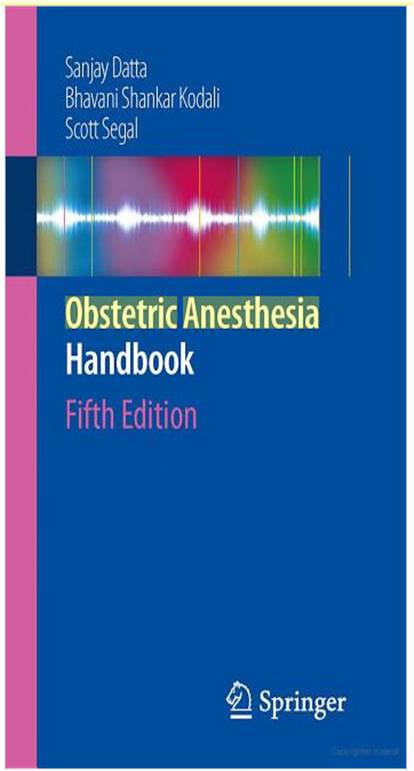
If a cardiologist is able to answer all these 5 questions correctly without guessing , probably they have the right to make fun of obstetricians or else they have to quietly buy this book and read !
Final message
Every responsible cardiologist must have good awareness about hemodynamic stress of pregnancy and the intricacies of obstetrical anesthesia
The contents of the this blog is being published as Kindle E book , as per the request of many of the readers. Every article will continue to be open source in this site. Again I shall reiterate the book format is not aimed at any commercial intent. It is only to facilitate learning in a single book format Here is the link to book https://amzn.in/d/euhL5vu
Click below to see who is watching this website live !
This site will never aim for profit. Still ,this donation link is added at the request of few visitors who wanted to contribute and of-course that will help make it sustainable .
Please Note
The author acknowledges all the queries posted by the readers and wishes to answer them .Due to logistic reasons only few could be responded. Inconvenience caused is regretted.