Before going into the topic, let us make it clear what is the real cut-off point between an embryo and fetus. All standard literature indicates an embryo becomes a fetus at the beginning of the 9th week when organogenesis, is to a large extent, completed. Ultrasonically, Crown-rump length > 35, beyond Carnegie stage 23, etc are used . But, practically, I think we have extended it up to 12 weeks, i.e., the first trimester. By this time, the fetus assumes a human shape in all aspects, moves the limbs, head, spine erect, eyes open, etc. Getting deep into this, the time-based cut-off definition is obviously not ideal. The errors of counting from the day of conception vs LMP is a big confounder in the published literature.
This may appear an non- issue , for most obsterticians , but specifcally in warfarin related embryoapthy , timing is everything*. Warfarin targets late embryo-to early fetal phase. (6-12weeks) This issue becomes very practical, when a pregannt women on prosthetic valve with warfarin reports to an obstercian at 10 weeks . Will he/she take a risk of preventing final phase of fetal warfarin related injury vs Heparin switch related prosthetic valve obstruction? (Ofcourse the Heparin bridge seems to have collapsed in most high risk thrombotic clinical settings. )
*Realise for fetopathy, there is no timing issue .It affects entire pregancy after 8 weeks.
Mechanism of Warfarin Embryo-fetopathy
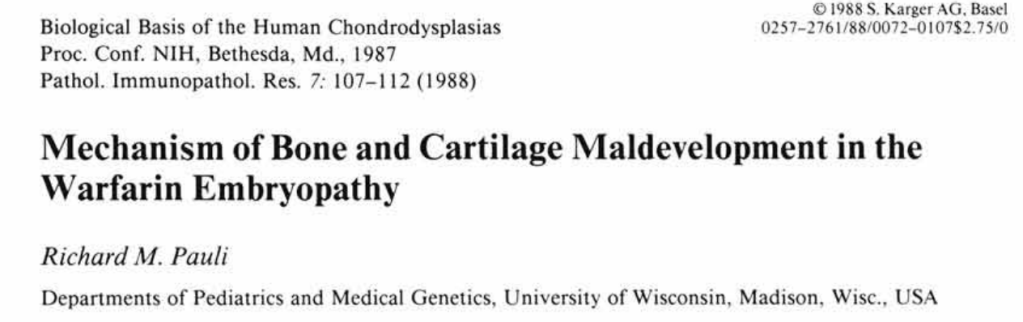
Warfarin inhibits vitamin K epoxide reductase blocking gamma-carboxylation of proteins like osteocalcin and matrix protein, leading to skeletal defects in the classic embryopathy window (weeks 6-12). This is a biochemical not genetic or mutational defect . In the fetus, the side effects are due to its intended action, ie exccessive bleeding.
| Warfarin Embryopathy | Warfarin Fetopathy | |
|---|---|---|
| Timing of Exposure | Primarily first trimester (typically 6-12) 6-10% risk with first-trimester exposure | Second and third trimesters (after week 12) The exact incidence of fetopathy not known.it can be up to 25 % if we include all spectrum from minor CNS defects to still births. (Surprising there is a need for more data capture in this ) |
| Mechanism | Primarily bio-chemical : Affects cartilage and bone formation via inhibition of vitamin K-dependent proteins like osteocalcin | Related to anticoagulation effects leading to hemorrhage, as well as CNS and developmental disruptions in the growing fetus |
| Clinical Features | Nasal hypoplasia Stippled epiphyses (calcified spots on bones visible on X-ray) – Skeletal abnormalities (e.g., short limbs, brachydactyly) – Facial dysmorphism – | CNS abnormalities (microcephaly, hydrocephalus, Dandy-Walker malformation) Eye anomalies (e.g., optic atrophy, microphthalmia) Intracranial or fetal hemorrhage Fetal loss, Neonatal bleeding |
| Overall Risk and Outcomes | Structural birth defects .Not dose-dependent beyond a certain threshold | Hemorrhagic and growth-related complications; more dose-dependent, with lower risks at low doses < 5mg |
Is there a overlap betweeen embryopathy and fetopathy ?
Obviously yes. If exposure occurs around weeks 9-12 (early fetal stage), it could contribute to both structural anomalies (embryopathy-like) and hemorrhagic risks (fetopathy-like). Continuous or exposure across trimesters results in a combined phenotype, sometimes referred to as “fetal warfarin syndrome” (FWS), with mixed skeletal and CNS defects
Warfarin risk profile with reference to time : Is first first 6 weeks warfarin absolutely safe ?
It seems so. There is no evidence for any defects in preganct women taking htis in the first 6 week. It is a paradox like because almost 3/4 th of embryonal period , warfarin exposure is safe. Tihs satement is can be perplexing , as trnstion perios of embti to fetus is stull not clear and it is ot uniform in all . It aslo assumes embrys dont have cartialge so vitamin k is safe
Warfrin dose : Low vs high dose risk ?
Dose plays a role too: Low-dose warfarin (≤5 mg/day) reduces fetopathy risk but doesn’t eliminate embryopathy risk. The overall incidence of FWS (combining both) is estimated at 4-8% with warfarin use in pregnancy, with higher risks if exposure spans multiple periods. The much-celebrated 5 mg warfarin cutoff for safety, adopted by most advisory committees, requires a relook.
Warfarin effect on cardiac develoment ?
Wrafarin is well recognised to cause VSD, PDA , but rarely cono truncal anomaly.This explains the warfarin doesnt interupt early cardaic development and looping that stastrs at 4 weeks. The final septal sealing which happens in 8 the week is affected.
Warfarin vs Acitrom comparison (Barcellona D et alWarfarin or acenocoumarol: which is better in the management of oral anticoagulants? Thromb Haemost. 1998)
Acitrom is almost doubly powerful. 2.5mg of Acitrom is equal to 5 mg of warfarin. Acitrom has a half-life of approximately 10 hours. Because of this shorter duration in the body, stopping the medication and administering Vitamin K allows for a quicker reversal of the bleeding risk compared to longer-acting agent like warfarin.
A comparative chart is available here Source :https://doi.org/10.18203/2349-3933.ijam20240367
Final mesage
1.Though we have strictly defined the time line between embryo and fetus (end of 8weeks) we are not clear when exactly the embryo, begins to synthesize cartilage and try to become a fetus.
2.The side effects of warfarin are purely bio-chemical and not due to genetic interruption or mutations.
3.To be more precise, the embryo is affected during it’s late phase, not in the first 6 weeks.
4.Low dose Warfarin is safe for the fetus, but not for the embryo. (The popular 5mg safety net is for optimising the risk, not for elimination)
Reference



 Dr.S.Venkatesan MD