The commonest cause of ST elevation is STEMI .
The non infarct causes of ST elevation include
- Pericarditis
- Early repolarisation syndrome
- Hyperkalemia
- Brugada syndrome
- CNS injury
What is the mechanism of ST eelvation in pericarditis ?
The mechanism of ST elevation in STEMI is injury current coming towards the recording lead. In pericarditis we are not sure about the presence of injury current because pericardial cells are not capable of depolarising and repolarsing .But , the fact that epicardium and visceral layer of pericardium are anatomically are almost same entities .Attempts to rip off visceral pericardium from myocardium ie epicardium is often futile .This makes it very obvious any true pericarditis must involve epicardial layers of the heart.
How does inflammation of epicardium lifts the ST elevation ?
This again is a mystery .The effect of inflammation on the polarity of ST segment is complex one. Diffuse and global ST segment elevation with concavity upwards is the hall mark of pericarditis. This makes us believe pericarditis has to be diffuse and involve the entire circumference of the heart.
Logically and realistically this happens rarely . Many of the pericarditis are localised and regional . Even regional constrictive pericarditis are reported .The factors that determine the ST elevation in pericarditis depend on the spread of the inflammatory process beneath the epicardium .If the inflammation is active andeep ST elevation is likely to be prominent.
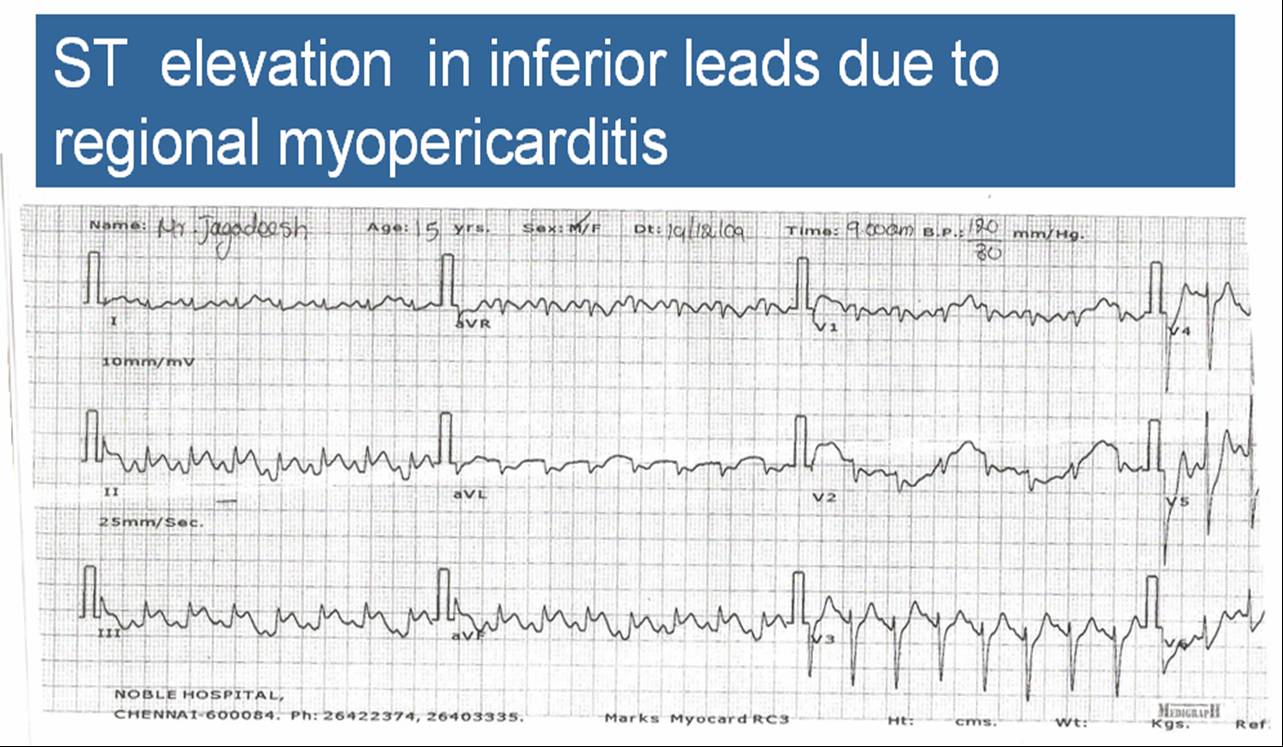
The ECG is that of a 15 year old boy with a febrile illness . He developed severe myopericarditis .The echocardiogram showed global hypokinesia and severe LV dysfunction .Patient failed to respond with medical therapy and succumbed after 48 hours of onset of shock .
Can we localise pericarditis with the help of ECG ?
It is possible. But there is no clinical purpose to do it.
Can troponin be elevated in pericarditis ?
No it should not happen in pure isolated pericarditis.But , epicardial involvement can result in inflammatory damage to muscle and troponin can be elevated. When pericarditis occurs as an accompanying manifestation of pancaritis troponin is bound to elevate (Fulminant pan carditis of acute rheumatic fever)
Final message
Pericarditis need not be diffuse and global infact pathologically it is rare to have global pericarditis . Localised pericarditis especailly adhesive type , which involves the posterior /anterior epicardial layers can mimic an either inferior or anterior STEMI . This has important clinical implication as unneccssary coronary interventions can be avoided.
Do not expect text book descriptions for any ECG pattern in clinical cardiology .
We will be rarely correct . . .



 Dr.S.Venkatesan MD
Dr.S.Venkatesan MD –
It was my understanding that LVH, LBBB, and paced rhythm are the most common causes of ST-elevation (not including the so-called “male pattern” of ST-elevation in the right precordial leads, which I suppose is a form of BER).
One could understand how a patient with chest discomfort would be emergently cathed with an ECG like the one you posted, especially if the history and clinical presentation was more suggestive!
Thanks for the thought-provoking post!
Tom