Feeds:
Posts
Comments

Archive for October, 2023

Can you believe that 68% of marathon runners show elevated Troponin levels after crossing the finish line? . 11% of them have significant levels that could lead to a diagnosis of ACS if they experience chest pain and end up in the hospital. (Fortescue EB 2007 )

Clinical experience suggest, that it doesn’t require a marathon race to bring troponins into the bloodstream. Any heavy, prolonged physical exertion can potentially release these biomarkers.
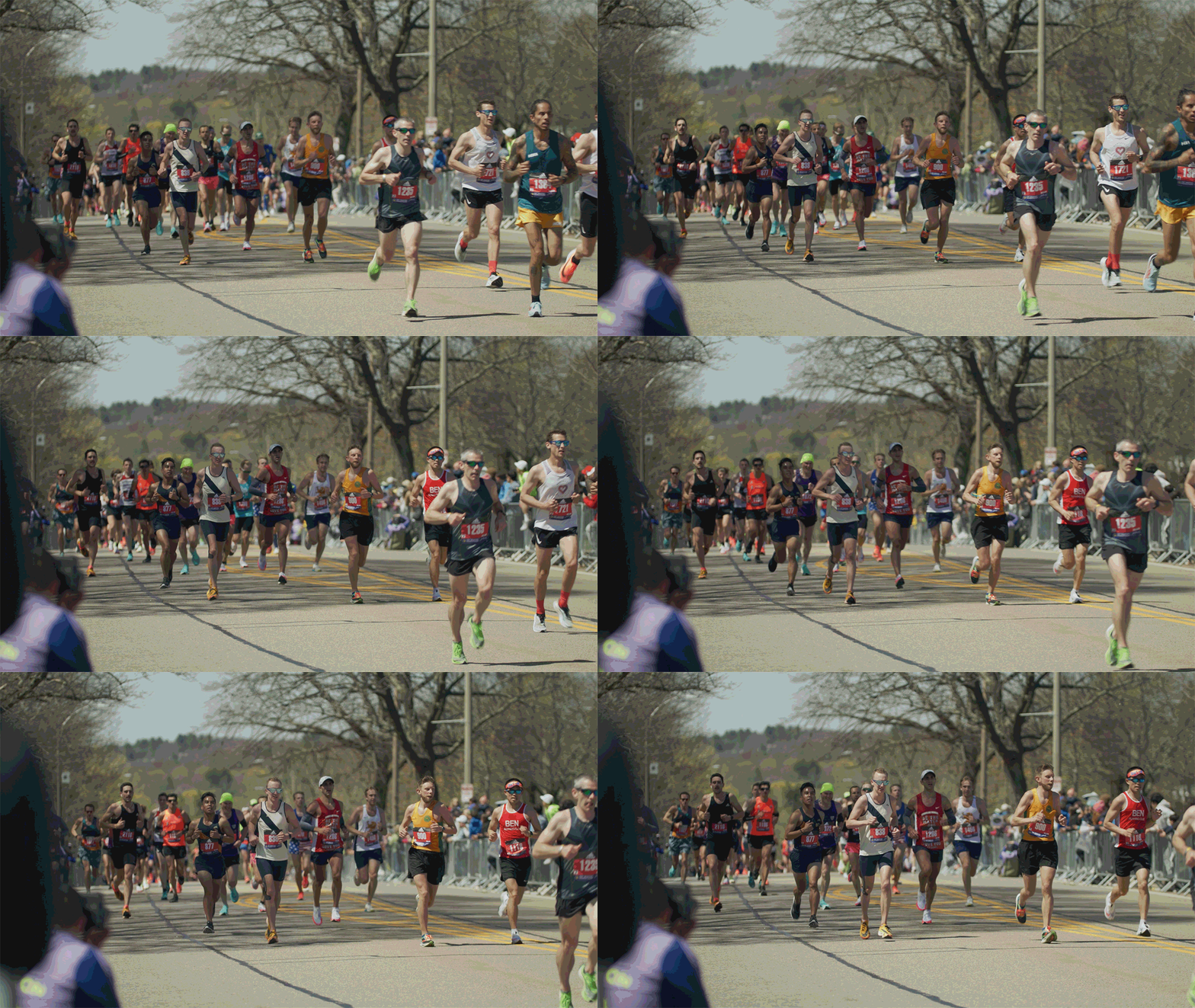
How much Troponins are released in these runners ? (Ref 3)

Most runners (68%) had some degree of  troponin increase (troponin T > or = 0.01 ng/mL or troponin I > or = 0.1 ng/mL), and 55 (11%) had significant increases (troponin T > or = 0.075 ng/mL or troponin I > or = 0.5 ng/mL))

Troponin distribution within myocyte

Troponins are structural cardaic protiens. 90 % are attached to contractile elements. Free floating troponin in cytoplasm (myoplasm) are detected in about 6–8% for cTnT and 3.5% for cTnI
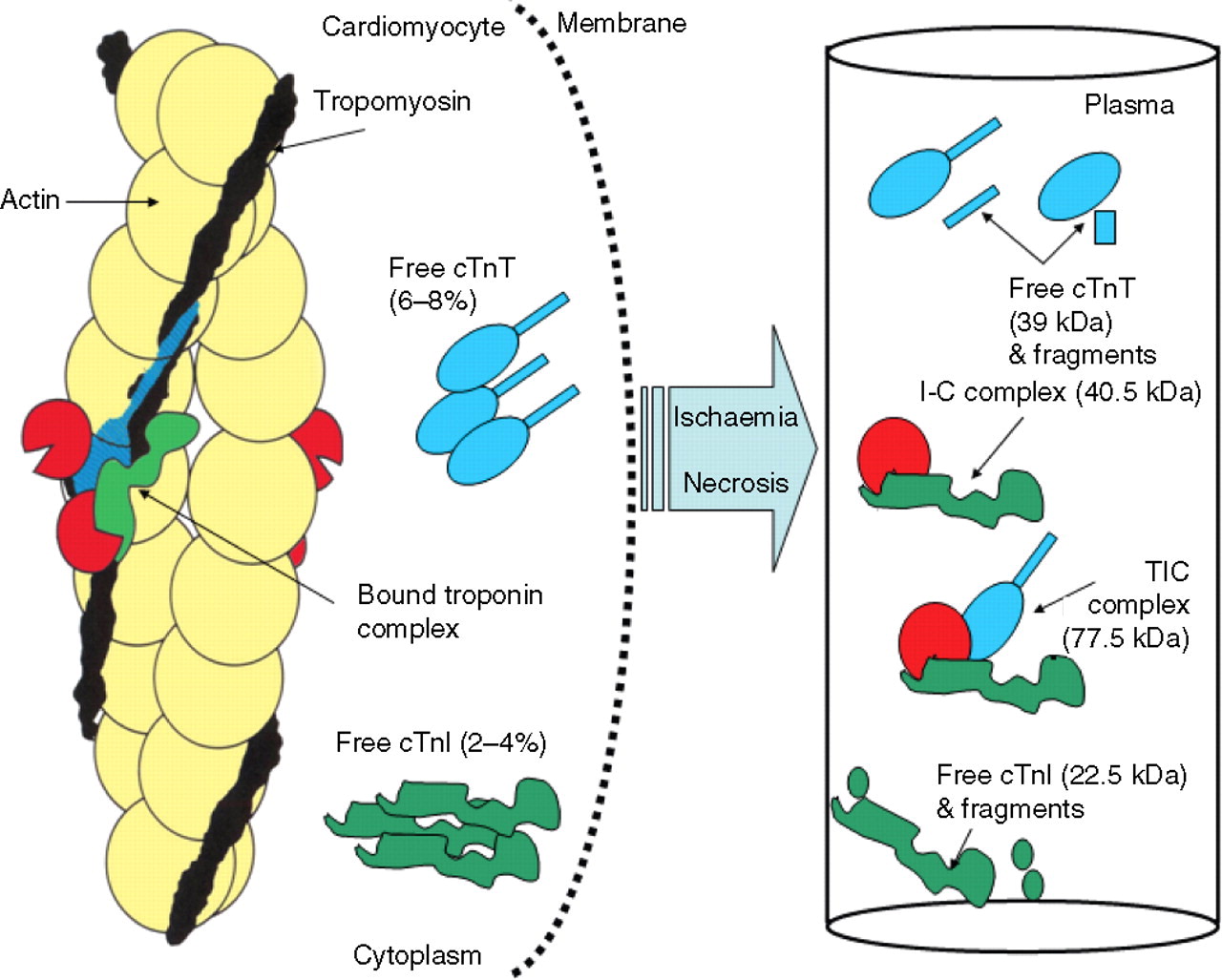
Gaze DC, Collinson PO. Multiple molecular forms of circulating cardiac troponin: analytical and clinical significance. Annals of Clinical Biochemistry. 2008;45(4):349-355. doi:10.1258/acb.2007.00722

Mechanism of Troponin leak

Why should a hale and healthy person , (in fact a super normal humans) release cardaic Troponin into blood stream ?

The following are the putative mechanism mentioned in the best availabe literature.(Ref 1)

  • An increased cardiomyocyte sarcolemmal permeability attributable to cell wounds,
  • Release of extracellular blebs
  • Increased exocytosis rates can be considered as reversible cardiac damage,
  • Physiological increase of cardiac troponin concentrations.
  • Similarly, an increased cardiomyocyte turnover may transiently increase cardiac troponin concentrations.
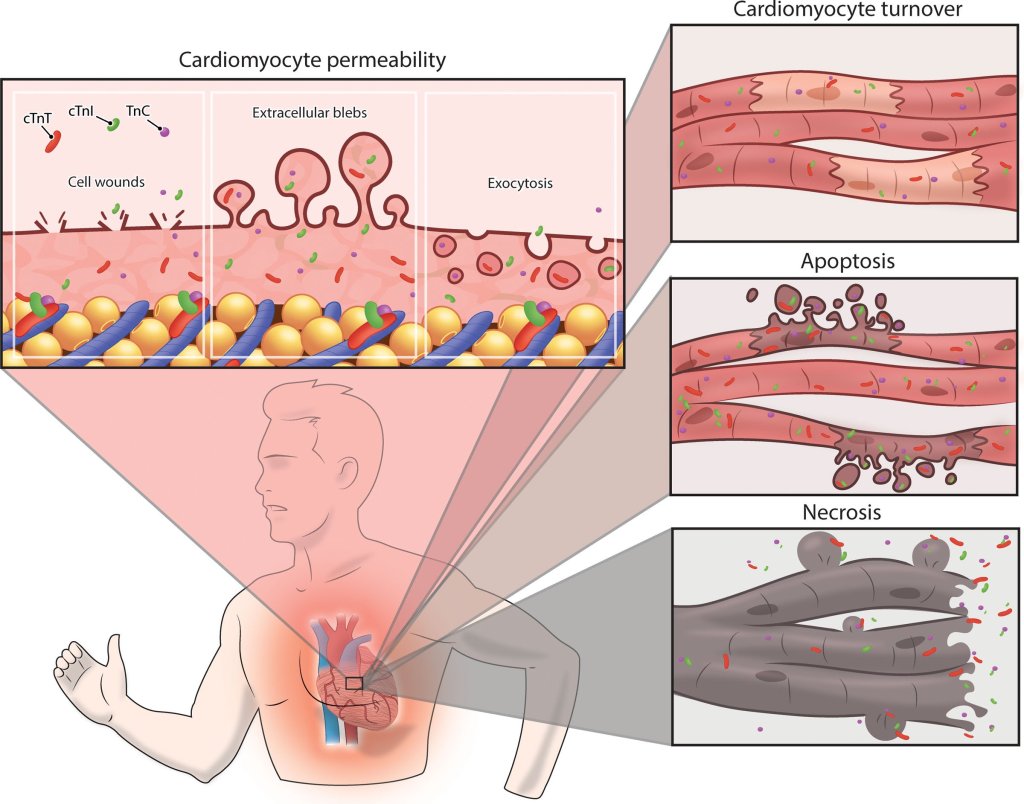
(Image courtesey & source : Aengevaeren VL Circualtion 2021)

Does any of the reasons given above appear convincing ?

What is more likely is that some unknown mechanical stretch and strain somehow fatigues the sarcolemmal cell membrane, and the cytosolic free Troponin T and I gets leaked across. In all likelihood, it does not imply myocardial necrosis, i.e., damage to structural proteins (Opinions are divided, still, some claim it does happen (Ref 1)

How does skeletal muscle behave during long distance running ?

Intense, unaccustomed systemic exercise increases myoglobinuria and rhabdomyolysis (Ref 2). It’s no surprise that the heart also excretes Troponin locally in a similar fashion.

How to diagnose ACS in these runners ?

Only clinical and ECG and follow up.

Long term consequnece of Troponin release in these atheletes

None in most. The apparently leaky membrane heals and settles down . However (Ref 1) do share some evidence for long term sequale in few . Who are those few & how to identify them ? . No answers as yet.

Final message

Troponins are “dangerously funny” molecules, that can either be a sure shot marker a heart attack or simply appear in an absolutely healthy person and laugh at you. This is a classic example, clinical acumen and examination can never become obsolete in any technological era.

An ethical & legal offshoot

Wish, this nebulous nature of biomarkers should teach some important lessons to the ever-hungry litigation specialists, the esteemed medical juries, as well as to beloved patients. Request them to show some sympathy for the cardiologists who grapple with multiple uncertainties at odd hours.

It is unavoidable, we may err in the “scientific guess game” played with Troponins .Some times, we are compelled to admit normal persons in CCU, for suspected ACS with borderline elevation of these biomarkers. Missing an ACS also can happen, if Troponins play hide and seek when their releases are pulsatile. Apart from this, there is well known mismatch of Troponin , with its electrical counterpart ie, ECG. which can be as dynamic as it is.

Reference

1.Aengevaeren VL, Baggish AL, Chung et al Exercise-Induced Cardiac Troponin Elevations: From Underlying Mechanisms to Clinical Relevance. Circulation. 2021 Dec 14;144(24):1955-1972.

2.HAROLD B. SCHIFF, EAMONN T. M. MACSEARRAIGH, JEFFREY C. KALLMEYER, Myoglobinuria, Rhabdomyolysis and Marathon Running, QJM: An International Journal of Medicine, Volume 47, Issue 4, October 1978, Pages 463–472

3.Fortescue EB, Cardiac troponin increases among runners in the Boston Marathon. Ann Emerg Med. 2007 Feb;49(2):137-43, 143.e1.

A simple quiz for the fellows

Read Full Post »

The heart is a mechanical pump, still electrically wired delicately and extensively, right from the SA node to the vast Purkinje network, which is activated by sequential propagation. Myocardial contraction occurs with amazing electro-mechanical coordination with millisecond precision. If the wiring line is interrupted, it is natural to expect some bumpy rides. This local delay often manifests as, wall motion abnormality.

WMA is commonly occurs in LBBB .What about LAFB ? LAFB is a term used if one of the fascicles of the left bundle is delayed or completely cut off. Wall motion defects are also expected in LAFB, but most of us do not give importance to it. If new-generation echo machines with speckle tracking imaging are used, these desynchronies can be identified.(Ref 1)

One of the reasons for LAFB-induced WMA is missed often, is that the plane of desynchrony is in an odd omni plane. The anterior fascicular delay is an electrical imbalance between the notoriously placed posterior fascicle, tending to deflect the electricity a few milliseconds early towards the crux. This results in desynchrony between the remote base ie the crux of the heart to the summit of the heart, which is difficult to pick up in conventional TTE views. Of course, if LAFB is proximal and complete, one may still get a clear-cut WMA. If RBBB is associated, WMA is definite and mimics an MI.

Clinical implications

Our experience suggests WMA in LAFB is not clinically significant, except when it is mistaken for an ACS event. Poor R wave in V1 to V3 is a feature of LAFB cann add more uncertainity.

It can also interfere with accruing or assessing the true benefits of CRT with biventricular or His bundle pacing.

Final message

It is true ,wall motion defect in echocardiography will raise an immediate alarm for every cardiologist.But, we must also realise there are atleast a dozen causes for it, other than ACS. It is prudent to know ,nonischemic electrical wall motion defects can occur in LAFB too, and cause diagnostic doubts. (Many fold rare though, when compared to LBBB)

Reference

Leeters IP, Davis A, Zusterzeel R, Atwater B, Risum N, Søgaard P, Klem I, Nijveldt R, Wagner GS, Gorgels AP, Kisslo J. Left ventricular regional contraction abnormalities by echocardiographic speckle tracking in combined right bundle branch with left anterior fascicular block compared to left bundle branch block. J Electrocardiol. 2016 May-Jun;49(3):353-61. doi: 10.1016/j.jelectrocard.2016.02.002. Epub 2016 Feb 10. PMID: 26931516.

Read Full Post »

Subscribe to continue reading

Subscribe to get access to the rest of this post and other subscriber-only content.

Read Full Post »

ECG diagnosis any one can make. The second part of the question needs some thoughts.

Dissecting the ECG* diagnosis

1.It is Atrial fibrillation with fast ventricular rate, with signifcant ST depression in V 4, V5, V6 .This could Indicate few things.

2.Preexisting LVH with AF

3.AF with new onset ST depression. This would mean an emergency (or may not) if it is an thromotic ACS high risk UA with posssible left main. But, one should bear in mind AF is an Natural atrial stress test , and ST depression could simply be a marker of tight fixed, stable lesion, (without a thrombus) that would require an elective Intervention.

4.Coming to the The ST elevation in AVR, many strongly believe it is a marker of left main disease. (Still, we can’t call it as AVR- STEMI, because it may just represent reciprocal ST elevation to any sort of ST depression in lead V5/V6 that includes benign LVH )

5.Look for ST elevation in lead V1 whenever you have ST lifts up in AVR. If V1 is isolectric , left main is very unlikely

The second part of the question.

I am sure, ruling out CAD without angiogram will be labeled as outright crazy. No cardiologist in their right sense will do that, I guess. Still, we could do it in this case. What did we forget in this discussion so far? We got lost in the electrical debate and failed to address the fundamentals. Why did this patient come to the hospital, requiring an ECG?

What did the clinical examination reveal?

While the cardiologist could not rule out CAD, the calm patient, complaining only of palpitations, ruled out a potential emergency chain reaction. Furthermore, a crescendo murmur in the aortic area sealed the issue. Yes, it is moderate aortic stenosis confirmed by an old GP’s prescription slip. She is being evaluated again for the severity of AS, treated with rate-controlling drugs for AF, since there was no acute heart failure or angina.

One more question

Why AF is not precipitating left heart failure even in patients with aortic stenosis ?

The concept of Left atrial functional reserve is a seperate topic, that will answer this query.

Final message

You don’t require an urgent cath lab mobilization to rule out CAD, even in a patient with a frightening ST segment, stuttering amongst irregular tachycardia. Always listen to the patient and have enough patience to look into the old records.. For that, we need to realize, we have to allow the patient to talk.

Postamble.

Presence of AS in no way rules out a CAD.Both can co exist. But if severe AS occurs with significant CAD, absence of angina is exceptional.

Read Full Post »

« Newer Posts