Here is a state of the art review article on peripartum cardiomyopathy from NEJM that came out in Jan 2024. It is one of the comprehensive article on the topic. Everyone will relish, and would like to preserve it as well . Click on the image for the PDF of the article .Sharing here purely for the academic purpose with the courtesy and thanks to NEJM group.
In this post, I wish to highlight two statements that occur in tandem in the latter half of the article‘ They are picked with one important academic purpose and a discussion on the combined entity of PIH associated PPCM.
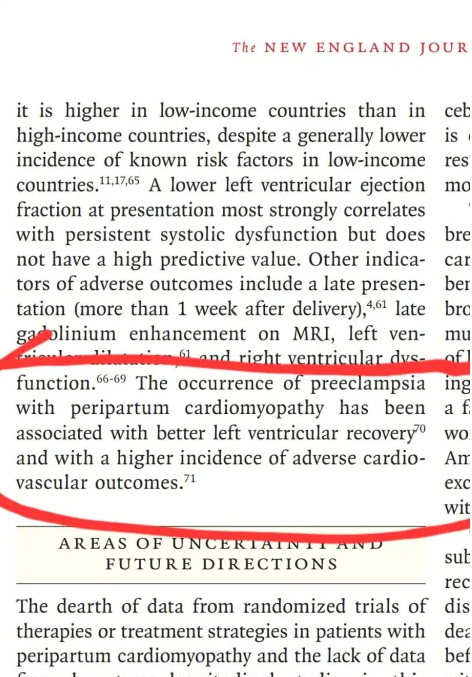
I hope , you could appreciate the two lines (under the red bracket) to appear as antagonistic statements. Read the cross- references and try to understand yourself. They are not wrong statements for sure . It only reflects the complexity of the interaction of PIH with PPCM.
The reference 70 & 71 is linked below
The non-linear fusion of bio-mathematics
A 26 year old woman with PIH was about to deliver in one month, went on to develop another serious complication. Her echocardiography revealed LV dilatation with mild LV dysfunction. One reputed hospital labeled her as peripartum cardiomyopathy (flagged her as very high sub-set as well, since the PPCM has occurred in the antenatal period).
The family was in distress and blaming their fate. I happened to see her for a consult. It is true ,she fulfilled the criteria for PPCM with the available records. When I examined the patient, she was in class 2 and her BP was yet to be controlled fully. I added alpha methyl dopa for two weeks. I know it is just an afterload mismatch that has dilated her LV .Assured the family they need not panic, and she is going to have a good outcome if we control the BP tightly. The worried family was very much relieved and her husband wanted to know how I could give a good outcome when everyone was saying his wife was suffering from double complication.
Doctor, are you sure? My obstetrician says it is a deadly combination, but you ask us to take it casually.
No, I am not asking you to take it casually. It is indeed high-risk pregnancy, but the outcome is not as bad as we predict, especially in your wife’s case (A combo of PIH with PPCM ) where we have a target to treat .
As I expected (with all concealed anxiety) the mother delivered a normal baby with a little bit of lung congestion in the immediate postpartum period .However , she recovered fast , discharged doing fine in follow-up. LV shrunk back to normal dimension two weeks.
Is PIH and PPCM are pathophysiologically linked ?
Peripartum cardiomyopathy is a complex primary/secondary cardiomyopathy with varied outcomes. It is a neurovascular and hormonal disorder, affecting the heart and possibly the entire vascular system. It is important to note, this happens in a rare population of genetically predisposed individual, who harbor molecular defects in cardiac structural muscle proteins and gap junctions.
It shares some of its pathologies with PPCM and affects the placental, uterine, and microcirculatory vascular bed, impacting the perfusion of the growing fetus. In the process, it gives false autoregulatory signals to the mother’s circulation, which responds with a dramatic increase in late pregnancy trying to perfuse the baby , reflecting natural mother-baby evolutionary survival model. This includes the RASS system , and for this reason only ACEI are an absolute contraindication in pregnancy.
PPCM is a rare but not a mystery diagnosis,. Obstetricians out of anxiety and compulsion refer to cardiologists every case of pregnancy ,(of course in your case it is a must, since it is established PIH ) Further, the current echo machines are too sensitive to pick up mild abnormalities. It is very important patients should be relaxed during echo. If the resting BP is high, LV wall will be stressed, global hypokinesia can occur . Often times , we have wrongly labeled transient LV dysfunction due to sudden spikes in BP as serious cardiac muscle diseases. This concept is called afterload mismatch.
This process can have drastic effects on the mother’s heart, as the response to raised afterload is unpredictable. This disease affects the maternal circulation primarily by increasing the BP. What is the heart’s response to this ? It can be a fight mode with development of LVH or a flight (fear) mode, ie dilatation of LV that may end up in echocardiographic LV dysfunction or clinical failure. We are comfortable in labeling this as a type of PPCM. Many such mothers do well once the baby is out and when the BP is normalized.
.
Final message
PIH increases the incidence of PPCM in the general population. While the prevalence of PIH in PPCM is 22%, the incidence of PPCM in PIH is a far lower(.05 to 1%) The outcome of PPCM is often dismal (18-56% Ref JAMA 2000) with mean mortality reaching 30 to 40%.
Though PIH appear in the adverse list, what we find find in the real world is , PPCM that is associated (most likely triggered) by PIH/preeclampsia has a much more favorable prognosis than other mysterious /idiopathic forms of PPCM. However ,the degree of LV dysfunction determine the ultimate recovery ,even in PIH associated PPCM.
In this era of Artificial ignorance , using mathematical models for biological risk prediction can be tricky or even misleading .PIH and PPCM are two high risk subsets, when looked in isolation, but when they occur together, the risks actually need not add up. Infact, it is plausible , LV dilatation in severe PIH could be a marker of utilization of cardiac reserve mechanism, which has crossed its limits transiently.
A post amble paradox
PPCM, if it occurs in the antenatal period, obviously It is more risky, because the mother has to pass through the test of labor or cesarean with a dysfunctional heart. Ironically, most of the PIH-related PPCM is expected to occur in the antenatal period, which may ultimately carry a better outcome
Reference



 Dr.S.Venkatesan MD