Here is a simple research paper on echocardiography , yet comprehensive, that assessed aortic leaflet separation distance with mean aortic gradient and valve area in patients with aortic stenosis. Kudos to the authors. It adds more pride, a validation of an important echo parameter in aortic stenosis has come from my part of the country, in a small town of Kerala .I am sure , It deserves to be published in JASE or ESC Imaging journal, which would have spread the importance of this study to more audience [(Jayaprakash et al 2017)
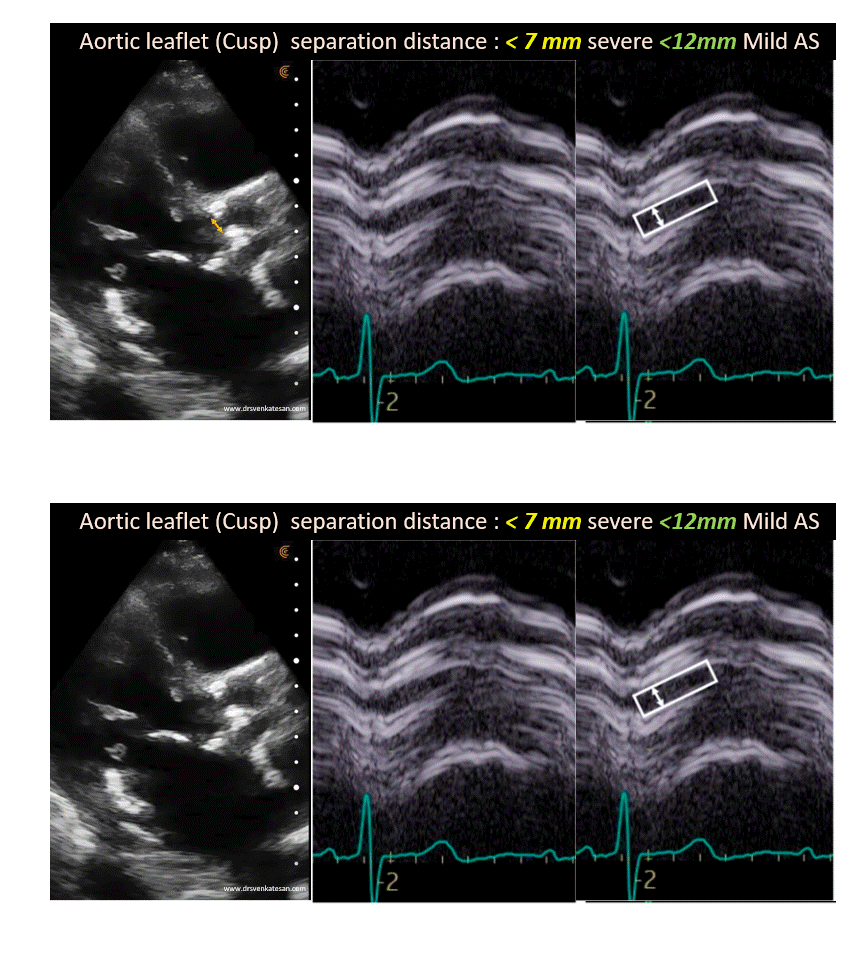
Mximal aortic leaflet separation (MACS) in M mode was identified as the distance between the inner edges of the tips of these structures at mid systole in the parasternal long axis view. Cuspal separation is also measured in 2D echocardiography from the parasternal long axis view and the average of the two values was taken as the MACS. 2D is more reliable than M-Mode. One might make it further simple by taking only 2D measurment. (In one way. it can be thought of as a 2-D equivalent to of vena- contracta in regurgitant lesions)
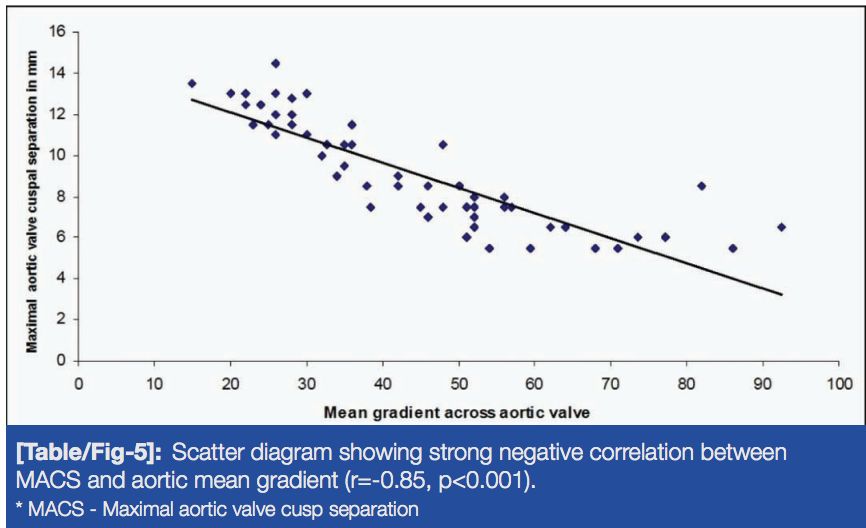
What will be the AVO if leaflet separation distance is 12 mm?
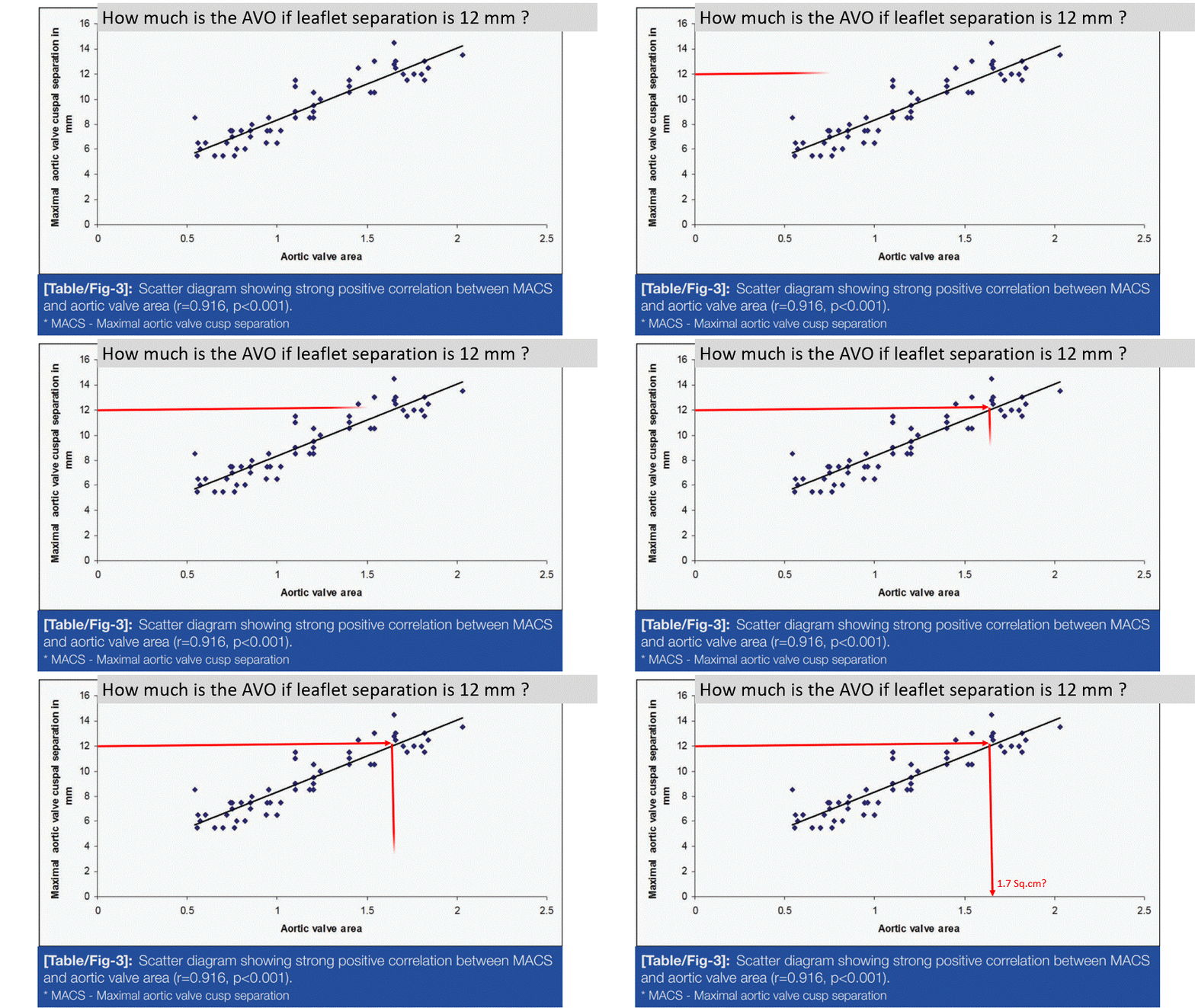
How can a simple M-mode/ 2-D parameter can accepted in this sophisticated Echo era ?
If it is so simple, then it must be error prone . Yes, you are right, but it is far less than we presume. To reduce errors zoom in to the valve to maximum while measuring. Please try to realize , the other much celebrated and complex Indices with multiple doppler, VTI, LVOT, etc. to calculate EOA are likely to amplify the errors many fold.
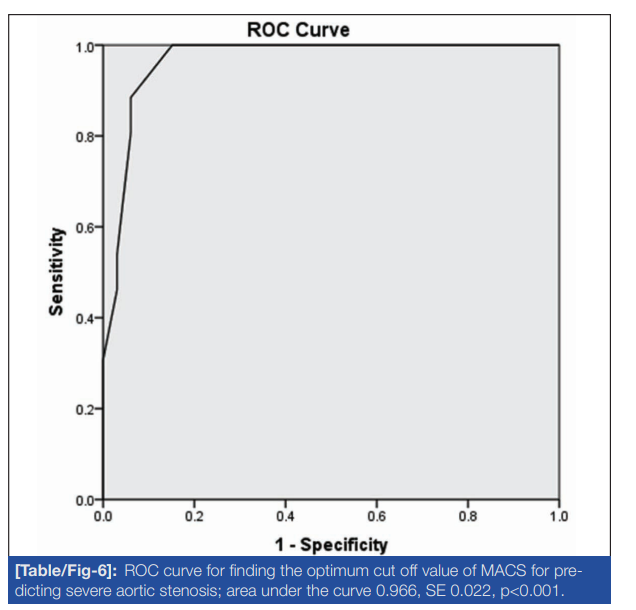
More stunning graphics is the ROC curve below . It is .96 just .04 less than a perfect 1. Wondering about the accuracy and simplicity of the measurement.
Limitations
The only limitation, could be the cuspal separation must be measured at maximum point of separation (Usually happens in mid-systole) between any two or three fused cusps. Angulation errors possible.Severe calcification would blur the edges. Color flow add on to 2-D will better delineate the margins.
Final message
Maximal cusp separation distance is a quick way to assess the severity of AS, that avoids the doppler angulation errors. Further,i f we can take cusp separation distance as the diameter of the aortic valve orifice, ( assuming it is a circle) , then we can straight away calculate the EOA. using πr². Some one should do this analysis.
Reference



 Dr.S.Venkatesan MD