Dyspnea is one of the commonest symptoms in medical practice. Whatever be the trigger, ultimately, it is a sensory perception, felt at the level of the cortex (to be specific, the Amygdala nucleus) decides the intensity . The initiating receptor usually arises from the muscle spindles , due to mismatch in the length and tension . These spindles are located widespread in intercostal and other respiratory muscles. The afferent pathways are complex, as are the brain stem processing centers and cortical modifications—all matters.
(* A proposed definition with mechanism :Both physiological and pathological dyspnea are the unpleasant breathing awareness (In time), till for the oxygen debt is repaid to the depleted mitochondrial, ATP treasury , for the cost of excess respiratory work done, is one popular definition )
The complexity of the neural circuit for dyspnea can be judged, even if the cranial or spinal pathways i.e., vagus or spinal transection, dyspnea is not fully relieved (experiments on post-vagotomy, quadriplegic patients, and transverse myelitis). The answer might look simple in one way. Please mind, we don’t need an intact nervous system to carry afferent dyspnea signals to the brain centers. It can simply be carried by blood, to the central chemoreceptor in biochemical form.
The uniqueness of this symptom is , it can be entirely physiological , or a harbinger of Instant fatality as in acute pulmonary embolism or LVF. Resting dyspnea is always a concern, unlike exertional which has more benign cause. As a cardiologist, we always equate dyspnea to elevated LVEDP and possible LVF . Though RV failure can also cause dyspnea.
Generally, young fellows might ignore non -cardiac non- pulmonary cause of dyspnea. It is better to reemphasize ,the commonest cause of dyspnea missed in ERs and ICUs are metabolic or systemic in nature . (We have seen Kusmaul’s breathing of DKA raising false cardiac alarm )
Systemic causes of dyspnea (With normal PCWP)
- Metabolic dyspnea*
- Bio-chemical dyspnea*
- Anemia*
- Most lung diseases
*Chemo receptors are as important as baro- recptors of heart and J receptors in lungs
Is cardiac dyspnea possible with normal PCWP ?
Pre capillary Pulmonary HT (Isolated Arterial PH)
RV infarction.
Classical Hypoxic dyspnes in cyanotic heart disease (TOF,)
Any RV failure , can trigger RV baro-receptors(similar to LV but less concentrated)
Final message
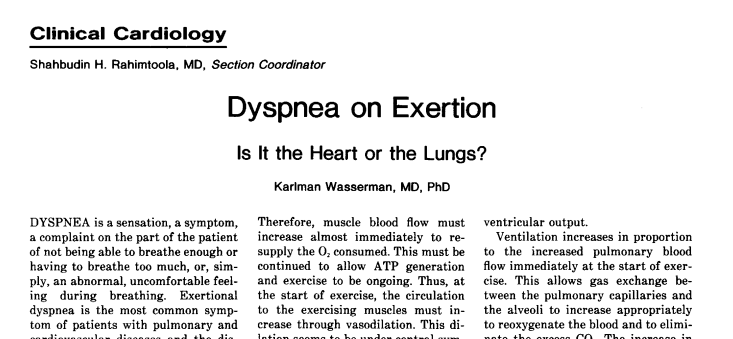
Dyspnea: is it from the heart or lungs? This popular debate has been going on for decades and was answered in a landmark review published four decades ago.(JAMA 1982).Every one of us, must go through this to understand critical cause of dyspnea that arise from heart and lungs.
However, if the question is, which is the commonest cause for exertional dyspnea? Is it from the heart or lungs? The answer is neither of the two. The commonest cause of dyspnea as a whole is neither from the heart nor lungs. It is probably anemia, physical deconditioning, fragility, or sluggish systemic skeletal muscle respiratory status due to a sedentary lifestyle. This explains why a marathon runner can run 42 km without stopping, while a healthy middle-aged man struggles to climb even three floors because of sedentary activity.
Reference



 Dr.S.Venkatesan MD