The following table was created , when there was a dispute in one of my lectures , when I told self expanding valves has more” Net-radial force”on the annular arena. It was pointed out, I was wrong and contrary to the published literature . Yes, may be, but could agree only partly on this. The physics of radial force/stress can be under stood only, if we classify it with reference to time , ie at the time of deployment vs long term stress. Also,the type of metal and the intrinsic potential energy stored in self expanding stent.By the way, this enhanced radial force is supposed reduce the PVL in SEV.
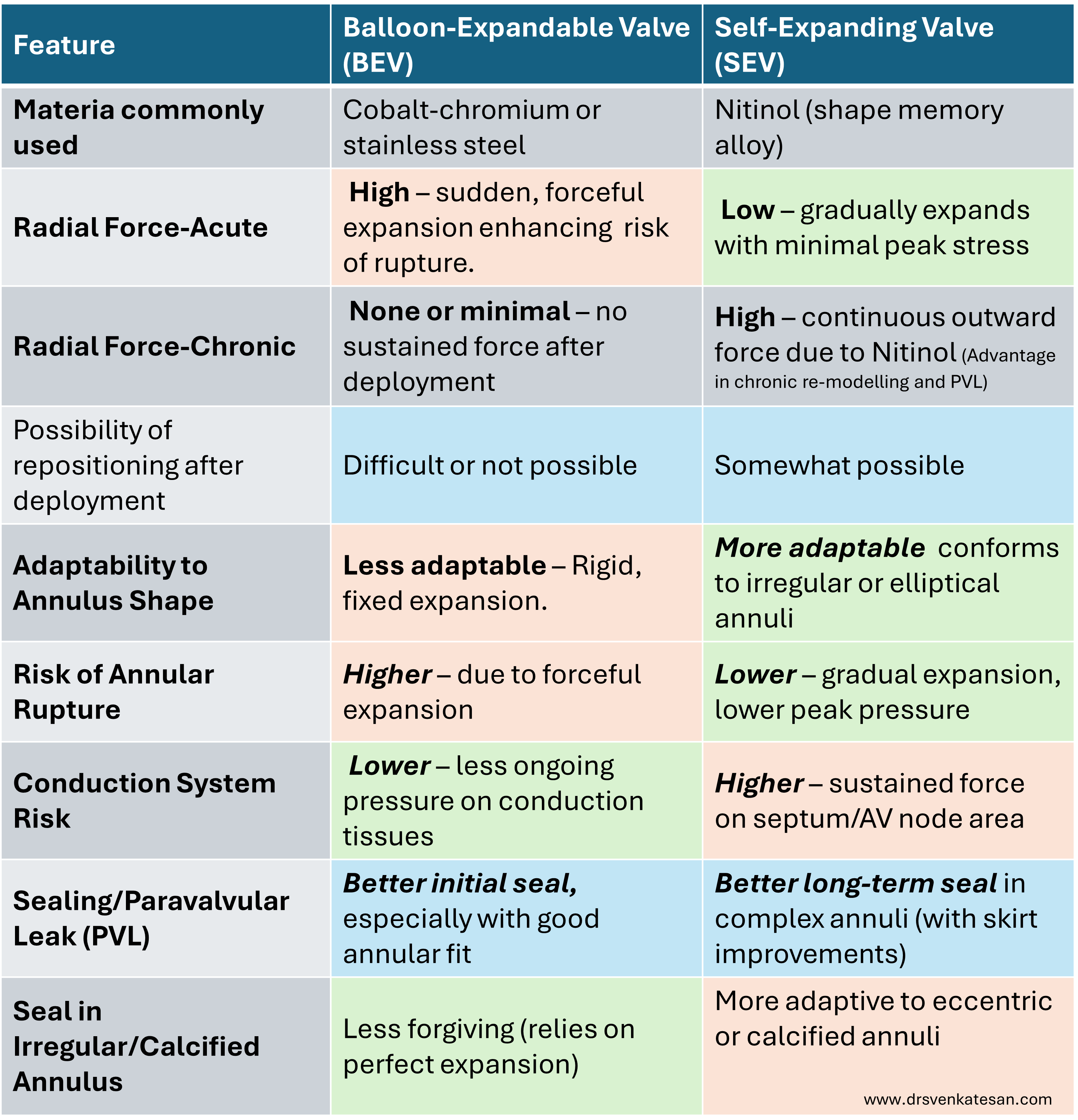
Note : One curious fact is often ignored. All self expandable valves, can be balloon expanded further, if there is a need. While, a balloon expandable valves can never acquire the properties of a self expanding valve.( Toutouzas K, The DIRECT Trial. JACC Cardiovasc Interv. 2019 )
TAVI : Current status
TAVI is considered by many (not all) as the revolution of this century ,in the field of Interventional cardiology .More than a million valves are implanted so for .TAVI as a concept is sustaining and trying to prove the test of time (Of course with lots of ifs and but)
The indications for TAVI has come down drastically ,from very high risk subsets to even low risk patients, without corresponding reduction in complications. (Consider this : Para valvular leaks in surgical AVR can be low as 1-3% while it can be as high as 40% ) Still TAVR has that magnetic attraction for a simple reason it avoids surgery.
Unfortunately, the technology has not seen much innovation beyond the PARTNER .We get to see so many clones of self-expanding and balloon-expanding platforms are crowding the market ,with extra skirts , sleeves, design for coronary access etc. Meanwhile, we have vastly improved in expertise, delivery hardware and managing complications.
However, until we develop methods to remove the native valve debri from the aortic root , it is very hard to bring an outcome, that is equipoise to surgical valve replacement. Future designs will look into active fixing valves with polymer-based leaflets to increase the longevity of the valve, which is, currently less than 50% of mechanical valves.



 Dr.S.Venkatesan MD