In a country fighting hard to lower its maternal mortality ratio (MMR), one might imagine a clear cut focus on fundamentals like anemia, hemorrhage, sepsis, obstructed labor. But instead, a new fad has crept into antenatal care, camouflaged as progressive medicine. It is the routine ordering of maternal echocardiograms in all pregnant women, a trend that appears to be driven less by evidence and more by fear, peer pressure, and the increasingly fashionable distrust of clinical acumen.
Pregnancy is not a cardiac disease. In fact, most young Indian women undergoing childbirth are remarkably resilient physiologically. But, thanks to a few well-publicized tragic outcomes in heart disease in general media and a rising paranoia, we now find ourselves in the midst of an echocardiographic epidemic, fueled by cardiologists, who are unwilling to say “no” to obstetricians who are terrified of missing something. Lastly, we have a system that forgets that over-testing could penalize patients in a variety of ways.
Doctors anxiety masquerading as Protocol
A spade is a spade whether you like it or not. The average Indian obstetrician today is not ordering an echocardiogram because she believes the woman has cardiac disease. She’s doing it because if anything anything goes wrong, she doesn’t want to be blamed for not “having ruled out everything.” In other words, to protect themselves, not the patients. This is classic defensive medicine, induced by aggressive audits of maternal deaths. What was meant to improve care has blunted our common sense. Government monitoring maternal deaths, though well-intentioned, has induced a culture of cover up obstetrics. When outcomes are uncertain and punitive audits loom large, “Do an echo” becomes the safest default.

But this anxiety-driven medicine is not safe. It’s perfect example of ignorance wrapped in a bag of fear. It is sad to note that even experienced obstetricians refer apparently normal pregnant women for routine echo. More curiously some of them are meant to rule out peripartum cardiomyopathy at 24-30 weeks. It sidelines clinical judgment and turns antenatal care into a tick-box ritual. It transforms even highly skilled obstetricians into a panic referral mode. And all the while, cardiologists, many of whom have seemingly disconnected to stethoscopes, happily oblige. (I used to tease my classmate colleague obstetrician, if you really want to rule out PPCM, you need to do serial echoes at least two, one in term and the next after delivery.)
The Cost of Routine
An echocardiogram costs roughly ₹2000 (or even more) in India today. Multiply that by 2.6 crore annual deliveries in India, and you arrive at a staggering ₹5200 crore annually, potentially spent on an investigation that is not recommended as routine by any global guideline, including those from the American College of Obstetricians and Gynecologists (ACOG), the Royal College of Obstetricians and Gynaecologists (RCOG), or WHO.
However, in India, where we are still battling basic issues like iron deficiency, safe delivery practices, and institutional access to labor rooms, many of the obstetricians are casually considering routine echocardiograms as a screening test in pregnant women. That’s not progressive medicine. (*It must be made clear, there are no official guideline that prescribes routine echo in India, but the obstetrician level trend is worrying.)
Let us not underestimate the psychological cost. A vague or equivocal echo report (mild chamber dilation, trace pericardial effusion, mild gradients creates unnecessary anxiety, referrals, and sometimes even unwarranted interventions. These aren’t just academic problems .They can unleash a cascade of referrals, expensive cardiology consults, prolonged hospitalizations fear-induced C-sections, all in women who never need it. Not to forget the worst of all side effects , the fear. A woman who walked into the antenatal clinic smiling, now spends her nights Googling mitral valve prolapse.
We forget that every test carries the burden of interpretation. And in the absence of clinical suspicion, these echoes do more harm than good. They confuse, they mislead, and they medicalize a natural physiological process.
The Misplaced Narrative: Is Cardiovascular Disease the New Villain?
There is a disproportionate narrative emerging in the corridors of public health, that cardiovascular causes are now the leading cause of maternal mortality. Though this is not entirely false, cardiac causes are rising in urban, high-risk populations. But this narrative, when extrapolated to the entire pan Indian obstetric population, is misleading. Most of these studies are from tertiary referral centers, which jack up the true incidence of heart disease in the general pregant population.
Let’s not forget, biggest killers of pregnant Indian women remain postpartum hemorrhage, sepsis, anemia, and eclampsia. These are not fancy diseases. They are diseases of neglect, of systemic failure, of poor infrastructure. Trying to divert funds, resources, manpower, and policy focus from these core issues toward a speculative cardiac screening agenda is not just unscientific, can be unethical too.
Probing the probe
This total dependence on Echo probe, by cardiologists also exposes a deeper malaise. It is the loss of confidence in clinical medicine. Ask yourself, when was the last time a cardiologist palpated a pregnant woman’s apex beat or auscultated thoroughly before performing an echo?
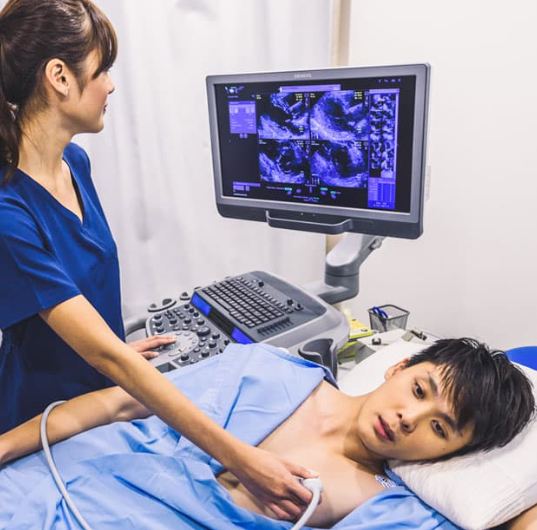
Echocardiography is indeed a quick, non-invasive, accurate tool . We think, there’s little downside for doing it. But this culture is eroding clinical skills. It raises the fundamental question. Have cardiologists lost the confidence to diagnose (or rule out) even simple heart disease without an echocardiogram? This loss of clinical finesse is not just tragic , it is dangerous. It inflates the false positive rate, undermines interdisciplinary trust, and sends the message that technology trumps clinical judgment. It doesn’t.
A Call for Sanity in Science
It is time, we stepped back and asked: what exactly are we doing? Why are we medicalizing normal pregnancy in the name of caution? Why are we spending precious public funds on routine Echo Imaging, when rural PHCs still lack blood banks and partography. Health policy in a country like India must be built on the twin pillars of evidence and equity. Routine Echo fails in both. It is not recommended by global societies, and it redirects attention from more pressing priorities. The answer to maternal mortality does not lie in a Doppler probe. It lies in blood transfusion protocols, nutrition programs, skilled birth attendants, and systemic accountability.
What if if we miss a condition ?
Most young Indian women undergoing childbirth are remarkably resilient physiologically. Even if a minor cardiac anomaly is missed on clinical examination, it rarely alters the course of a normal pregnancy. Ironically, even when we cardiologists do detect such conditions, say, a small ASD or a benign valve lesion we usually end up doing nothing more than “observe” throughout the pregnancy. So the real question is: why are we spending time, money, and emotional burden to look for what we’re not going to treat anyway? Of course, echo is a must in all tertiary hospitals, where high-risk pregnancies are treated.
A request to all Stakeholders
To the Ministry of Health: Please do not be carried away by the seduction of technology. Focus on the basics. Improve the undergraduate education, with a complete overhaul of the curriculum and arrest the shaky clinical foundation. Build safe spaces for childbirth, increase paramedical workers, and establish a speedy referral system. Don’t fall for universal screening of pregnant women with costly gadgets.
To the Federation of Obstetricians: Have courage. Do not let fear dictate your protocols. Stand for rational care, and reclaim your clinical space. Refer pregnant women for a cardiologist opinion, only if you strongly suspect heart disease.
To our esteemed cardiologists: First, spend sufficient time listening to the pregant women , and then therr heart through the Laennec’s device. Record an ECG. 9.5/10 times you can rule out any significant heart disease. If you decide to do an Echo, ensure it’s truly beyond your clinical sense. I know, the reality is much more troubling. Often times, In India, pregnant women are referred to our office only for Echo, they are least bothered about your opinion. (Why I am saying this, because I had a nasty experience with an Anesthetist-Obstetrician combo, who sort of violently argued with me when i said echo is not required in one particular patient. Their concern was, how on earth, I could certify a pregnant women’s heart as normal without doing an Echo.)
To the public : Remember that not everything that can be tested needs to be tested. Sometimes, the best care is less care but delivered with wisdom.
Final message
Indian pregnant women needs true care out of passion, not out of fear. (Which can lead to cascade of inappropriate investigations) Let us go back to the basics and bring down the MMR with mindful allotment of resources, cost rationalization, and technology worthiness assessment.
Further reading
- Regitz-Zagrosek V, et al. (2018). ESC Guidelines for the management of cardiovascular diseases during pregnancy.
Recommends targeted cardiac evaluation only for high-risk cases.
[Eur Heart J. 2018;39(34):3165–3241.] - Siu SC, et al. (2001). Risk of cardiac complications in pregnant women with heart disease.
Supports risk stratification, not blanket screening.
[N Engl J Med. 2001; 345: 1606–1611.] - Kovács AH, et al. (2014). Guidelines for the management of pregnancy in women with cardiac disease.
No support for routine echo in low-risk women.
[Can J Cardiol. 2014;30(10):1003–1030.] - Chandraratna PA, Moharir M. (1995). Value of echocardiography in the diagnosis of heart disease in pregnancy.
Concludes it is most helpful when clinical suspicion is high.
[Am Heart J. 1995;129(6):1115–1117.] - American College of Obstetricians and Gynecologists (ACOG). Practice Bulletin No. 212.
Recommends echo only when clinically indicated.
[Obstet Gynecol. 2019;133:e320–e356.]
Post amble
* Please note : None of the guidelines recommend echocardiography as a routine tool in low-risk pregnancies. All support clinical risk assessment first.



 Dr.S.Venkatesan MD