• Home
  • Aim of this blog

Dr.S.Venkatesan MD

Expressions in cardiology

Feeds:
Posts
Comments

Why should we fall for PPG, amidst the onslaught of coronary flow Indices ?

August 7, 2025 by dr s venkatesan

History beckons… once upon a time, assessing severity in valvular heart disease was gloriously simple. We used to just a pullback pressure gradient across the aortic valve . Now, history repeats itself, as the same philosophy returns to coronary arteries, offering a surprisingly elegant solution amid a chaos of physiological indices. That is PPG .

What Is PPG*?

Pullback Pressure Gradient (PPG) is a physiological mapping method that evaluates the pressure gradient across a coronary artery using a gradual pullback of a pressure wire . It helps to:

  • Localize ischemia
  • Differentiate focal from diffuse disease
  • Guide a more logical PCI strategy

Rather than a strict binary verdict (ischemic or not), PPG gives us a gradient map — revealing how pressure falls, where it falls, and whether intervention makes sense.

*I would love to call it as plain old PPG. POPP-G . (Sort of POBA equivalent in PCI)

How to Measure It ?

  1. Essentially it is a less glorified iFR or FFR .Same hard ware is used.
  2. Pull back happens in both .But ,here thats is only that happens, that’s devoid of the clumsy Adenosine protocols, Incomplete hyperemia, patient anxiety, or microvascular dysfunction etc.
  3. Apart from measurinng pressure drop the rate of fall the gradient slope is also analysed. PPG = ΔP / pullback distance (mm) .If the slope is steep the lesion is probably stentable . If the rate of fall is slow or flat we may avoid stenting.

PPG is a dynamic, localized, gradient-based insight into coronary disease. A focal ΔP over small length ΔL would be a perfect PCI candidate. A flat gradient over long ΔL , would suggest medical therapy .(May be CABG in few)

PPG in bifurcation Lesions

How do you FFR in bifurcation or trifurcation lesions . If you ask this question to any cardiologist, will try to get away from the scene. Such is the complexity involved. Here comes the savior. PPG helps you out in a smart fashion.

  • PPG allows branch-specific physiological localization, Can be used selectively in each branch to map the true pressure loss. This is contrast to the crude FFR that may falsely elevate due to competitive flow or tandem disease.
  • PPG can avoid the unnecessary double stenting and of course make the make the bifurcation club members unhappy in the process. PPG also can help detect ostial branch disease (by inching technique we do in cardiac auscultation,) by very slow pull back.
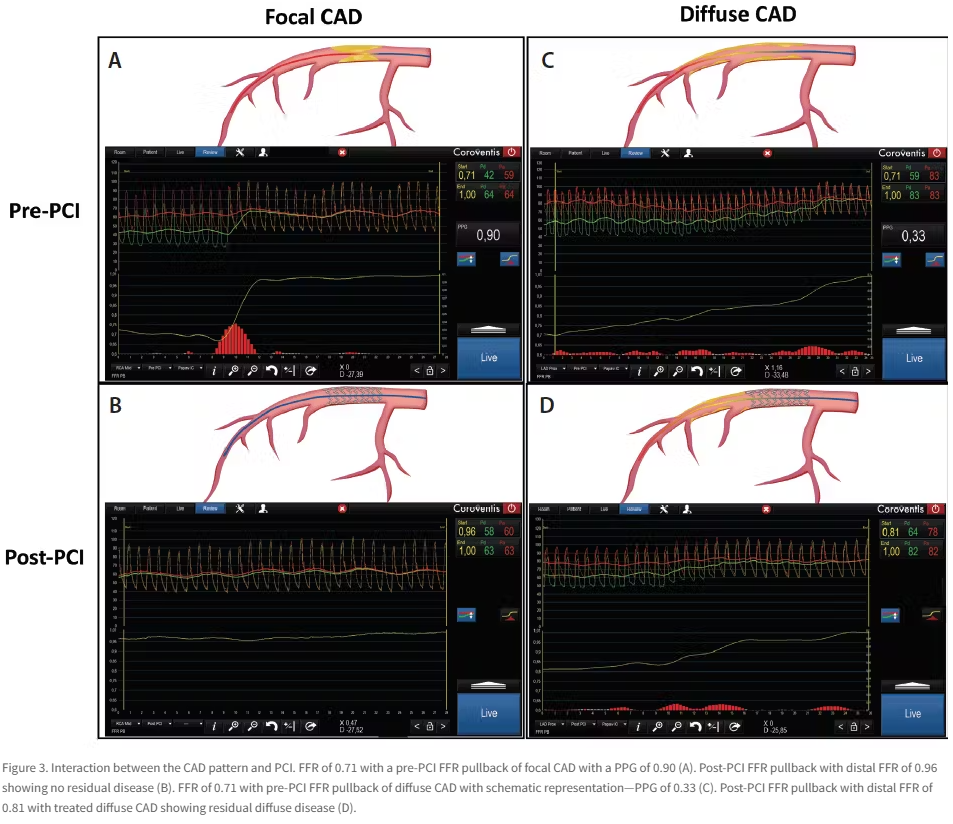
Image courtesy : Daniel Munhoz CARDIAC INTERVENTIONS TODAY MAY/JUNE 2021 VOL. 15, NO. 3

Is FFR really problematic ? Be aware of conflicting studies

FFR was a great concept when it came in. FAME I study adored It. FAME II questioned PCI’s benefit despite FFR-positive lesions. Then came DEFINE-FLAIR and iFR-SWEDEHEART, questioning the need for hyperemia at all. Still, residual ischemia post-PCI in up to 20% of cases (DEFINE-PCI) even when FFR said “normal.” Confused? So are most cardiologists.

Modern cardiologist’s dilemma: How to cross coronary jungle infested multiple flow Indices ?

The list is long . FFR , iFR, FFR-CT, QFR, RFR, dPR, NHPR, µQFR (there are few more I might have left ) . None are perfect. Some contradict. Some cost too much. Many need drugs. All add layers of complexity to what should be a simple clinical question: Should I stent this lesion? Now, we have the simple plain PPG.

Why should, we fall for PPG ?

Let’s be honest. PPG is not flawless. After all, we take pressure drop as a surrogate marker for restricted flow . Every Indices does that. But unlike other indices It’s intuitive. It’s visual. It tells you where to treat. It gets the pressure data on the spot from ground zero . It can bring reliable info without the need for intracoronary medication , or costly software. Finally, it restores some simple sense in us ,without great knowledge in coronary hemodynamics.

Reference

  1. Kobayashi Y, Johnson NP, et al. “Physiological Assessment of Residual Ischemia After Coronary Stent Implantation Using Instantaneous Wave-Free Ratio.” JACC Cardiovasc Interv. 2019;12(19):1996–2007. https://doi.org/10.1016/j.jcin.2019.04.040
    PPG-based residual gradients predicted poor outcomes post-PCI even when angiographic results looked fine.
  2. Collet C, et al. “Stress myocardial perfusion imaging vs coronary functional assessment with PPG and FFR: A physiologic map approach.” Eur Heart J. 2021;42(10):926–938.
    PPG superior in identifying focal lesions amenable to PCI compared to binary FFR thresholds.
  3. van Belle E, et al. “DEFINE-PCI: Residual Ischemia Post-PCI Detected by PPG and iFR Pullback.” JACC Cardiovasc Interv. 2019;12(20):1991–2001.
    Post-PCI ischemia often missed by angiography alone — PPG reveals it.
  4. Davies JE, et al. “Use of the Instantaneous Wave-Free Ratio or Fractional Flow Reserve in PCI.” N Engl J Med. 2017;376:1824–34.
    iFR non-inferior to FFR .Suggests resting physiology-based PPG.

5.Munhoz D, Collet C, Mizukami T, Yong A, Leone AM, Eftekhari A, Ko B, da Costa BR, Berry C, Collison D, Perera D, Christiansen EH, Rivero F, Zimmermann FM, Ando H, Matsuo H, Nakayama M, Escaned J, Sonck J, Sakai K, Adjedj J, Desta L, van Nunen LX, West NEJ, Fournier S, Storozhenko T, Amano T, Engstrøm T, Johnson T, Shinke T, Biscaglia S, Fearon WF, Ali Z, De Bruyne B, Johnson NP. Rationale and design of the pullback pressure gradient (PPG) global registry. Am Heart J. 2023 Nov;265:170-179. doi: 10.1016/j.ahj.2023.07.016. Epub 2023 Aug 21. PMID: 37611857.

Rate this:

Share this:

  • Click to share on LinkedIn (Opens in new window) LinkedIn
  • Click to share on WhatsApp (Opens in new window) WhatsApp
  • Click to share on X (Opens in new window) X
  • Click to share on Facebook (Opens in new window) Facebook
  • Click to email a link to a friend (Opens in new window) Email
Like Loading...

Posted in Uncategorized | Tagged coronary flow reserve, ct ffr, fame 1 2 study define -flair study, ffr, hyperemic flow indices, ifr, Intermediate coronary lesion, non hyperemic indices, ppg, pull back pressure gradient, qfr, rfr, swede heart study |

  • Categories

  • The contents of the this blog is being published as Kindle E book , as per the request of many of the readers. Every article will continue to be open source in this site. Again I shall reiterate the book format is not aimed at any commercial intent. It is only to facilitate learning in a single book format Here is the link to book
    https://amzn.in/d/euhL5vu
  • Archives

    • December 2025 (8)
    • November 2025 (7)
    • October 2025 (8)
    • September 2025 (7)
    • August 2025 (9)
    • July 2025 (10)
    • June 2025 (8)
    • May 2025 (9)
    • April 2025 (7)
    • March 2025 (10)
    • February 2025 (4)
    • January 2025 (9)
    • December 2024 (11)
    • November 2024 (8)
    • October 2024 (10)
    • September 2024 (5)
    • August 2024 (5)
    • July 2024 (6)
    • June 2024 (5)
    • May 2024 (4)
    • April 2024 (7)
    • March 2024 (4)
    • February 2024 (8)
    • January 2024 (6)
    • December 2023 (8)
    • November 2023 (13)
    • October 2023 (14)
    • September 2023 (5)
    • August 2023 (6)
    • July 2023 (10)
    • June 2023 (5)
    • May 2023 (5)
    • April 2023 (4)
    • March 2023 (5)
    • February 2023 (2)
    • January 2023 (7)
    • December 2022 (3)
    • November 2022 (5)
    • October 2022 (5)
    • September 2022 (4)
    • August 2022 (3)
    • July 2022 (9)
    • June 2022 (2)
    • May 2022 (1)
    • April 2022 (2)
    • March 2022 (1)
    • February 2022 (3)
    • January 2022 (7)
    • December 2021 (3)
    • November 2021 (5)
    • October 2021 (8)
    • September 2021 (4)
    • August 2021 (6)
    • July 2021 (6)
    • June 2021 (7)
    • May 2021 (5)
    • April 2021 (4)
    • March 2021 (3)
    • February 2021 (6)
    • January 2021 (8)
    • December 2020 (4)
    • November 2020 (5)
    • October 2020 (7)
    • September 2020 (7)
    • August 2020 (10)
    • July 2020 (6)
    • June 2020 (9)
    • May 2020 (9)
    • April 2020 (5)
    • March 2020 (7)
    • February 2020 (3)
    • January 2020 (4)
    • December 2019 (4)
    • November 2019 (6)
    • October 2019 (3)
    • September 2019 (6)
    • August 2019 (3)
    • July 2019 (1)
    • June 2019 (3)
    • May 2019 (2)
    • April 2019 (2)
    • March 2019 (2)
    • February 2019 (4)
    • January 2019 (2)
    • December 2018 (2)
    • November 2018 (2)
    • October 2018 (2)
    • September 2018 (1)
    • August 2018 (2)
    • July 2018 (3)
    • June 2018 (1)
    • May 2018 (3)
    • April 2018 (1)
    • March 2018 (3)
    • February 2018 (3)
    • January 2018 (1)
    • December 2017 (3)
    • November 2017 (3)
    • October 2017 (3)
    • September 2017 (2)
    • August 2017 (2)
    • July 2017 (2)
    • June 2017 (2)
    • May 2017 (4)
    • April 2017 (3)
    • March 2017 (3)
    • February 2017 (5)
    • January 2017 (3)
    • December 2016 (2)
    • November 2016 (5)
    • October 2016 (4)
    • September 2016 (3)
    • August 2016 (5)
    • July 2016 (3)
    • June 2016 (4)
    • May 2016 (3)
    • April 2016 (6)
    • March 2016 (4)
    • February 2016 (3)
    • January 2016 (5)
    • December 2015 (6)
    • November 2015 (5)
    • October 2015 (8)
    • September 2015 (2)
    • August 2015 (5)
    • July 2015 (7)
    • June 2015 (4)
    • May 2015 (6)
    • April 2015 (5)
    • March 2015 (7)
    • February 2015 (15)
    • January 2015 (8)
    • December 2014 (5)
    • November 2014 (9)
    • October 2014 (7)
    • September 2014 (9)
    • August 2014 (5)
    • July 2014 (11)
    • June 2014 (5)
    • May 2014 (4)
    • April 2014 (5)
    • March 2014 (8)
    • February 2014 (8)
    • January 2014 (5)
    • December 2013 (7)
    • November 2013 (7)
    • October 2013 (14)
    • September 2013 (12)
    • August 2013 (15)
    • July 2013 (15)
    • June 2013 (15)
    • May 2013 (15)
    • April 2013 (15)
    • March 2013 (15)
    • February 2013 (15)
    • January 2013 (15)
    • December 2012 (15)
    • November 2012 (15)
    • October 2012 (15)
    • September 2012 (15)
    • August 2012 (15)
    • July 2012 (15)
    • June 2012 (15)
    • May 2012 (15)
    • April 2012 (15)
    • March 2012 (15)
    • February 2012 (15)
    • January 2012 (15)
    • December 2011 (15)
    • November 2011 (17)
    • October 2011 (17)
    • September 2011 (17)
    • August 2011 (21)
    • July 2011 (20)
    • June 2011 (17)
    • May 2011 (15)
    • April 2011 (17)
    • March 2011 (25)
    • February 2011 (20)
    • January 2011 (20)
    • December 2010 (18)
    • November 2010 (21)
    • October 2010 (21)
    • September 2010 (25)
    • August 2010 (20)
    • July 2010 (10)
    • June 2010 (11)
    • May 2010 (19)
    • April 2010 (16)
    • March 2010 (14)
    • February 2010 (22)
    • January 2010 (18)
    • December 2009 (20)
    • November 2009 (20)
    • October 2009 (3)
    • September 2009 (21)
    • August 2009 (19)
    • July 2009 (12)
    • June 2009 (12)
    • May 2009 (11)
    • April 2009 (15)
    • March 2009 (21)
    • February 2009 (4)
    • January 2009 (12)
    • December 2008 (13)
    • November 2008 (9)
    • October 2008 (22)
    • September 2008 (20)
    • August 2008 (16)
    • July 2008 (14)
    • June 2008 (7)
  • Blog Stats

    • 6,587,717 hits
  • Please give your feed back .

  • Click below to see who is watching this website live !

  • This site will never aim for profit. Still ,this donation link is added at the request of few visitors who wanted to contribute and of-course that will help make it sustainable . Donate Button with Credit Cards
  • Please Note

    The author acknowledges all the queries posted by the readers and wishes to answer them .Due to logistic reasons only few could be responded. Inconvenience caused is regretted.

WPThemes.


  • Reblog
  • Subscribe Subscribed
    • Dr.S.Venkatesan MD
    • Join 793 other subscribers
    • Already have a WordPress.com account? Log in now.
    • Dr.S.Venkatesan MD
    • Subscribe Subscribed
    • Sign up
    • Log in
    • Copy shortlink
    • Report this content
    • View post in Reader
    • Manage subscriptions
    • Collapse this bar
 

Loading Comments...
 

    %d
