“Nothing moves without an external physical force”
SCAD is a popular entity among cardiologists in angiographically sub-categorizing of ACS, especially in women. The entity is indeed important to recognize, as the otherwise omnipresent PCI, is contraindicated in SCAD.
Meanwhile, we can’t take every suspicious-looking dissecting flap as SCAD in women. The word spontaneous in SCAD, could often convey a potentially erroneous meaning, for the simple reason, plaque ruptures and fissures that triggers dissections of varying lengths can be spontaneous as well.
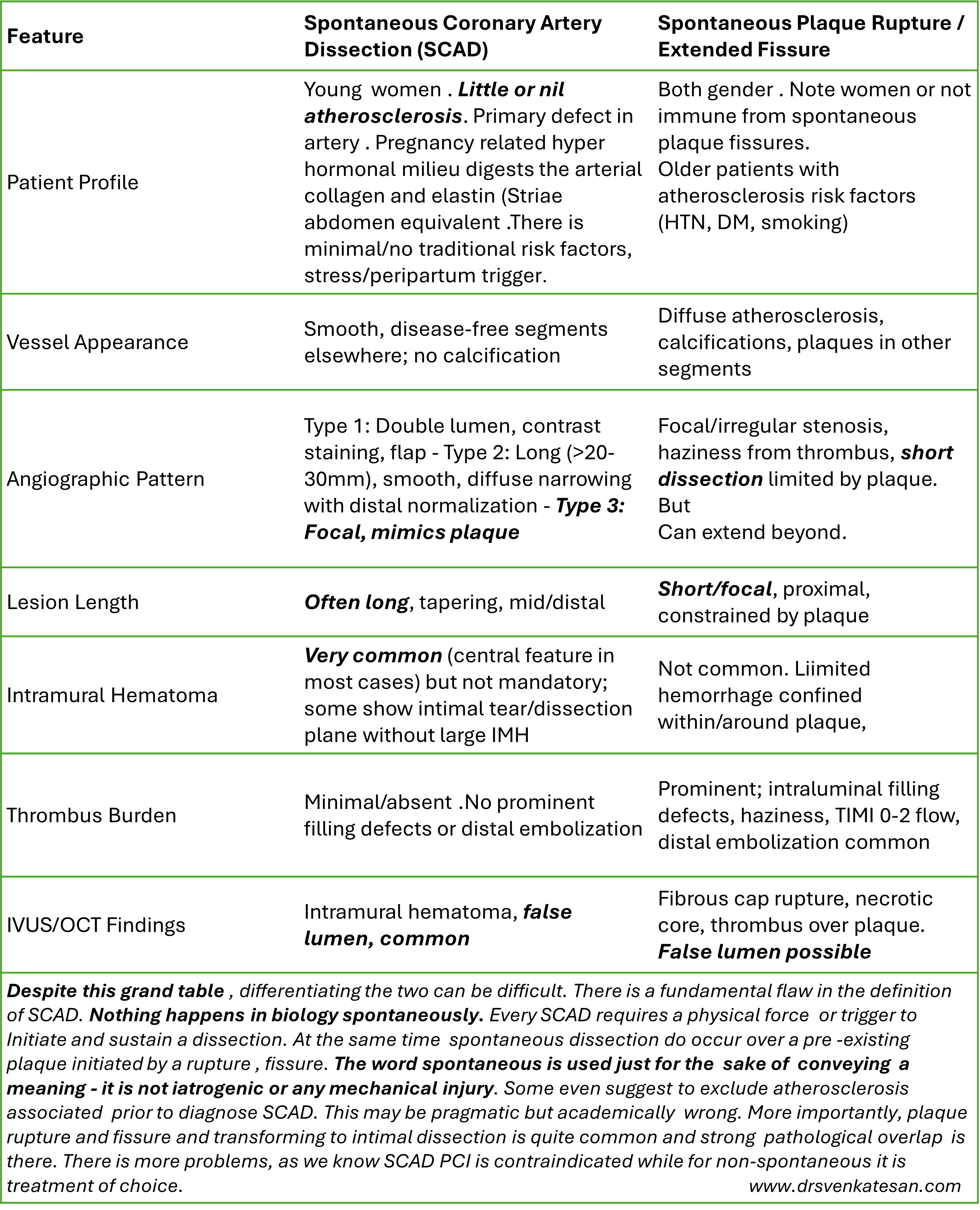
By the way, any tips to differentiate SCAD from spontaneous plaque ruptures and fissures ?
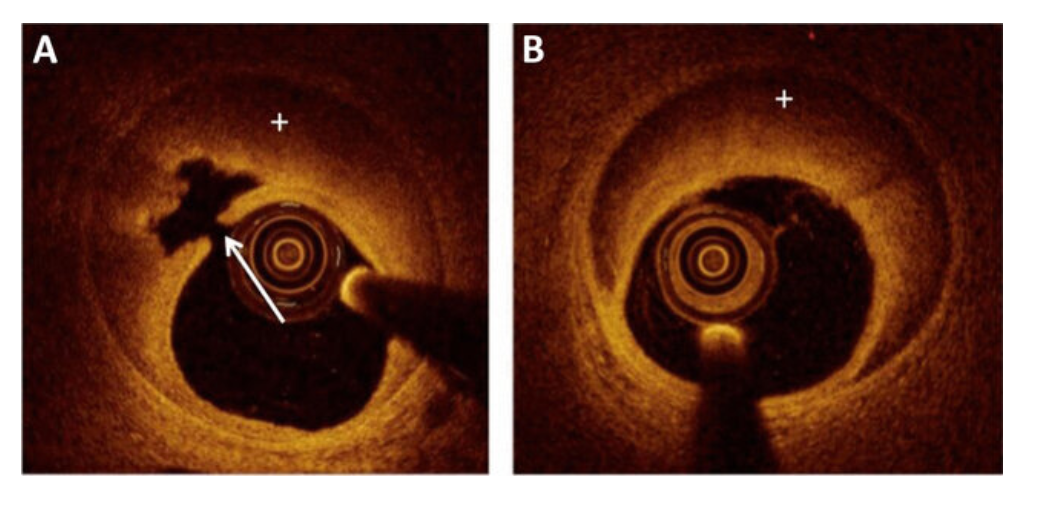
OCT in SCAD : A SCAD caused by an intimal tear (arrow) resulting in expansion of a false lumen and an intramural hematoma (plus sign). B SCAD caused by de novo injury and bleed inside vessel wall resulting in the false lumen with intramural hematoma (plus sign) Source Shah, T et al Curr Cardiol Rep 24, 529–540 (2022). https://doi.org/10.1007/s11886-022-01676-7
Final message
Nothing moves with out a force either from witjin or external . In both SCAD or plaque rupture , an emotional or hemodynamic stress is responsible.
The above list to differentiate SCAD from plaque fissure is big, but few are actually useful. Sometimes, the confirmation comes from the direct feel and the haptics of the lesion and the level of difficulty in crossing the lesion.
Caution : However, in explict clinical situations, as in a young pregnant women with ACS, who has a long spiral dissection , never diagnose anything other than SCAD.
Post-amble: * I wonder, how did the cardiology literature accumulated so much OCT data in SCAD, it should have been very risky procedure in those friable vessels. If PCI is contraindicated , OCT comes very close to it.



 Dr.S.Venkatesan MD