Feeds:
Posts
Comments

Archive for the ‘cardiac anatomy’ Category

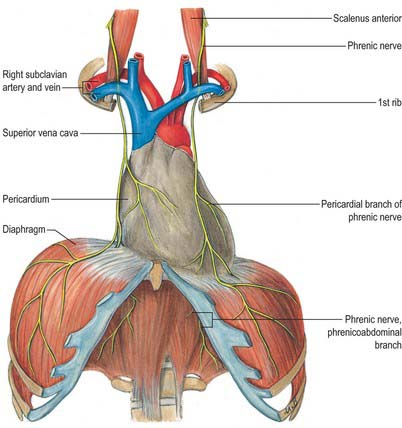
Phrenic nerve arises from C3, C4, C5 cervical spinal nerves ,but essentially from C4 . In the neck, it runs along the anterior scalene muscle, deep to the pre-vertebral fascia. It Enters the thoracic inlet posterior to the subclavian vein and anterior to the subclavian artery.
Does It traverse the Pericardial Space?

Contrary to my longstanding belief, realized just now, the phrenic nerve does not enter the pericardial cavity. Rather, It courses within the fibrous pericardium, between the fibrous pericardium (outer layer) and mediastinal pleura. Hence, it is extrapericardial but intimately related to the fibrous pericardium. (Yes, I was indeed a prof of cardiology, teaching students. Wish, I could learn cardiac anatomy from the scratch again)

Anyway, the fact that it runs outside the pericardium, doesn’t give any comfort to the electrophysiologists, both during epicardial and sub-endicardial ablations. It is worth noting the important differences in the course of right and left phrenic nerves.

Difference between right and left phrenic nerves anatomy

Understanding the anatomy of the phrenic nerve is crucial for both cardiac surgeons (of course they see with their eyes) and electrophysiologists. Phreni nerve injury or ablatio can lead to serious consequences.

Right phrenic nerve

Familiarity with phrenic nerve anatomy is key during an ablation. Specifically, the right phrenic nerve should be carefully delineated during endocardial ablation at key sites, such as SVC, the postero-lateral aspects RA. right superior pulmonary vein, and the junction of the IVC and RA. Fortunately right phrenic nerve never cross over the free wall of RV, unlike the LV,

Left phreic nerve

The left phrenic nerve, on the otherhand, should be localized when performing endocardial ablation near the LAA, ablation of left sided accessory pathways,and epicardial ablation of left ventricular tachycardias

How to avoid phrenic nerve injury during RF ablation ?

There are a variety of ways to displace the phrenic nerve from the ablation site, like fluid, air, or balloon inflation. Here is a step-by-step review article in the Journal of Cardiac Electrophysiology in the current issue, June 2025. It is free access too.

Reference
1.Sánchez-Quintana D, Cabrera JA, Climent V, Farré J, Weiglein A, Ho SY. How close are the phrenic nerves to cardiac structures? Implications for cardiac interventionalists. J Cardiovasc Electrophysiol. 2005 Mar;16(3):309-13. doi: 10.1046/j.1540-8167.2005.40759.x. PMID: 15817092.

2.Peters CJ, Supple GE. Step-by-Step Approach to Phrenic Nerve Displacement. J Cardiovasc Electrophysiol. 2025 Jun;36(6):1201-1212. doi: 10.1111/jce.16617. Epub 2025 Mar 12. PMID: 40077935; PMCID: PMC12160695.

Read Full Post »

Left main bifurcates into two , that’s  the classical anatomical behavior of LCA. (Or it trifurcates) When left main divides , it tends to share its diameter between its two siblings LAD and LCX with considerable  whims and fancies.(Though Finet* et all thought it has a working rule !) * From  Biomedical Engineering, Cardiovascular Hospital and Claude Bernard University France

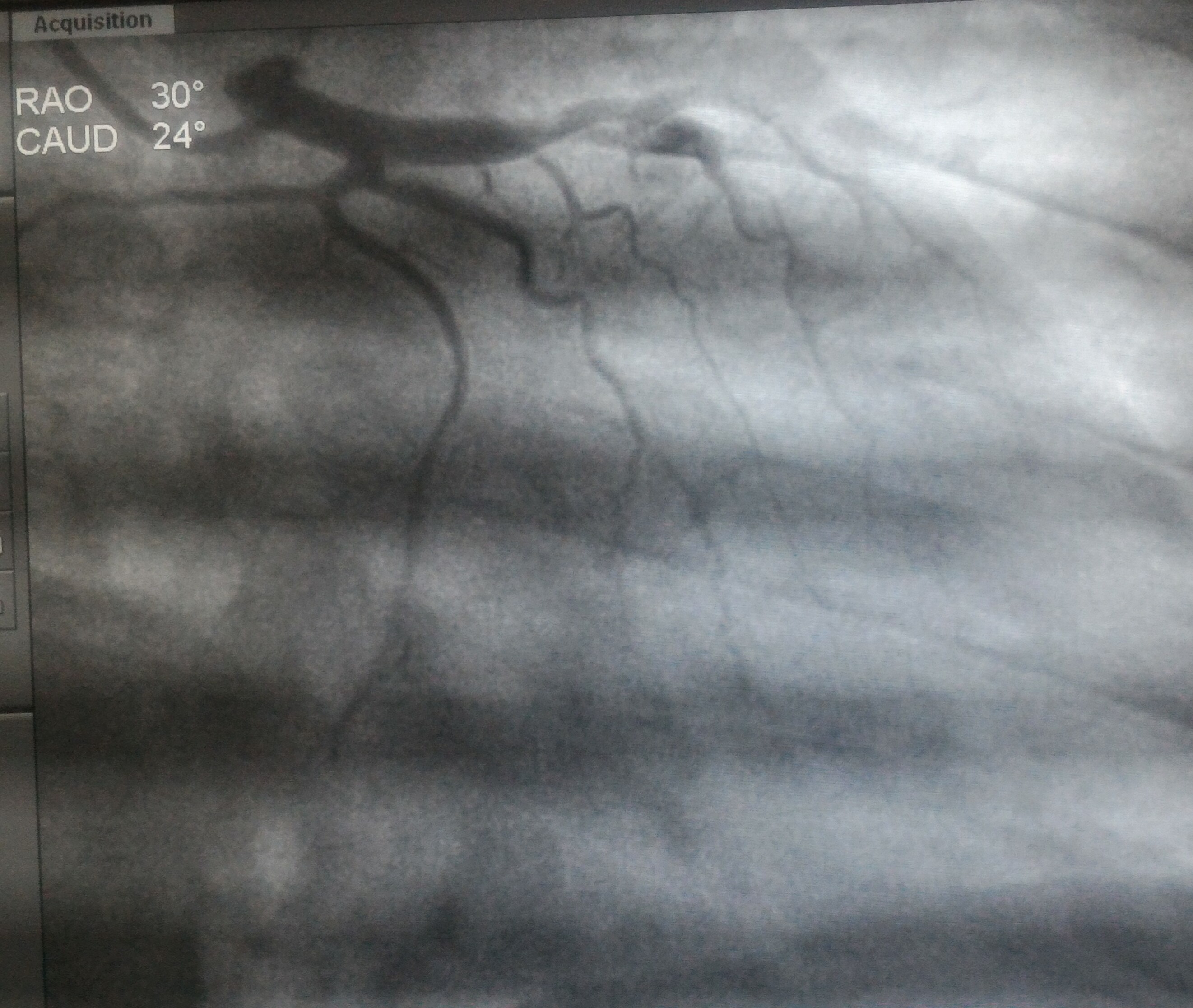
Now , have a look at this , its a rare example of  how a left main might Ignore the rule of bifurcation just like that !

Left main simply continues as left main* after giving off a casual side branch from mid left main shaft .Yes , Its a innocuous looking LCX which would be non dominant as expected

LCX arises exactly mid way in left main , (Technically LAD begins at this point ) but , can you find any difference in the left main after giving off  LCX branch.

Can we say left main continues as LAD without a bifurcation ?

Or shall we say  left main gives off a premature early side branch ( true LCX)  non bifurcating  branch ?

It is an unusual anatomy and  as expected , this patient had a dominant  RCA .

What could be the clinical implication for such a premature  LCX ?

We can only guess . May be nothing !  Obviously ,these patients are immune to develop true bifurcation lesion. Does it in any way mean they have anatomically blessed coronaries !


Reference 

1.Finet G1, Gilard M, Perrenot B Fractal geometry of arterial coronary bifurcations: a quantitative coronary angiography and intravascular ultrasound analysis. , EuroIntervention. 2008 Jan;3(4):490-8.

Read Full Post »

Hey , What’s that moving object over  AML ?  It looks odd,  it doesn’t look like a thrombus or a vegetation.

Yes, I agree , its moving  independently  but  I think , Its benign threads of fibrin attached to the valve .They are called as valvular strands.

Is it ?, I haven’t heard about it !  Can you please  tell me something about it.


Strands are  highly mobile, fine, filiform  threadlike excrescences that is seen arising from valvular structures. Synonym : Its same as Lambl’s excresceneces , the Czech physician who described  it over Aortic valve in 1860.

The following TEE clip shows strands attached to Aortic valve

Incidence

Reported Incidence of valvular strands  varies .Some reports suggested it may be up to 5-10 % .( SPARC study Mayo clinic 1999 its staggering 46 % !)The reason for  such high incidence  is,   many of us are still not clear what we refer to as strand.The imaging modality also has a say. With improving resolution of TTE and liberal TEE use more  strands are detected .A recent large study from Israel , suggest a good news , in large population based study (21,000) true strands are  observed in  just around  1 %.(Marina Leitman 2014 )

Is it Physiological or Pathological ?

The valve closure lines are physiologically stressed , some amount of denudation of endothelium is expected .This leads to a thrombus formation along with the exposed mucopolysacchride  layers of the valve form a filiform ,filamentous structure. .To call it physiological or pathological is left to our wisdom and  perception. The size however matters. It could be  the reason behind many  unexplained strokes.

What is the natural history of these strands ?

Its difficult to believe It may persist for lifetime.If its truely fibrinous strands it may have a life cycle and disappear.

Size

Should be less than 1 mm.

Length varies between  3 mm to 5 mm

Location 

Can be seen in any valve or even in aortic root.

Attachment : Atrial side of mitral valve and ventricular side of Aortic valve.

Strands over prosthetic valve is also reported.

Clinical significance 

It has three common issues.

One: Getting confused with other more pathological entities.

Two : Risk of stroke.

Three: Nidus for normal native valve endocarditis ?

Strands may closely mimic 

  • Vegetations
  • Bland thrombus
  • Redundant leaflet /Chrodae (Marfan and variants)
  • Disrupted chordae (After MVR)
  • Flail leaflet
  • Fibroelastomas

Risk of dislodgement and  stroke 

These strands are minute. It seems plausible dislodgement need not necessarily result in stroke or other organ ischemia.We don’t know whether it gets dissolved on transit.However the risk of stroke is increased in most reports except few studies(Roldan).

Management

First question to ask is , Should we inform our patients about  these ubiquitous accessory valve  tissues if detected incidentally ?

Largely benign and can be ignored in most.A follow up echo may be adviced once in a year or 2. (I have one anxious patient  after I reported such strands in Marfan syndrome )

In patients who has h/o stroke presence of these strands gains importance and  is an indication for anticoagulation.

Surgical excision of large strand is a dramatic option and is rarely performed.

Queries with no answers 

Is it accessory valvular (mesenchymal) tissue ?

Does Atheromatous plaque contribute to these strands in Aortic valve ?

Strands , if  disappears  by natural means , do they regrow from the same spot of raw surface  ?

Final message 

Fibrous strands detected  over the valves by routine echo are uncommon .However , It may give considerable  anxiety if  documented and reported to our patients and physicians .Though these have negligible clinical significance , the risk of stroke is increased in those with large strands.

Reference

Links

Read Full Post »
