Feeds:
Posts
Comments

Archive for the ‘Uncategorized’ Category

Who is a doctor?  Where are they made?

I haven’t clearly understood the true meaning of customary Dr tag, my name carries for more than 3 decades, till I saw this. Wish, this video is played to all young medical students on their graduation day.

             I am realizing with guilt, it requires a Holywood movie buff to remind us the true meaning of the famous WHO – definition of Health, done in the most holistic fashion in the year 1948. 

Health is a state of complete physical, mental, and social well-being and not merely the absence of disease or infirmity.

So, technically, whoever serves to improve these three components and alleviate human suffering becomes a doctor. 

Happy to share this on July 1st, the official Doctor’s day in India in memory of the Bharat Ratna Dr.B.C.Roy of Bengal. 

Reference

The clip is from the movie Patch Adams, Directed by Tom Shadyac.  A Hollywood celebrity movie maker, Virginian professor of communication turned philanthropist, now retired to a minimalist life. He is also known for his famous documentary I am that talks about the problems faced by the world. Though his works are much appreciated, I  must say, they are underrated. Deserves more than an Oscar for communicating his thoughts on the medical profession perfectly and for social equality.


Read Full Post »

It’s halfway way through 2020 , still miles to go.

Welcome to a non academic break.This 3 minutes video definitley helped, amidst the paronia.


Wish, we can retire peacefully and join this family.

Read Full Post »

That’s how the title sounded to me, when I happened to read this paper from the reputed Circulation journal.

Even in the serene non-covid days, primary PCI rate in most countries is at best 10 % and thrombolysis* is the only savior in STEMI.(*with or without Pharmaco Invasvive )

It’s Covid times you know, can’t take science for a ride. Let us all take a pledge, in this deadly pandemic to increase pPCI rate to atleast 50% and ditch that dedicated, trustworthy , uncomplicated all weather friend !

Reference

https://www.ahajournals.org/doi/10.1161/CIRCOUTCOMES.120.006885


Read Full Post »

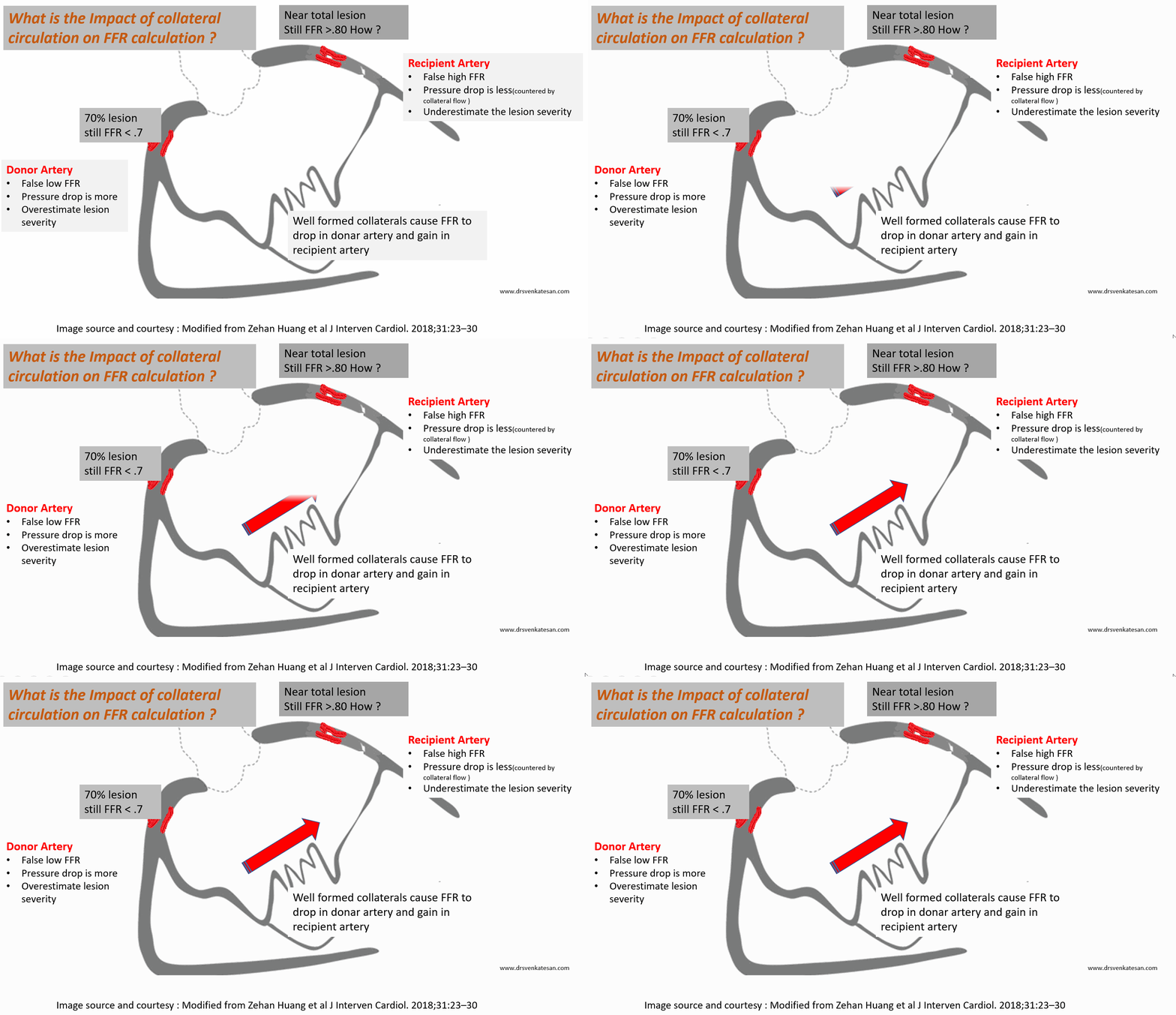
FFR is based on the hemodynamic principle of pressure drop when fluid or blood flows across a narrowed segment (similar to Bernoulli principle). If there is more than 25 % pressure drop across the lesion under maximum hyperemic condition (or steady-state) it is counted as significant.(FFR is .75)

Now, if the distal vessel is supported by collaterals, what happens?

When a vessel in question, is supplied by well-formed distal collaterals, it will prevent this pressure drop and hence lesion is underestimated. Similarly, if the donor artery has a suspicious intermediatory lesion, the FFR across it is falsely low, and overestimates the lesion.The distal pressure drop here is not because of the lesion but due to rapid collateral flow into the recipient artery.


Let us take a hypothetical case.  In a post anterior MI 90 % LAD lesion receiving well-formed collateral from RCA which also has a 70 % proximal lesion.

FFR is artificially low in donar RCA (<.75) and makes an insignificant lesion as significant ( ie false positive) . Meanwhile, in the recipient artery LAD  FFR is artificially high, and give a false negative result, underestimating the severity


Clinical significance

  • First, fix a lesion in the recipient artery and then reassess donor artery.
  • This is especially important in LAD CTO
  • If you open up CTO, a lesion in RCA might become insignificant and may not require intervention.

Summary

FFR overestimates lesion in the donor artery. Under-estimates lesion severity in the recipient artery.

Reference 

Reality check 

FFR as a concept has suffered a conceptual as well as situational issues (Left main, bifurcation blues, ACS confounders, Adenosine antics! etc) . Hence,we have  moved to IFR, CT-FFR, QFR, IMR, etc.(Sorry to say this, even these modalities are struggling to become a practical tool for the true physiological assessment of a lesion) 

I used to tell my students, do a stress test if we encounter 70 to 90 % single-vessel lesion (or even multivessel ). If it comes negative or if the patient has good exercise capacity,  it is a non-invasive marker of adequate FFR and avoids an Intervention.

I wish , we can call the humble stress test as poor(smart) man’s FFR.  

Read Full Post »

Two stents Onyx (Medtronic) and Biofreedom(Biosensors) appear promising with rapid endothelisation and hence short DAPT. There are three more options, available for this situation.

Option 1

Avoid the endothelium unfriendly DES and use BMS* with MAPT (Mono or minimal duration antiplatelet therapy). For the sake of young generation cardiologists, let me expand BMS,ie Bare metal stents.

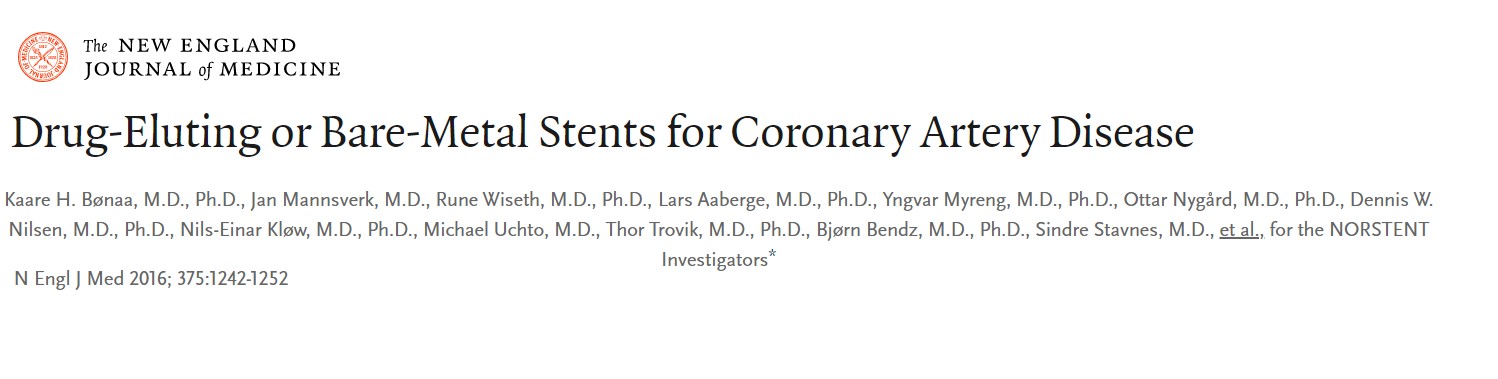
BMS in 2020 , what nonsense are you talking about ? (For those who ask this question, please go through the following study with a conscience)

(NORSTENT 2016 -One of the most underrated, deliberately concealed landmark paper in cardiology. We understand, even papers from NEJM don’t get noticed, if it confronts commerce. As expected, none of the cardiology bodies considered it worthy to use this study data in CAD management guidelines)

Want more evidence?

One more study, BASKET -PROVE explicitly showed in large-caliber vessel (Stent >3mm) BMS vs DES doesn’t make any difference.(Christoph Kaiser 2010 NEJM)

What is the 2nd and 3rd option?

Did you guess it ? Yes, correct, avoid the stent altogether. Do a POBA* if feasible, or just continue with the self humiliating medical management and be happy to prevent a potential stroke.

Mind you, in our hind sight, we always realise, most lesions are amenable for medical management, unless it is critical, proximal and symptomatic.

*If you think doing POBA downgrades your Interventional worthiness, we may add a DEB top up, to pacify our restless scientistic sense.

BVS(Bioreabsorbable vascular scaffold)

It is not yet ready as on option, since it appears risky even with 60 micron struts as stent digestion is patchy and incomplete and paradoxically create a more thrombotic milieu.

Final message

In high bleed risk patients, though special stents are avialable, BMS is always an option.

Postamble

After seeing this , one of my colleagues told me, two weeks of vigorous search all through India, he failed to get a single BMS supplier. When enquired, I also found the same. Yes, India is a poor country, they can’t afford to stock cheap BMS, try asking rich western countries. I am sure Germany has it.

( Scientifically, the option of BMS need not be confined to high bleeding risk ,it can very well extend to any CAD profile)

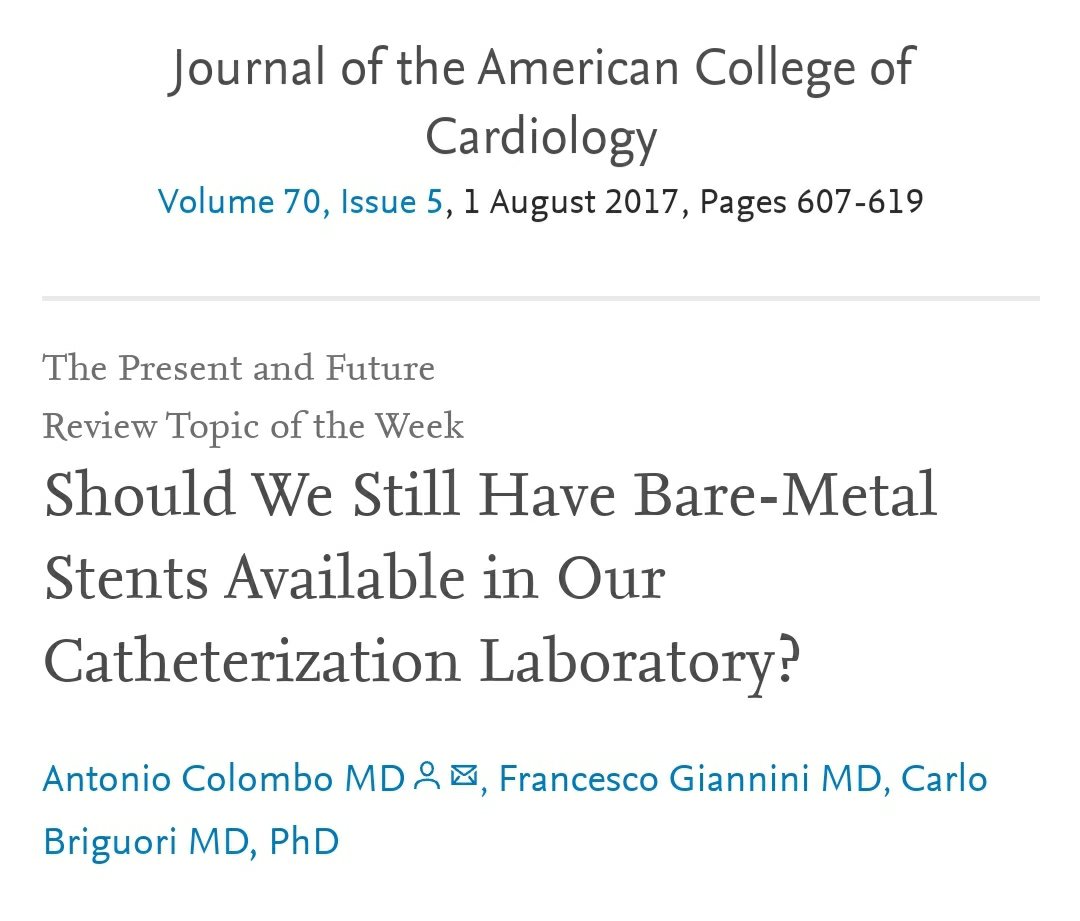
What Dr Antanio Colombo has to say on this

https://www.sciencedirect.com/science/article/pii/S0735109717376064

Read Full Post »

I stumbled upon this unique historical info about my college. *According to Prof. Emeritus M.G. Sahadevan., F.R.C.P. (London), the first medical college of Kerala was started at Calicut, in 1942-43, during the Second World War. Due to a shortage of doctors to serve the military, the British Government decided to open a branch of Madras Medical College in Malabar, which was under Madras Presidency then. The Medical School was started close to the then district hospital at Kottaparamba ( now Women and Children’s Hospital).

The war was over before the medical students completed their course. After the war, the medical school at Calicut was closed and the students continued their studies at Madras Medical College. Captain A.B. Das,(late) a veteran doctor who practiced in Calicut belonged to that batch. Nothing much is known about other students who might have served in the British military. Until recently the building which housed the medical school was the R.D.O office. The building next to that is the public health laboratory even now and the buildings beyond those are the doctor’s quarters of W & C Hospital even now.


Those of you, who have any further information on this historical fact are welcome to share it here.

http://calmedcollege.freeservers.com/cmchistory.html


Read Full Post »

The antiviral properties of hydroxychloroquine are well known. The doubt is whether this property works against the pandemic Coronavirus.

Mechanism of HCQ’s antiviral action. HCQ primarily gets concentrated intracellular endosomes, that’s where the virus resides and multiply.

The study, all of us were expecting has come out. It concludes,   

While, many of us might think, its end of the controversy, but definitely not.

Why the top medical journal uses a term “unable to confirm” the benefits of HCQ on covid. Why it hasn’t concluded as “No benefit”  This is because , they know their limitations. They really believe their statistical Interpretation is still tentative, and the truth is yet to come out,  right ?

The main thrust for the negative results of this study is related to the loosely defined term ventricular arrhythmias. (Few asymptomatic  NSVT? Three VPDs enough? we don’t know ). Of course, combining two drugs that are known to prolong the QT interval is to be avoided. Further, it is a well known statistical principle that analysis from registries is not a good tool to assess the efficacy of a drug as they are retrospective. (Read the CSIR review of this  paper in the reference )

Final message

Chloroquine is not useful for Corona declares this Important study from Lancet,… but we also realize, this study may end up as neither landmark nor important. (The authors themselves are ready to accept this possibility) 

As I finish this topic, I got to see the following response to this study from official  Indian authorities. 

Council of Scientific and Industrial Research (CSIR) , Institute of Genomics and Integrative Biology (IGIB) Delhi .Chennai Mathematical Institute (CMI)


Now Lancet study in more trouble: Suspicious data

From a major journal Science. Lancet has already reported a clarification and concern. Let us wait, there is more dram to follow.

Postamble

When coming to drug trials, why registries, meta-analysis, systematic reviews, even high-quality RCTs are bringing more controversy than clarity?

I leave the answer to our conscience. Post Corona, I wish we learn some harsh, new lessons, in contemporary scientific research & how it shall be conducted, interpreted, and reported without bias. The definition of “bias” itself needs some overhaul. (I will be called biased if I say the bulk of the published EBM is intrinsically biased! I guess there is good bias, if it leans towards truth.)

Read Full Post »

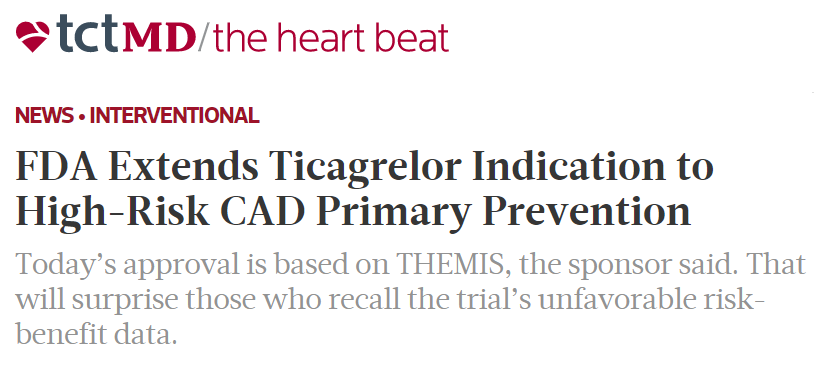
It’s all happening. FDA approves Ticagrelor for high-risk cad primary prevention and stroke. I am sure, even Astra Zenica wouldn’t have expected this. At best, the evidence from THEMIS for this Indication, can be called as a statistical extrapolation of comical proportion.  

Meanwhile, Ticagrelor thanks Aspirin for its extreme kindness for agreeing to co-live with it. 


The twitter reacts. This one is fromDr. Davide Capodanno , current Editor In chief , of  EuroIntervention, the journal with one of the top Impact factor with a huge following. 

Read Full Post »

After decades into the field of medicine, I am unable to come to terms with one of the most fundamental questions in our profession.

What does the term Public health means?

Have we erred, by defining health in terms of its delivery rather than a comprehensive biological definition? How do you compare a guy, who gets pride with glittering five-star care in a private hospital , with that of man who humbly accepts the same in a crowded public health facility?

“It’s 1 .30 AM past midnight. I am part of the  COVID supervisory team on rounds. I could see a tired-looking corporation worker wheeling out an elderly man who had just expired in ward R-3, in one of the biggest Corona care hospitals that house 350 COVID patients. In the background, haunting sirens break the eerie silence of Chennai midnight. In the far end, I see a stream of ambulances wait in a queue to drop patients, which, they have ferried across from various private hospitals. Chilling thoughts of this grand old hospital might crumble looked real for a moment”. (This is exactly the time, I got the urge to write this piece) 

When calamity strikes, the true colors of the capitalistic mindset are being exposed. It looked shamelessly obvious, that the responsibility of guarding even private health has been shrugged off and has become a public responsibility. 

It’s a  politico -Intellectual tragedy, that the private sector enjoys a right to ignore public health ,.. for the public hospitals, it’s a crime to ignore private health . 
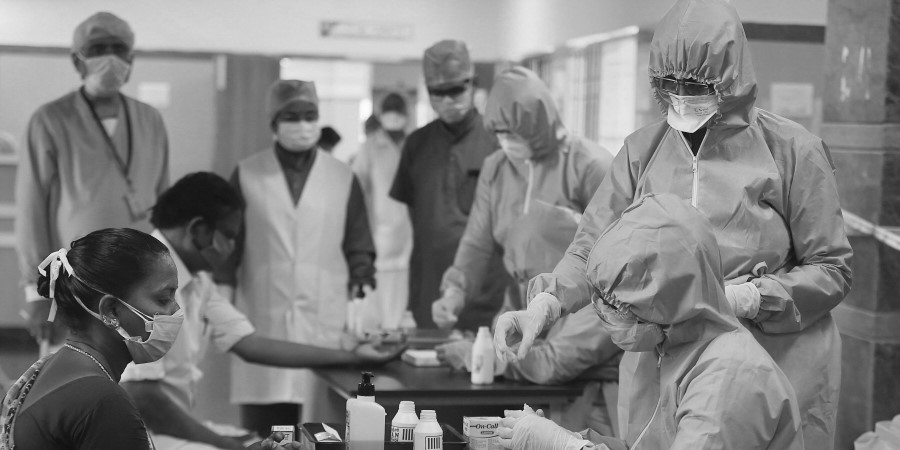
 

A 24/7 hour COVID control room in our hospital with  an untiring, committed workforce 

Few days later, the Times of India reports this.I wonder, what I am supposed to feel ?

The report  is a shocking revelation.I wish its wrong.

When the sun shines, someone tends to thrive pathologically on public health. At times of natural crisis, they want a bailout from the public (state) sources. Why not we reverse the deal in normal times?  Should the Government take over all private health providers and make it accessible to the public at all times?

We have a directorate of public health in every state of India, which has zero control over private health care in normal times. How can they get control over them only during pandemics and calamities?  Wonder, should we consider a separate cadre of  “Director of Private health” 

Final message 

So, after spending substantial time trying to find what is public health, I must say,  I lost track. I don’t think any medical school has ever taught us, to differentiate two biological systems in the human body, one for the public and other for private.

The stigma associated with the word public should be erased once for all. It may sound strange, let us dismantle the term public health (How about  Unified human health ?)  . All private and public hospitals to be administered, regulated, and audited by WHO. I believe it may restore some sense in global health. United Nations and the World health assembly should work on this and usurp the required power

We should also ensure, the more powerful vectors of human disease, like climate change, air pollution, poverty,  inequality, war, violence, all should enter first-year medical school along with Anatomy, physiology, and biochemistry to bring up a generational change. (I know very well, this crazy and cranky thoughts, is as good as a faded dream  )   


Read Full Post »

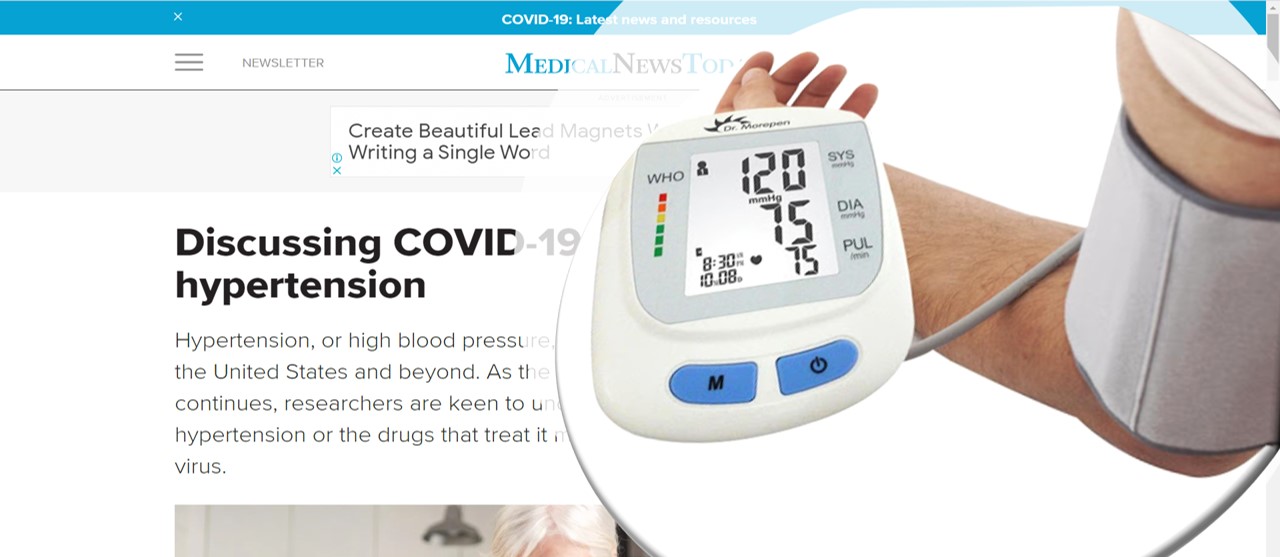
The mainstream (& the sidestream) medical media have already named one culprit ie hypertension (HT) as a significant comorbid entity in the current Corona pandemic. But, If we ask one direct question, how Corona and HT are linked ? , the answer is not forthcoming fluently.

.

Some of the thought process about the Issue.

1. Does Coronavirus relish high blood pressure on its journey to attack lungs ?

Funny question you may think. The virus primarily lives and tracts through the respiratory tract to reach lungs. Viral load in the bloodstream is nil or minuscule till late stages. BP is nothing to do with what is happening in pulmonocytes . BP doesn’t influence the viremia in any significant way.

2. Does HT related pulmonary endothelial dysfunction facilitate and accelerate viral injury?

We don’t know. If at all,  this is true,  we have to worry about pulmonary hypertension (PH) and not SHT . PAH and SHT have absolutely no relation as far as I know.

3. Is concomitant anti-HT drugs cause relative hypotension and cause morbidity?

Maybe. We don’t know. Hypotension should be avoided at all costs.

4. Is there a conflict between Antihypertemive agents and Corona?  

We don’t know.(Much has been written about the ACEI genetic susceptibility Here is a current reference South, A.M., Tomlinson, L., Edmonston, D. et al. Controversies of renin–angiotensin system inhibition during the COVID-19 pandemic. Nat Rev Nephrol 16, 305–307 (2020).)

5. Does Corona precipitate  LV dysfunction in patients with corona infection?

Possible. Very rare (We haven’t seen much of uncontrollable HT causing afterload mismatch in corona setting as of now)

6. Do silent or manifest Coronary artery disease (CAD) and diabetes (The close buddy of HT) add up the risk?

Yes.definitely is possible. (No doubt, DM confers definite additional risk in Corona) 

7. Is preexisting HT cause CKD and argument the morbidity?

Yes. This happens only if HT has damaged the target organs sufficiently. Here the outcome of Corona infection might have an aggressive course.

Final message

So what exactly is the relationship between HT and Corona?

(Actually, this question was asked not in a cardiology academic meet. It was a casual query from one of my studious patients. I think nowadays we learn cardiology more from them than textbooks)

I guess, there is no direct, meaningful link in most people who just have isolated  HT without any target organ damage. It is more of perceived risk, and views are speculative and conjectural (Including what is written here) Corona affects the elderly and HT is also common in the elderly (30% of all elders) that’s it. 

The estimated 300 million people who are labeled as hypertension around the globe need not panic. Just because you are having high BP, corona doesn’t have any special attraction to you.   

Read Full Post »

« Newer Posts - Older Posts »