Here is the link to one of the best illustration for cardiac action potential which I have stumbled upon !
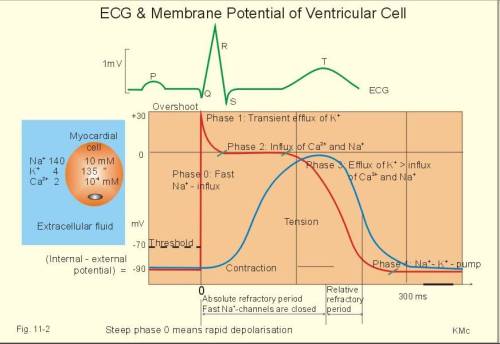
Spend some time on the following illustration depicting the normal cardiac action potential that explain the ionic movements . Understand why a cardiac muscle has two refractory periods , why there is a sustained dome for myocardial action potential and this is missing in SA and AV nodal potential ?
Click below to reach the online book
Textbook in Medical Physiology And Pathophysiology
Essentials and clinical problems Copenhagen Medical Publisher
Note :
Red curve indicates electrical action potential .Blue depicts the mechanical contraction . Both red and blue curves together form the electromechanical systole. Realise , QT interval represents electro mechanical systole . It includes both cardiac depolarisation and repolarisation .
There is a inherent tendency for our brains to equate depolarisation with systole and repolarisation with diastole .It is totally a wrong perception. Please , be aware of this !
Identify the gap between the red and blue curves that represent 50% of ARP .This is the time the myocytes can not be stimulated whatever be the power of stimuli because the Na channels are closed .
Understand ,the above action potential represents only half of the cardiac cycle as diastole is not fully illustrated here .Recognise the fact , diastole begins at the end of phase 3 and goes into phase 4 as diastolic depolarisation by a slow Na current.
After learning the basics of action potential read about the antiarrhythmic drugs . You will get to understand it better .
Learn which drug acts on which receptors or channels and what does it do to the various intervals .For example , any drug that is prolonging an action potential duration is fraught with risk of ventricular arrhythmia as it is synonymous with prolonging QT interval (Eg Class 1 A /1B/Class 3) .
Sicilian gambit is the receptor & channel based classification for anti arrhythmic drugs . (Sicilian gambit 2 )
- Understand the paradox of QT interval getting shortens with Class 1 B (ligocaine /Mexilitine ) while 1 A does the opposite !
Class 1 Drugs blocks sodium channels .The blockage occurs in a complex rate dependent fashion . It blunts the slope the phase 0 and hence prolongs the action potential .
Class 2 . Beta blockers
Class 3 . Blocks K + Channels and hence prolongs the AP
Class 4 .Calcium blockers
Finally don’t forget to say thanks to Copenhagen medical publishers for this excellent illustration .



 Dr.S.Venkatesan MD