Feeds:
Posts
Comments

Posts Tagged ‘coronary dissection’

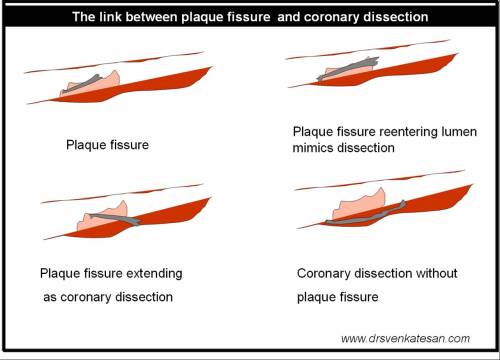
plaque-fissure-and-coronary-dissection

  • Plaque fissure is  the most common intra-plaque event that   precipitates  an acute coronary syndrome.
  • It is the  site of   attachment  for coronary thrombus
  • It can  either be spontaneous or PCI induced.
  • Plaque fissure can  either be  partial or complete and  may  reenter the lumen.
  • Eccentric plaques are likely  to fissure often  , as the  wall stress on the plaque shoulder region is  high  (Laplace law)
  • Angiographically  it is often difficult to differentiate  fissure from true coronary dissection.Both manifest as intraluminal filling defect.Coronary dissection  often extend beyond the length of plaque.
  • Many of the reported cases of spontaneous coronary dissection are thought to be  nothing  , but plaque fissures and their extensions.

Is plaque fissure a painful event ?

Plaques do not have neural innervation.So the plaque fissure is generally not painful.But when it extends into the media of vessel wall it can be severely painful.

Read Full Post »

Intraluminal filling defect is often  observed during coronary angiogram .Thrombosis  has become the default diagnosis in most situations.This has resulted in over diagnosis of thrombosis .In fact a strategically located plaque stained by the dye is an equally common cause for intraluminal filling defect.

In fact there are many recognised caused of filling defect

  1. Thrombus
  2. Dissection
  3. An eccentric plaque
  4. Dye trapped within  plaque fissures
  5. Calcification projecting into lumen
  6. Plaque prolapse from stent struts
  7. Artifacts-End on view of  side branches
  8. Static myocardial bridges
  9. Trapped air bubble(Transient filling defect)
  10. Streaming  effect  dye may mimic a filling defect

Message

It is  not advicable  to make a  default dignosis of coronary thrombosis in all cases of intraluminal filling defects

Read Full Post »
