Why 3-24h ?
The famous & popular 3-24 hr time window for pharmaco-invasive strategy was adopted from STREAM (prehospital tenecteplase + PCI <6-24h in <3h presenters) and FAST-MI assuming uniform IRA patency. It fails to stress the rescue vs routine distinction, allowing Inappropriately delayed PCI in at least 30% of STEMI.
The 24-hour upper cutoff in pharmacoinvasive strategy serves to prevent reocclusion, address residual stenosis if any, the not myocardial salvage, which is irrelevant post-successful lysis.
Mind you IRA optimisation is never a time bound emergency. In fact PCI is not an absolute neccesity for long term IRA patency. With TIMI 3 flow ,and in the absence of any ischemic substrate , there is no need to chase the 24 hr time window. If lysis achieves complete( or almost complete) IRA patency, PCI can safely extended to 48-72 hours, or even permanent deferral (No-PCI , stand alone thrombolysis’ ) in stable patients with optimal medical therapy.
A study is published , from my institute in the current issue of AJC with a tilte Extended Pharmacoinvasive PCI Compared to Primary PCI: Insights From Madras Medical College STEMI Registry . This study argues for extending the time window for pharmacoinvasive strategy to 48 hrs. (It could still be higher.) It suggests , this flexibility suits the LMIC, due to logistical realities. Realised, I have also contibuted a little to this paper , when I was in Madras medical college few years ago, nice to be listed as a co-athour.
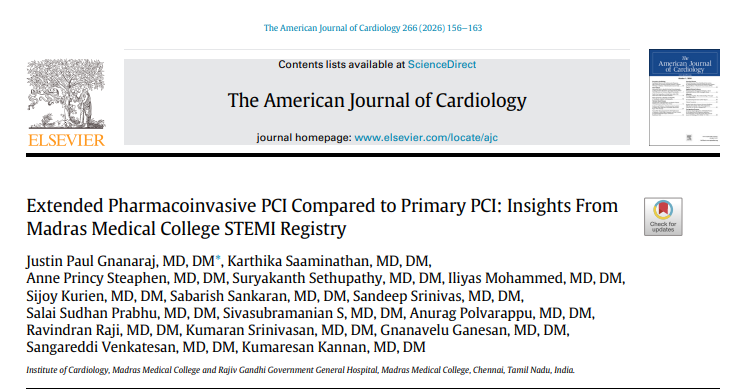
Link to the PDF of the article
I am sure, this study, demands to reset the 24 hr upper limit of cut off for pharmaco invasive strategy.Looking beyond this study, there is an urgent need to clarify the specifc purpose of the generalised time window of “3 to 24” hr time window in pharmaco invasive strategy.
Final message
Pharmaco Invasive strategy time windows needs to be based on timing and efficacy of the Initial lysis.
Successful Lysis* (TIMI 2-3, in about 70%): Routine angiography/PCI 3-24h (prevent reocclusion/residual stenosis) .Extendable to 48-72h + or elective deferral if stable, with patent IRA no need for further salvage at all. Doing PCI for the purpose of reduction of reocclsuion alone is not driven by soIld data.
Failed Lysis* (TIMI 0-1, 30%): Rescue PCI immediately (<3-6h post-lysi, like PPCI) Here the time window should be hastened and can never afford to extend it, at any stretch of imagination.
* Ironically, the 24hr cut of has no place in both the above subsets. (May be in failed lysis , 24 hr cut off might apply , again it is 12 hr longer than primary PCI .
Postamble
Commenting this paper as a third person : (With due respect to all )
One limitation in this study is to be admitted. I think, the generalised comparative efficacy of extended PIPCI with primary PCI can not be made, for the simple reason, the extension of time window is possible only in patients who had successful lysis. At best, this study can only conclude: “3-24h pharmacoinvasive PCI can extend to 48h if initial lysis successful” a fact we already accept. If initial lysis fails (30% TIMI 0-1), any extension is contraindicated and requires immediate rescue PCI akin to PPCI. Also, data regarding non-IRA intervention will help understand the importance of the extension of the time window better.



 Dr.S.Venkatesan MD