Peripartum cardiomyopathy (PPCM) , first reported almost a century ago (Ref 1) is getting lot of attention in recent years.Most works are trying to find out the true cause for this ubiquitous entity.The fact that it occurs in the peripartum period, we are forced to link it to hemodynamic and hormonal stress.
Advanced molecular genetic studies reveal PPCM unmasks abnormal sarcolemmal protein mutations in a random population, that express as pregnancy-related DCM. The genes most commonly associated with peripartum cardiomyopathy (PPCM) are Titin, Filamin C, Desmosome, and BAG3-Athanogene (B-Cell related). These genes are involved in the sarcomere, desmosome, intercalated discs, and autophagy.
Link between PPCM & PIH : Is real, not a speculation
Genetically vulnerable women who happen to develop PIH are obviously are at high risk for PPCM. No surprise 30 % of PPCM patients have a history of PIH. If we allow Occam’s razor to teach a few lessons in the Obstetrical suite, then simplistically, a large chunk of PPCM is just a prolonged myocardial distress to abnormal loading conditions of the heart. Afterload mismatch in PIH and preload mismatch in women without PIH. The latter term simply represents volume enhanced myocardial stretch in the postpartum period. Acute LV dilatation adds on to wall stress , thereby hiking the afterload as per Laplace law.
(*There are the molecular triggers that switch on the dormant , yet dysfunctional gap junctional proteins and stretch them beyond physiological limits, resulting in temporary loss of elastic function and precipitating PPCM, which recovers in many women , if God willing)
Hickam’s also welcome : PPCM is a likely Pituitury cardiomyopathy. Though it is a suspicious circumstantial culprit, it has become a popular hormonal model for PPCM .It is yet to accrue authentic evidence. Meanwhile, bromocrtiptine,the prolactin antagonist is being used with wide ranging efficacy. (Koenig T, Card Fail Rev. 2018 )
Final message
PPCM is essentially a form of cardiac inefficiency in handling either the afterload or preload (or both) in the peripartum period, probably influenced by the pituitary gland in those with genetically vulnerable sarcomere .The fact that it is recurring in substanial number of women in subsequent pregancy , would point out to the same hemodynamic distress story.
Counterpoint
*Some would argue , PPCM should not be diagnosed if the mother has PIH .The rule is PPCM is diagnosed only after excluding all reversible diagnosis. Many guidelines endorse that. I couldn’t understand the logic, unless we know the true reasons why some hearts struggle to handle the BP effectively. Incidence of RV dysfunction in PPCM would argue for diffuse global myocardial pathology, still it might also be poor tolerance to raised pulmonary pressure .
Reference
1.Hull E, Hidden E. Postpartal heart failure. South Med J. 1938;31:265–270. doi: 10.1097/00007611-193803000-00010 [CrossRef]
2.Demakis JG, Rahimtoola SH. Peripartum cardiomyopathy. Circulation. 1971;44(5):964–968. doi: 10.1161/01.CIR.44.5.964 [PubMed]
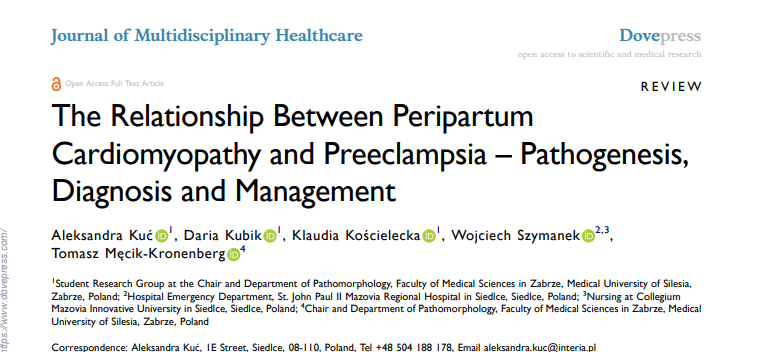
4.Journal of Multidisciplinary Healthcare 2022:15 857–867



 Dr.S.Venkatesan MD