Great things happen in India nowadays .Economy is growing at 9% , the growth of automobile industry is fastest in the world. But in scientific research and development it has been traditionally lagging behind . Things are set to change. The medical science , (If you want to call it as industry it is fine !) especially the imaging science is making rapid strides. The proliferation of private and corporate hospitals and institutes has helped us practice the latest .
Pulmonary atresia with VSD is a rare congenital disease where there is partial or total (chaotic )pulmonary arterial blood supply .
When the pulmonary artery becomes atretic , what will the lung do ?
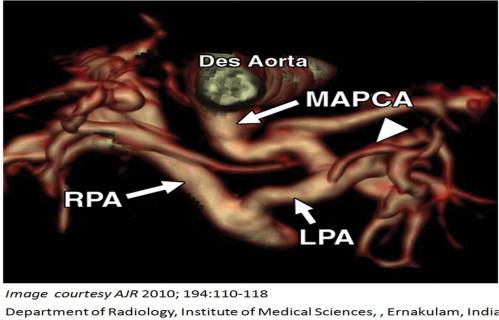
It has to get perfused somehow ! It tries to snatch the blood from the aorta in whatever possible manner . Depending on the severity of pulmonary atresia , there can be a total anomalous pulmonary arterial supply (Type 4 ) .Here , few twigs directly originate from Aorta, few from branches of Aorta and sometimes bilateral PDA etc .These are collectively called major arotopulmonary collateral (MAPCAS) .In fact differentiating a PDA from a MAPCA can be extremely difficult .(It has only academic purpose though !)
Hither to , visualising the MAPCAS was a huge task . Aortogram with selective cannulation of MAPCA was neccessary.Now, with the advent of MDCT we can get some stunning images of these collaterals non invasively.
Why is visualizing and delineating MAPCA anatomy important ?
This will facilitate the surgeon to plan the unification of pulmonary arterial flow and reenginnering the pulmonary circulation (with or with out conduits)
Here is a rare publication originating from India in American journal of radiology . An exclusive article with CT scan images of the defect .
Amrita Institute , from the southern Indian state of Kerala ( also known as God’s own country ) is doing a phenomenal cardiology work especially in pediatric cardiology.
Three cheers to the team which published this master piece . With the courtesy of AJR the link to the article is placed here.



 Dr.S.Venkatesan MD