Feeds:
Posts
Comments

Posts Tagged ‘accessory pathway’

None exposes the expertise and stretches the electrophysiological acumen of a cardiologist, more than a strip of wide QRS tachycardia. Here is a patient who comes with palpitations, with mild hypotension , still comfortably entering the OPD with a non-emergency appointment.
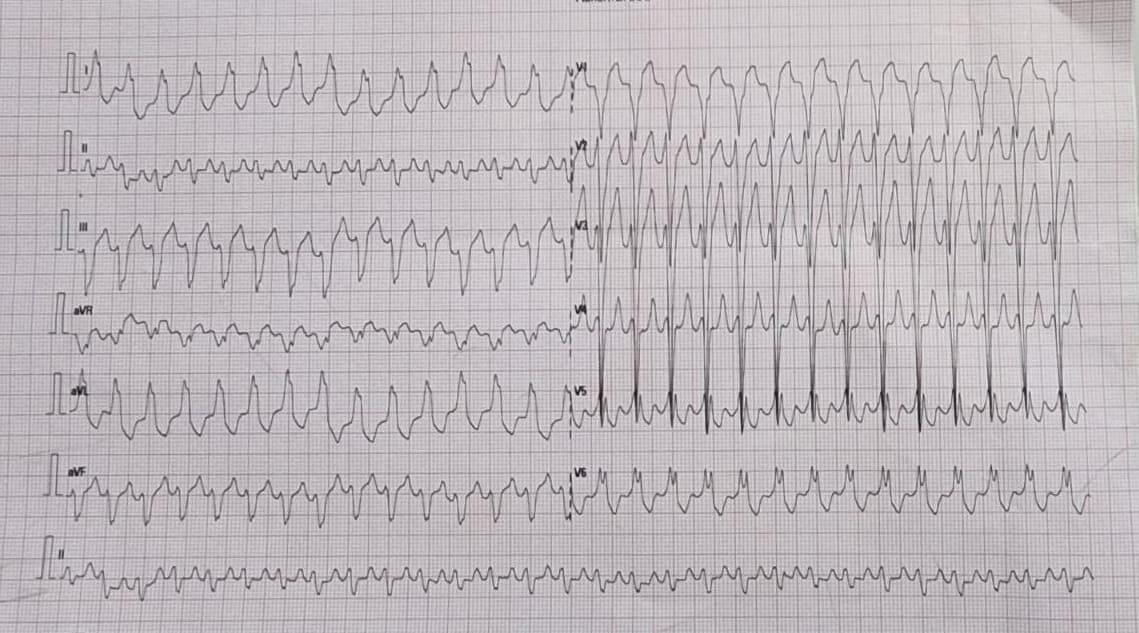
How many diagnosis are running through your mind when you see this ECG . How much it got narrowed after applying criteria like Brugada, Vereckei  etc ( VT, FT, OTVT, Mahaim Tachycardia, AVRT /AVNRT with aberrancy etc)

Now let me reveal the age of the patient .He is a 13 year old boy. Does this help you to narrow down the list of possibilities ? Logically, It should , but for some it can widen the list as well .( Brugada, Anderson, Long QT, Naxos all runs through the mind)

What happed next ?

As the cardiologist was wondering how to tackle this arrhythmia . Adenosine? Amiodarone or DC shock, thankfully, the boy got to spontaneous sinus rhythm .

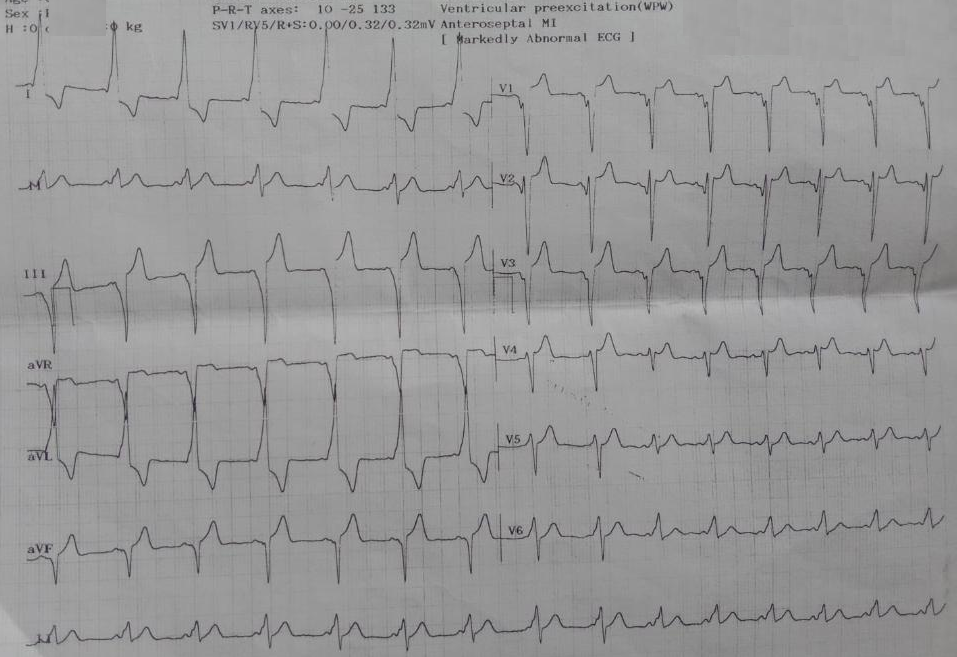
Click here to see the ECG after restored sinus rhythm & the diagnosis is Instant .

Yes it is a WPW substrate. Localization of pathway is a must and a headache for the fellows. .For me, It looks like a posterior pathway in the para-spetal area. 90% of AVRT are narrow QRS . Here it is wide. Why ?

It’s simple. The tachycardia is anti-dromic.

Is it ? Look at the strip again and confirm is this antidromic ?

I am not sure , I still think it is still antidromic .

I am saying No. This is Ortho-dromic wide QRS tachycardia .

How do you say so ?

Antidromic will still more wide and rapid and won’t terminate spontaneously .Of course one problem here aberrancy usually take an RBBB morphology.

How are you so sure . Let us send this to an EP guy.

*What did the EP say? Well, he didn’t commit to anything as I expected. He said until he measures the refractory period of the accessory path, he won’t comment anything about ortho or antidromic query of AVRT. He asked us to send the case for ablation immediately,


Ok. Let us analyse the reason for orthodromic wide QRS AVRT

1.Rate dependent aberrancy

2.Functional abberancy.

3.Preexisting BBB

4.If patients are on drugs that can prolong his Purkinje conduction


Final message

Two lessons may be learnt.

Lesson 1: Trying to decode a wide QRS tachycardia, without knowing clinical background, should be forbidden. This topic is intentionally made complicated by a flawed teaching methodology of wide QRS tachycardia for over 4 decades. Maybe the single lead AVR algorithm promises to be a quick remedy. If AVR is positive, it is VT; cannot be SVT.

(For the curious readers , please go through Dr. Masood Akhtar’s article from Wisconsin on how to differentiate VT & SVT without even looking at the ECG by law of statistics that beat the invasive EP studies).

Lesson 2 : Wide QRS AVRT is not always antidromic . In fact, orthodromic wide QRS AVRT is 2 to 3 times more common. Many of us don’t realise this bias in our learning.

Related topic

How common is orthodromic wide QRS atrial fibrillation ?

Reference

1.Vereckei A. Current algorithms for the diagnosis of wide QRS complex tachycardias. Curr Cardiol Rev. 2014 Aug;10(3):262-76. doi: 10.2174/1573403×10666140514103309. PMID: 24827795; PMCID:

2.Vereckei A, Duray G, Szénási G, Altemose GT, Miller JM. New algorithm using only lead aVR for differential diagnosis of wide QRS complex tachycardia. Heart Rhythm. 2008 Jan;5(1):89-98. doi: 10.1016/j.hrthm.2007.09.020. Epub 2007 Sep 20. PMID: 18180024.

3.Akhtar M, Shenasa M, Jazayeri M, Caceres J, Tchou PJ. Wide QRS complex tachycardia. Reappraisal of a common clinical problem. Ann Intern Med. 1988 Dec 1;109(11):905-12. doi: 10.7326/0003-4819-109-11-905. PMID: 3190044.

4.Tchou P, Young P, Mahmud R, Denker S, Jazayeri M, Akhtar M. Useful clinical criteria for the diagnosis of ventricular tachycardia. Am J Med. 1988 Jan;84(1):53-6. doi: 10.1016/0002-9343(88)90008-3. PMID: 3337132.

Acknowledgemt

The ECG is posted with courtesy of my colleague Dr. C.Moorthy, Cardiologist, Chennai.

Read Full Post »

WPW syndrome is the prototype of cardiac pre- excitation . The accessory  AV pathway short circuits the ventricle .Since  there are two options  available   for the  incoming  atrial  impulse  to reach ventricle ,  often  times  the qrs is contributed by both .Hence a  fusion  occurs  within qrs complex and stretches it wide   ,  it also  generates a delta wave and short PR interval .

The complexities of  conduction   properties and refractionaries of AV node and  accessory  pathways determine the degree of pre- excitation. When an optimally timed  APD  gate crashes  into the  accessary pathway it gets blocked ,  only to recover little late ,  unfortunately  invites AV nodal impulse  from below  . This facilitates a  re- entry circuit from ventricle to atria and result in classical AV reciprocating tachycardia .

Antegrade conduction through AV node is  physiological and  benign as it inherently checks the heart  rate . Antegrade conduction  occurring through the  accessory pathway  (which  constitutes the pathological  component  ), is   potentially  dangerous  as it lacks the  electrical breaks (Technically called decremental conduction )

What  is the  specific  ECG evidence for  antegrade conduction thorough accessory pathway  in ECG ?

Delta  waves

So,  what does it mean if there is absent delta waves  in WPW syndrome ?

It can mean three things

  1. Concealed pathway
  2. Manifest pathway , but intermittently  blocked pathway.
  3. It is not WPW syndrome at all .

We know concealed  pathways are  safe* as it allows only retrograde conduction. ( Safe  regarding   risk  of  sudden cardiac death ,  still unsafe for AVRT !)

Intermittent WPW

Intermittent pathways are equally  safe  as intermittent absence of  pre-excitation   indicate  the  presence   of naturally occurring     breaking system within accessory pathway . Are these  accessory pathways blessed with some AV nodal cells ?  May be !  . Histological studies do suggest that .This explains   intermittent missing of delta waves  which is  electro-physiologically a good sign

(We also know   there are exclusive slowly conducting accessory pathways like  Mahim and variants  )

If  one is lucky to observe this phenomenon in ECG  it can be termed as  a poor man’s  EP study  . ( Which requires specialized methods to document the refractory period of accessory pathway  to be   < 250 msec)

Techniques to  screen for or / unmask this concept.

Whenever  we  diagnose  WPW one has to look   ,  whether the patient  harbors  this phenomenon .

  • Holter monitoring has a useful role in this regard .
  • If there is nocturnal   disappearance of pre- excitation it would  suggest a safe  accessory pathway.
  • Similarly , if pre- excitation disappear during exercise  stress  testing it  would indicate a  type of intermittent WPW syndrome.

Final message

An astute cardiologist shall  look for this intermittent nature of delta waves  and  help avoid a costly and  potentially harmful EP study !

Read Full Post »