Feeds:
Posts
Comments

Posts Tagged ‘bicuspid aortic valve’

Simple answer : If one leaflet is absent (True embryonal agenesis of anlagen) then corresponding sinus also fails to germinate. So number of leaflet is equal to number of sinus.This implies,In normal Tricuspid aortic valve there are three Aortic sinuses. In Bi-cuspid Aortic valve there are two Aortic sinuses depending on the absent leaflet (Generally R & L sinus present)

But, reality is complex : (Apparently , there can be no relation between the leaflet and cusp) Here, a distinction is made between truly absent leaflet to fused BCAV. In fused BCAV (ie with or without raphe )the number of sinus can be three like a normal Aortic root .

Is fusion line same as Raphe ?

Usually yes. Raphe is a raised ridge which is a marker of fusion plane But, cardiac morphology never allows us to take things easy. To complicatt our thinking, the fusion can be smooth and perfect without a ridge or raphe. This raphe less fusion makes it difficult whether we are dealing with true geno-phenotypically BCAV or simply fusion phenotypes of what should have been a genotypic- tricuspid valves . There is a simple clue in this complex scenario .In the later case it is identified by presence of three sinus. Does this make simple our understanding right ?( I am not sure, the above understanding is correct , this is how I Interpreted. (Please, clarify if some one finds it wrong)

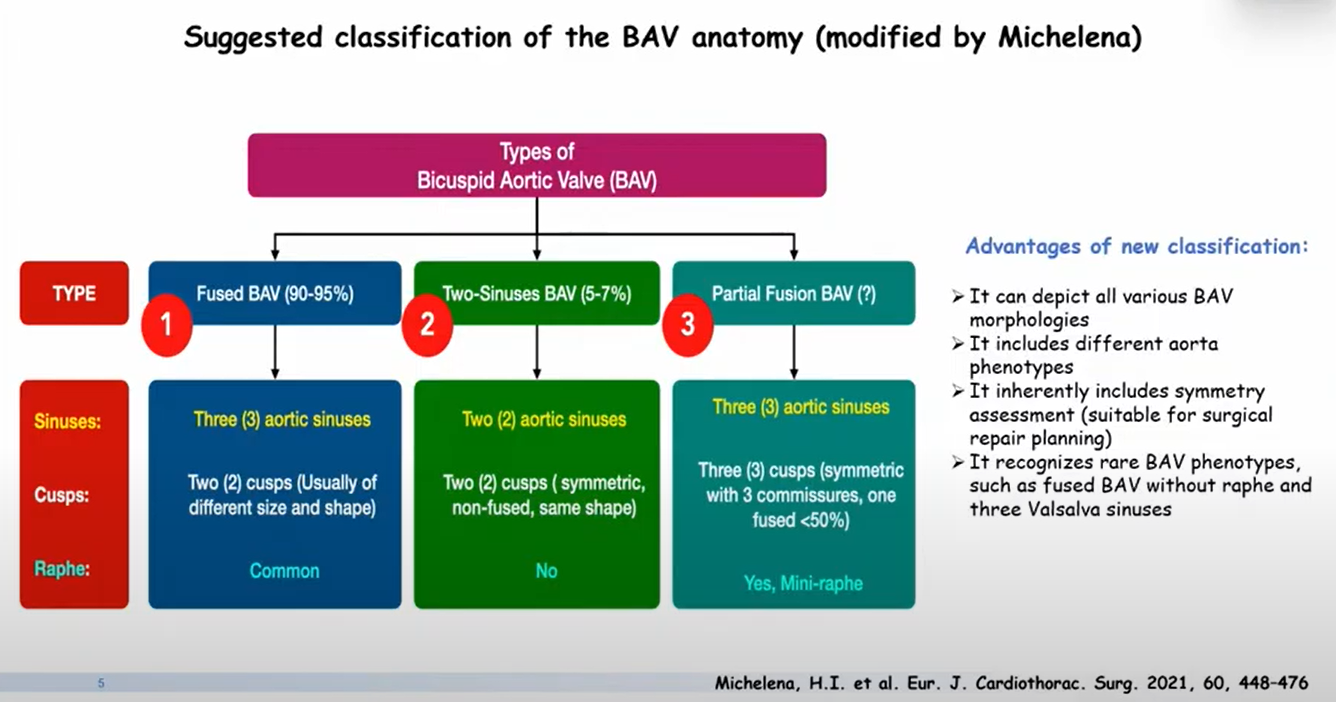
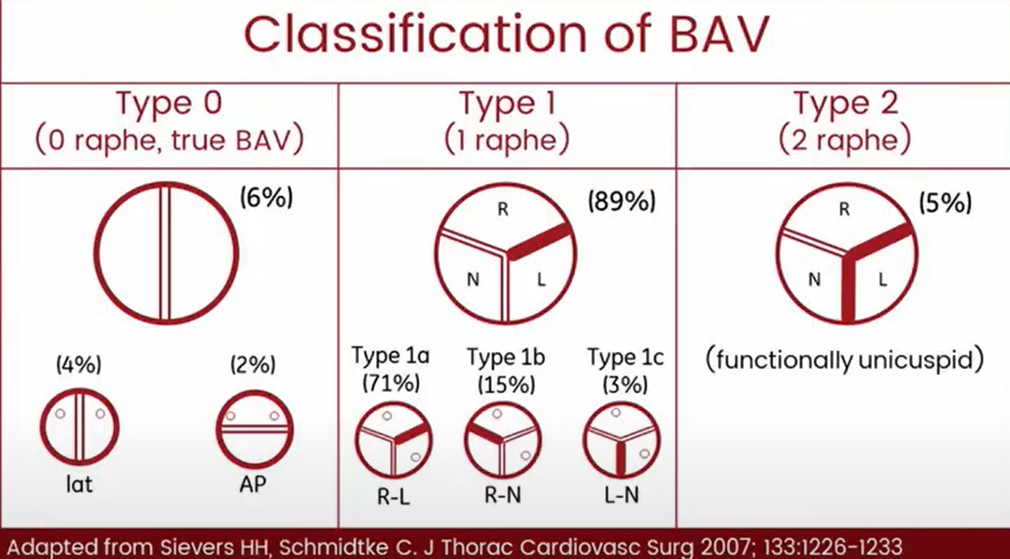
The two famous classification of Aortic leaflet 1.Siever 2.Micahlena
Why is the number of cusps important ?

It decides the type of TAVI valves and location of implant.

Fortunately, we have a consensus nomenclature system for Aortic valve leaflets

  1. BCAV types are defined as fused BCAV,
  2. Two-sinus BCAV,
  3. Partial-fusion (or forme fruste) BCAV.

The fused BCAV type is the most common type (90-95% of BAV cases); and is characterized by two of three cusps appearing fused within three distinguishable sinuses of Valsalva; frequently but not always with a congenital fibrous ridge (raphe) between the fused cusps.

  • Right-left fusion is most common (70-80%). The right-left phenotype also is most common across all variations of aortic valve dysfunction (AS or AR) and aortic phenotypes (normal aorta, dilated root, dilated ascending aorta, dilated arch).
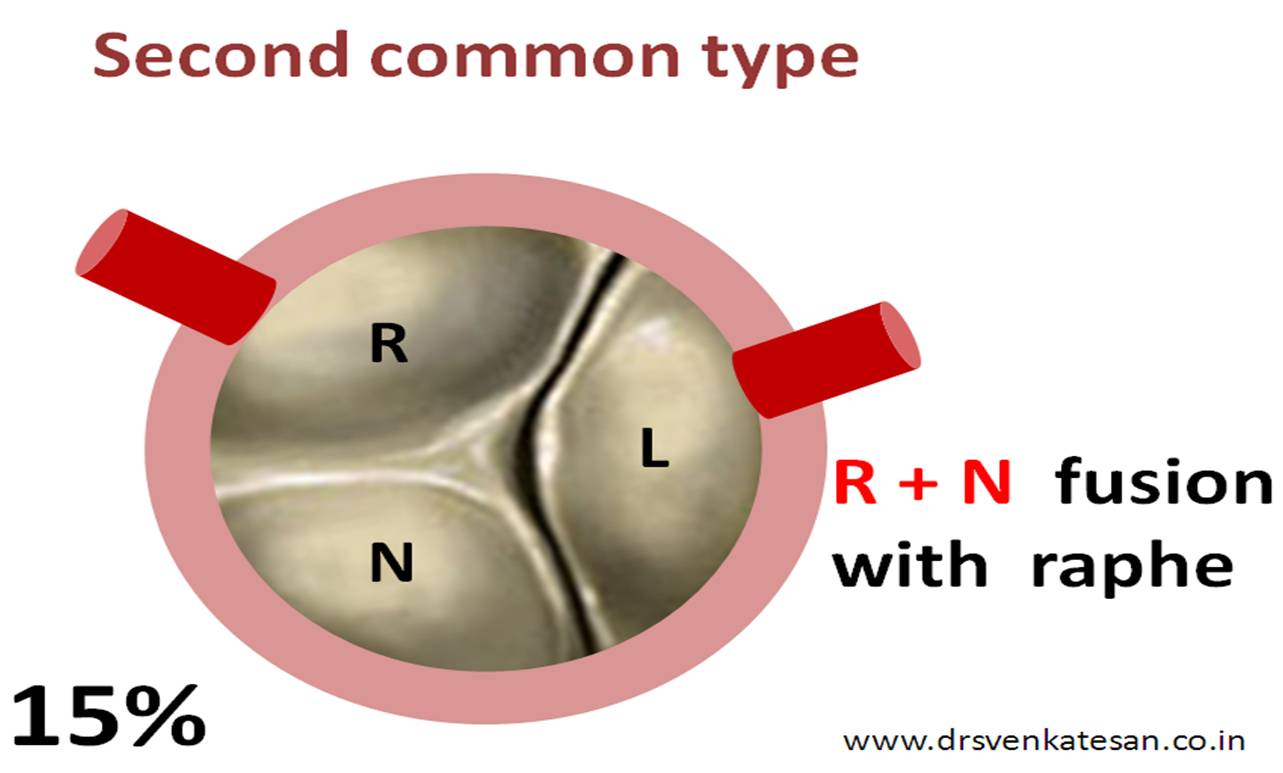
  • Right-nonfusion is second most common (20-30%), and in adults is associated with a higher prevalence of AS and of progressive AR.
  • Left-non fusion is least common (3-5%).

The two-sinus BCAV type is uncommon (5% of BAV cases), with two cusps of roughly equal size within two sinuses of Valsalva.

  • Laterolateral (side-to-side) two-sinus BAV has one coronary artery arising from each sinus.
  • Anteroposterior (front and back) two-sinus BAV can have one coronary artery arising from each sinus or both coronaries arising from the anterior sinus.

The partial-fusion BCAV forme fruste) type is more recently recognized and of unknown prevalence. The appearance is similar to a typical tricuspid aortic valve, but with <50% fusion between two cusps at the commissural base forming a mini-raphe.

Next query :

What are differences between raphe and commissure ?

Read Full Post »

Bicuspid aortic valve (BCAV) is  one of the common  congenital abnormality of heart . Incidence can be 1-2% of population . It can result in premature aortic degeneration with Aortic stenosis/Aortic regurgitation or both .

The normal development and arrangement of three cusps is altered ( rather interrupted )  during fetal life.

There can be two ways BCAV can occur. One is due to the   fusion* of two leaflets to covert a  tricuspid  valve into  bicuspid  ,  and the other is    two cusps develop de novo .The former has a raphe , while the later has no raphe.

The  fusion* occurs between  either

  • Right and left (R +L)
  • Right and  non coronary cusp  (R +N )
  • or Left and Non coronary cusp (L +N)

(* The fusion is embryological , not acquired )

Most often the  fusion is due to lack of division in the valve  analgen .Hence a raphe (A conjoint remnant) is noticed .

90% of BCAV has raphe  ,only 10 % lack raphe . Aortic root is also structurally abnormal in many .(Little clinical sequale though !)

Coronary artery origin anomalies  are more common with  BCAV. We also know co-arctation of aorta has a embryological link with BCAV.

The commonest type of BCAV is

The most hemodyanmic stressed BCAV is R +N type fortunately it is rare

R + N fusion is a high risk BCAV as degeneration occur fast

The least common type is

The coronary artery origin anomalies are common

BCAV in the absence of raphe is classified separately (This constitutes 10 % of all BCAV)

The nomenclature  is

  • Antero posterior (Common type ) AP
  • Lateral (L )

What is  the pathological significance of raphe ?

Many  believe presence of raphe accelerates degeneration as leaflets have  rough surfaces . Still , BCAV with raphe has less coronary anomalies and aortic root pathology .

Presence of raphe  indicate relatively  a minor embryological defect  , as the fault is in the failure to divide after the formation of analgen , while BCAV without raphe  imply  lack of development of analgen itself . This is expressed in the coronary sinus anatomy and aortic root dimension and orientation .

So currently it is  welcome  to spot  a raphe in the patient point of view  .Echo cardiogram is notoriously  unreliable to diagnose raphe. Once degeneration process sets  in ,  it is almost impossible to recognize  the  presence or absence of raphe .

* Please note ,tricsupid aortic valve with eccentric leaflet closure  shares  a close pathological relationship with BCAV. Premature degeneration ,  (AR more common than AS here ) .This entity will be discussed separately later.


Image courtesey

Part of the Image (The valve) is adopted from Yale university Image Bank .

Read Full Post »


Bicuspid aortic valve is  probably the commonest congenital heart disease.

  • It can be a totally benign entity and can be incidental finding in many .
  • Only a fraction progress to pathological entities like aortic stenosis , aortic root dilatation  etc .
  • Those afflicted need periodic echocardiography
  • These valves are prone for premature degeneration
  • Intervention is rarely required

Here is a complete review on the topic from the  top rated cardiology journal circulation.


Link to the article

Read Full Post »