What happens to bleeding time with antiplatlet drugs ?
- Does not have any effect
- Prolongs it marginally .(This can not be detected accurately by the conventional Ivy bleeding time)
- BT is significantly prolonged at therapeutic doses .Bleeding time is useful to monitor efficacy of these drugs.
- Prolongs only with loading dose hence it has no clinical utility .
Answer :
I have been struggling to find an answer in the literature . Response 2 seems to be correct .
Back to basics
We are taught reverently in the first clinical year at medical schools , platelets are primarily responsible for stopping the capillary bleeding . Clot formation follows later . The coagulation cascade occurs over the platelet plug with number of mediators from platelet taking part in the clotting process.
If anti-platelet drugs functionally paralyse the platelets , it must prolong the bleeding time . If that is so , why we are simply not bothered about measuring bleeding time to assess the efficacy of anti-platelet drugs ?
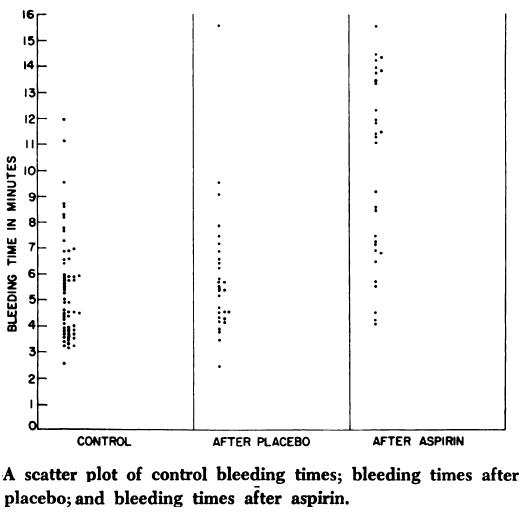
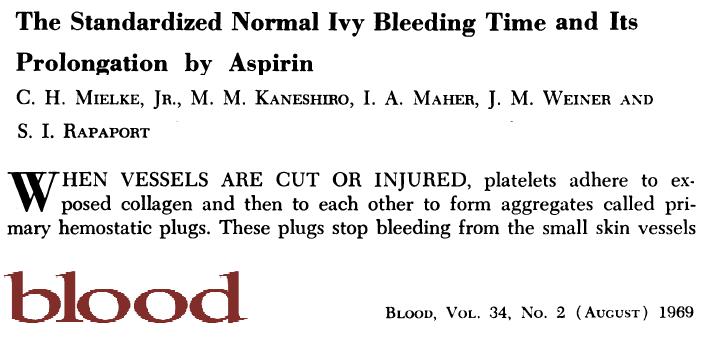
Surgeons tell us every other day about the ooze in a patients pretreated with aspirin. In fact there is very good evidence for this . Following data is taken from the journal “Blood” in 1969 .
There are few important reasons why bleeding time is not in vogue to monitor anti-platelet efficacy
- A marginal elevation ( say . . . from 6 minutes to 8 minutes ) may not convey any meaning (Is it really so ?)
- The method of bleeding time measuring is primitive one ( Ivy ) and it is time-consuming (Since the normal bleeding time can be up to 3-9 minutes ,it is too long period for the modern day cardiologist )
- A prick has to be made and the patient may feel awkward.(While he can very well tolerate the nicks in radials and femorals !)
- Simple BT costs nothing and can be readily done in bed side , while digital platelet reactivity testing adds spice ! It would be humiliating for a cardiologist (who lands to the cath lab in a Audi saloon ) to order for simple bleeding time
So what does the newer platelet assay tools do ?
Ironically , the currently available sophisticated point of care platelet function test is grossly error prone .Currently they are not recommended for routine use . So what is the big deal ? Modern physicians has no right to ridicule the age-old tests ! . In fact should try to give a new lease of life to the conventional BT .
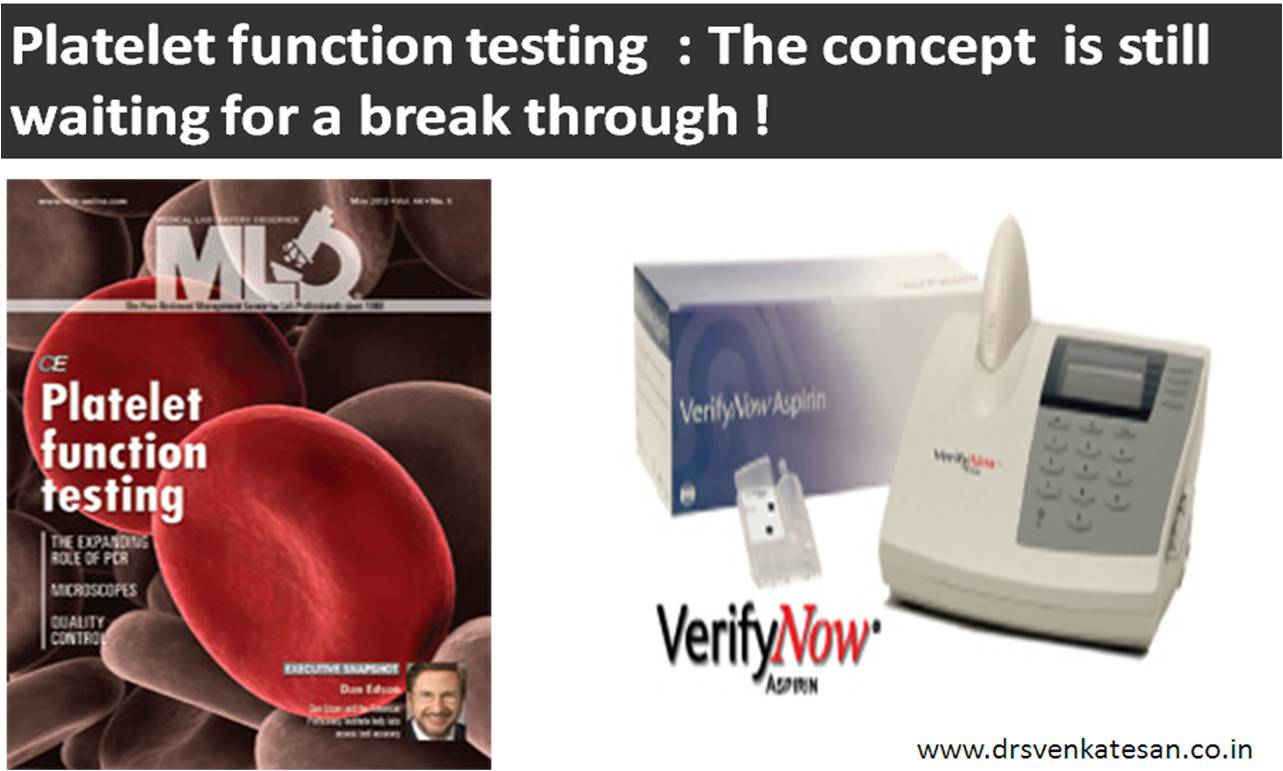
I personally feel there could be a role for conventional BT in an occasional patient after complex angioplasties . Confirming the adequacy of anti platelet drug is critical . A simple one time monitoring of bleeding time 24-48 hours after a PCI with full dose of anti-platelet drugs should help us track and monitor the efficacy these drugs . My guess is it can be kept at upper border of normal or slightly above it . If we know the basal bleeding time it will be added advantage as one can prolong it more objectively.
We plan to undertake a simple study of effect of loading dose of clopidogrel on the bleeding time . The results will be reported .
Final message.
Ignoring age-old basic medical concepts is a serious threat facing the current medical professionals . Can we afford to ignore a grossly elevated ESR in a patient with fever , since it is cheap and primitive investigation . Similarly a low bleeding time in a patient with dual anti-platelet therapy and a drug eluting stent would convey a serious message , (All is not well In terms of adequacy of platelet inhibition. ! )
Reference



 Dr.S.Venkatesan MD