PH is an important clinical cardio-pulmonary entity , which we confront day to day. Though the prevalence of PH in a community is just 1 % (25 times less than systemic hypertension) it deserves a special place as the diagnosis is more complex and outcome is often adverse.
The defining criteria , the classification, and grading of PH has always been a difficult and dynamic academic task .Right from WHO’s 1974 definition, we have 7 global symposiums , last one happened few months ago, in July 2024 in Barcelona.
We have made rapid strides in all aspects of PH right from molecular , genetic , imaging and therpeutics. Still, there is one important issue that has been overlooked for quiet some long. The concept of fitting PH in 5 groups based on etiology, though appear to simplify things, there is a significant flaw.
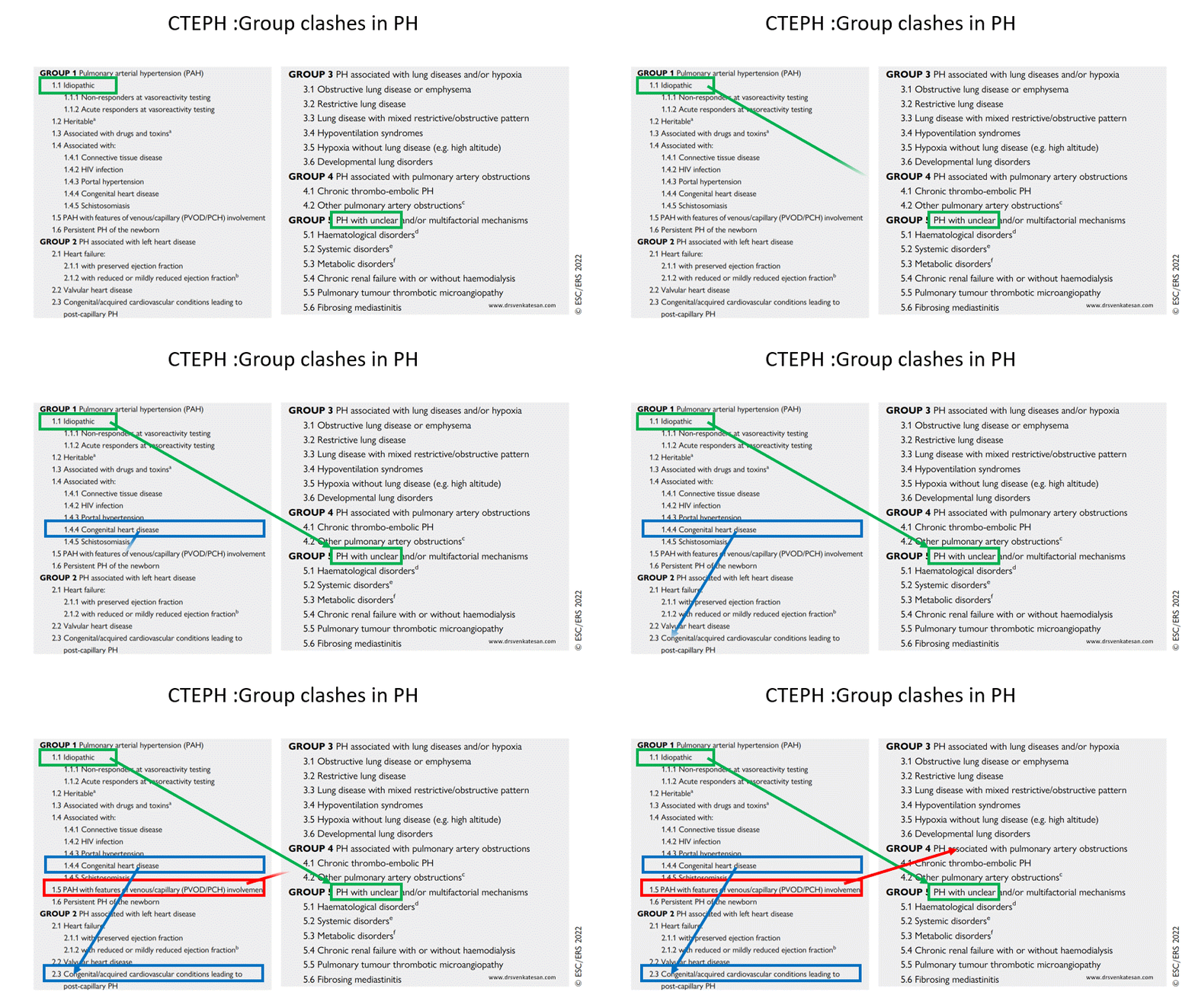
The overlaps in etiology
1.The group 1 contains the famous , (now obsolete entity of primary pulmonary hypertension) Idiopathic PH , meaning that we don’t know the cause of it or we have excluded all known causes. Meanwhile, group 5 also has set of conditions of PH of unknown or unclear etiology. So, a IPH of group one can migrate to either group 4 or group 5 or vice versa.
2.PH due to congenital heart disease can be in both Group 1 and 3
3.If you take PH due to some of the connective tissue order, I am sure, it can fall into any of the 5 groups
Suggestions for the next PH working group
It is desirable that the next working group should acknowledge existence of inter and intra group overlaps of PH in a more clear manner. Either we should take away the groupism or the current definition of group 5 need to be more elaborate . It says multi-factorial. Instead we can try to find what are the groups it is likely to have an overlap. Should we need another a sixth group ? GO-PH (Group overlapping PH)
There can also be a place for combined etiological-hemodyanmic classification . (Example : Group 1 .Pre capillary .Group 1 Intra-capillary as in PVOD) . CTEPH though essentially is a precap PH, the risk factors of CTEPH and HFpEF can be shared one, making it combined pre and post cap PH a distinct possibility. )
Final message
While the problem of groupism in PH exists, the issue of highest importance in PH is something different. This is more philosophical . We need to be very clear what we mean by Idiopathic. As physicians, we must realize how relative this terminology is . What is idiopathic in your hospital, (However big you are) may turn out to be a missed case of mixed connective tissue disorder or silent CTEPH detected only by V/Q scan or a dual energy CT or a rare case of PVOD by judiciously reading a pulmonary angiogram in a dedicated PH center.
*Also we must recall, statistically up to 80% of PH is due to left heart (This HFpEF stuff has jacked this incidence still more ) and lung disease. Our efforts and resources should be used judiciously for optimal diagnosis and management of common conditions first.
The contents of the this blog is being published as Kindle E book , as per the request of many of the readers. Every article will continue to be open source in this site. Again I shall reiterate the book format is not aimed at any commercial intent. It is only to facilitate learning in a single book format Here is the link to book https://amzn.in/d/euhL5vu
Click below to see who is watching this website live !
This site will never aim for profit. Still ,this donation link is added at the request of few visitors who wanted to contribute and of-course that will help make it sustainable .
Please Note
The author acknowledges all the queries posted by the readers and wishes to answer them .Due to logistic reasons only few could be responded. Inconvenience caused is regretted.





 Dr.S.Venkatesan MD
