Feeds:
Posts
Comments

Archive for May 29th, 2011

We presume  ECG  fails miserably against echocardiography for assessing hemodynamics , while  echocardiogram  has  little value  when it comes to studying   electrophysiology .  Ironically ,  we often  ignore  the fact  ,   ECG can  provide  important long-term   hemodynamic  data . The pattern of  chamber enlargement  give us  vital clues to the prevailing hemodynamic  stress and loading conditions. While echo  can be termed as an  anatomical and  physiologic   modality  , ECG  apart from  its unique capacity to record cardiac  electrical finger prints ,  it  provides  useful ,  anatomical ,  hemodynamic information too !

While Doppler is a  fascinating modality to measure hemodynamic data in a moment to moment fashion it can never ever tell us  , what has been going around in the preceding months or years. This  is were chamber size helps which  give us chronic physiological information (Chronic  Doppler ?)

A simple E:A reversal  in  mitral inflow doppler can be a  innocuous  finding in isolation  . If it is associated with even   minimal grades of  LAE  it gains huge importance. That is why left atrial size is  funnily referred to as HB A1C of diastolic dysfunction ( A marker of chronicity  of  diastolic dysfunction)

If LAE is so important to diagnose diastolic dysfunction , why  we are so  obsessed  with doppler filling profiles  of mitral valve ,pulmonary veins, mitral annular tissue Doppler and what not ! .Many of these sophisticated doppler methods are extremely operator dependent  and are  subjected  to technical and mathematical errors. Especially , with  tissue doppler where we  magnify the errors as we  filter  extremely  slow tissue motion .

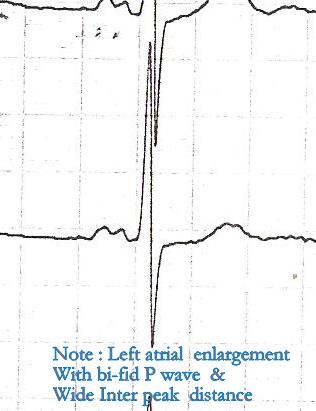
For  many  decades  we  have failed  to impress ourselves  , about the importance of subtle P wave abnormalities in the  ECGs   of  hypertensive patients.

In fact those  innocuous looking  slurs and notches   in P waves ,  suggest the left atrial  stress and a definite marker of underlying LV diastolic dysfunction .

P wave is the only electrical wave that occur in diastole .Hence there is no surprise  ,i  gives us enormous information about this phase of cardiac cycle .

If only we look  at them carefully, zoom it (Now it is made easy with so many softwares)  analyse critically we can find a wealth of information about the atrial behavior in hypertension.
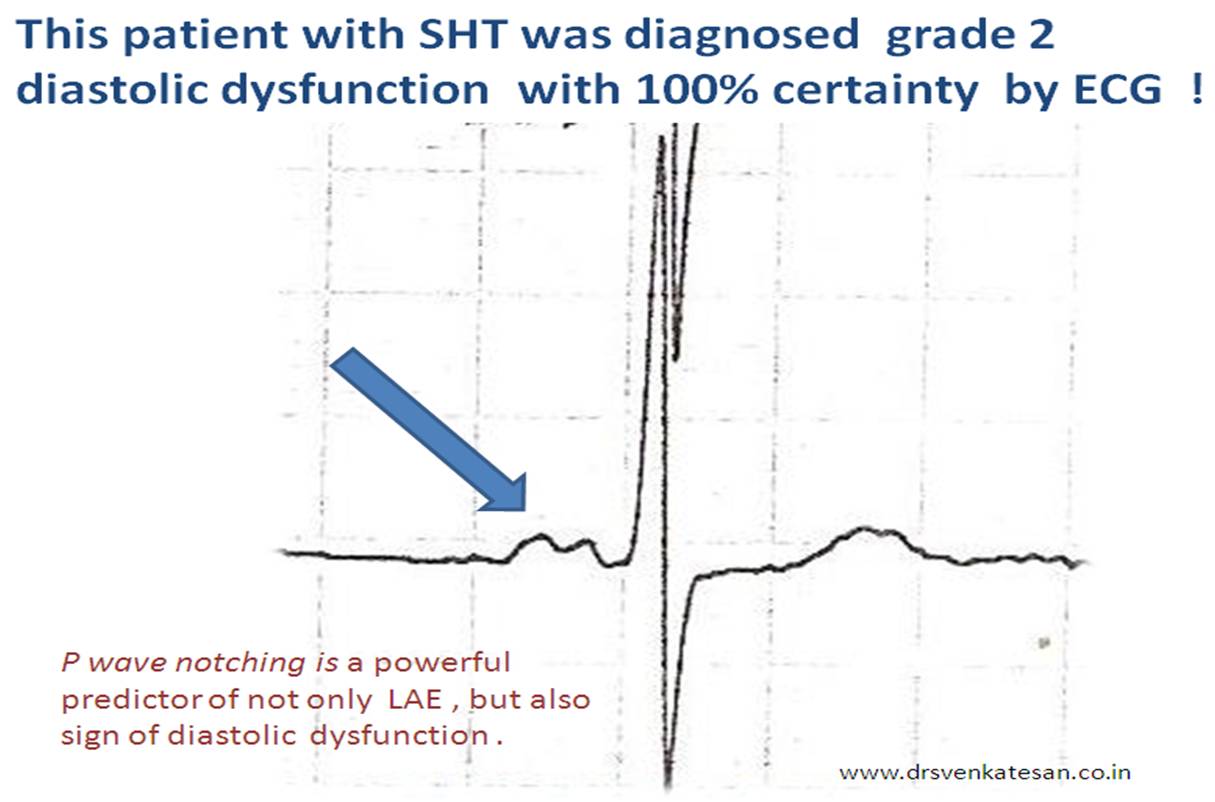
Experience from our hypertension clinic  with periodic echocardiograms suggest ,  the following  ECG  findings   can be   good markers  of significant  diastolic dysfunction .

  1. Notched P wave
  2. Wide  P waves
  3. Slurred  P wave
  4. Bi-phasic P waves

* Surprisingly  , these abnormalities correlated with at least grade 1 diastolic dysfunction even in the absence of  for LAE or LVH by echocardiogram.

** In an  occasional patient  P waves  can widen due to inter atrial block or conduction delay. This a rare exception for wide P waves without LAE.

Final message

A well recorded and   analysed   ECG can  predict diastolic dysfunction  with fair  degree of accuracy .This fact need to be emphasized  by every one  .  Next to ECG ,  LA size and volume  by 2d echo are excellent parameters  to assess diastolic function in a long term fashion. Sophisticated  but  error prone ,  momentary doppler parameters are getting too much attention  at the cost of simple ,  shrewd ECG and 2D echo  !

Read Full Post »

LVH can be diagnosed with fair degree of  accuracy  by surface ECG . We have a set criteria .The Estes  scoring is  the most popular. Very rarely we have all  the classical features of LVH in a given ECG .

With the advent of echocardiography ECG diagnosis of LVH has become redundant . Still , it is essential to  build the  foundations  in cardiology  for the current generation cardiologists.

The following are the  magnified views from the above   ECG

High Voltage

High voltage QRS is a hall mark of LVH .It increases in both chest  and  limb leads .In chest leads , both R and S wave gets amplified , while in limb leads only the R wave  is taller . We have to sum up R  from lead  V 5 and S from V2  (Practically any deep S and tall R can be added . LVH is diagnosed  if  sum qrs voltage  is  >35 mm . Voltage criterias in limb leads do not require these  addition business . An  R wave amplitude > 11mm  in limb leads by itself  would indicate an LVH (In the absence of bundle blocks )

Pit falls in voltage  criteria

It is our belief    qRS voltage  would faithfully   reflect the   quantum of cardiac muscle mass ,  but in general  to equate qRS voltage  to myocardial  mass  is   a  huge error we make ! (Of course  It  may be true in  some cases  following MI )  .

The qRS  voltage is determined by   numerous  factors (Important ones are :  chest wall thickness , age , LV cavity size ,  amount of blood inside LV cavity,  heart rate , conduction delays  etc ) This is the reason a 10-year-old boy’s   ECG will  satisfy the criteria of LVH  by 100 % .Do not ever report a ECG without knowing the age of the patient .

At high heart rates R wave amplitude increases(Broddy effect) due to high conductance of blood

Chest lead always balances RV and LV forces .One can mask the other .So be ready for surprises when you find a perfectly normal ECH in bi-ventricular  hypertrophies ) A balancing act !

Mini summary : Never diagnose LVH with high voltage alone

Left axis deviation

The axis deviation is again non specific  . The LV mass shifts the mean axis to left (Beyond -15 degrees) .The axis shift would also be contributed by mild forms of LAFB . This  fascicle  which criss crosses the LVOT  easily gets injured to hemodynamic stress ( or rather insulted ) and  lose its function . So its job is  transferred to  the posterior fascicle  which  shoots  towards  anterior and superior and left , hence the  left axis deviation) .The LAFB is generally a benign defect unless it occurs in an acute fashion as a response to ischemia.

Mini summary : Never diagnose LVH on the basis of left axis alone

Left Atrial  abnormality

This need not be present in every one with LVH . It happens only  if  LVH  is associated with relaxation defect , when   it calls for  LA’s  assistance .(In other words , presence  of LAE in hypertensive  patients is  a  sure and simple way to confirm diastolic dysfunction ) . Similarly absence of  LAE (  with a   significant LVH )  is a good sign as the LV is able to tackle the hypertensive stress in solo fashion in all likely hood free from significant diastolic dysfunction.

Apart from LAE , note also the p wave encroaches good part of PR interval .

Mini summary : LAE can be very useful parameter to diagnose LVH . (Is it not ironical  to note   LAE is more reliable to diagnose LVH ! . This is because qrs morphology is unreliable as it influenced by many factors  while p wave  changes are  not subjected to such influence )

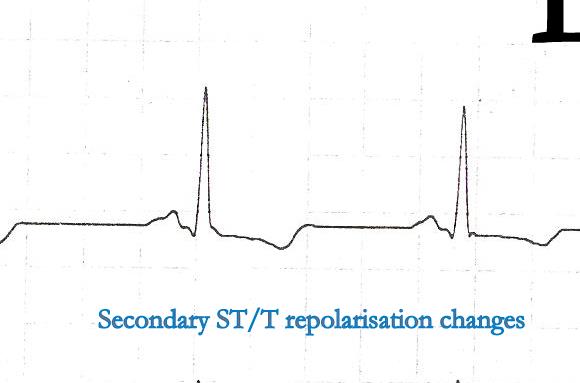
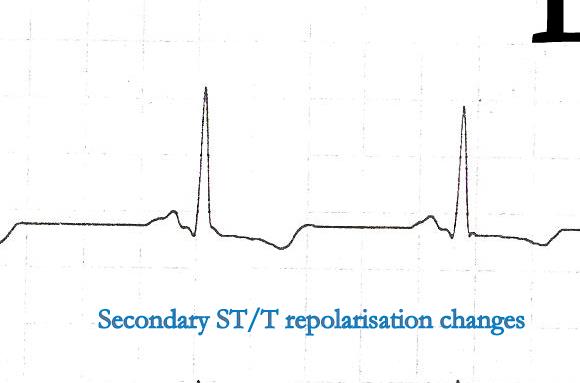
Secondary repolarization changes

We know ventricular depolarization and repolarization are interlinked phenomenon .Both  occur in  opposite directions still  , able to  record   ECG deflection  in same direction  (positive QRS/positive T)  . This is due to the fact  the epicardium and endocardium has  action potential with different velocities . At times of   LVH this epicardial  , endocardial heterogeneity in repolarization becomes void. (Note : This is a simplified statement of a complex repolarization process)

Because of this the repolarization is recorded opposite to that of depolarization .Hence we get all sorts of secondary ST /T changes. (The  term secondary is used to denote secondary to alteration  in depolarisation ).

Many times  all of the following  could   mean the same  in the bed side clinical parlance !

  • Secondary ST/T changes
  • Non specific ST/T ,
  • LV strain
  • LV systolic over load etc .

Note : Primary ST depression occurs in true ischemia without any alteration in LV Mass or conduction defect.

*** For advanced readers  only : Some of the ST depression that occur in ischemia could again be secondary changes. This  needs further reading.

Definitions

Echo is the gold standard for diagnosing LVH .There are two definitions .

  1. Based on septal thickness
  2. Based on LV mass*

LV mass > 200mg in men and 175mg in women is considered LVH . LVH based on LV mass is  ideal . But can be misleading in a dilated heart where the mass may be increased with a  relatively   thinned  out IVS .

Final message

There are numerous  ways to miss    LVH in ECG,  But the definite way  for not missing  is by echocardiogram !


Read Full Post »