Often general practitioners refer ECGs with abnormal resting ST/T wave patterns to cardiologists .
Following are few of them
- ST elevation
- ST depression
- T wave inversion
- Tall T waves
- A relatively uncommon finding is a flat ST segment , which is discussed here.
The commonest( benign) abnormality is T wave inversion in women and tall ST /T waves reflecting early repolarisation pattern in men. A flat ST segment is an occasional finding in general population.
ST segment is inscribed during the most important time of cardiac cycle.This is the period the ventricle is doing its prime function , namely ejecting the blood in systole .Hence it is subjected to maximum stress . During times of ischemia ST segment gets elevated or depressed depending upon the severity of ischemia. For the same reason , even subtle changes in this segment is frowned upon by cardiologists. Most of them would receive a EST.
It is ironical to note , few normal people show almost silent electrical activity during this crucial phase of their ECG .ST segment is often a flat line in them . This is a ECG of a women referred as CAD. She was asymptomatic . Echocardiogram was normal . She was asked to do a EST.
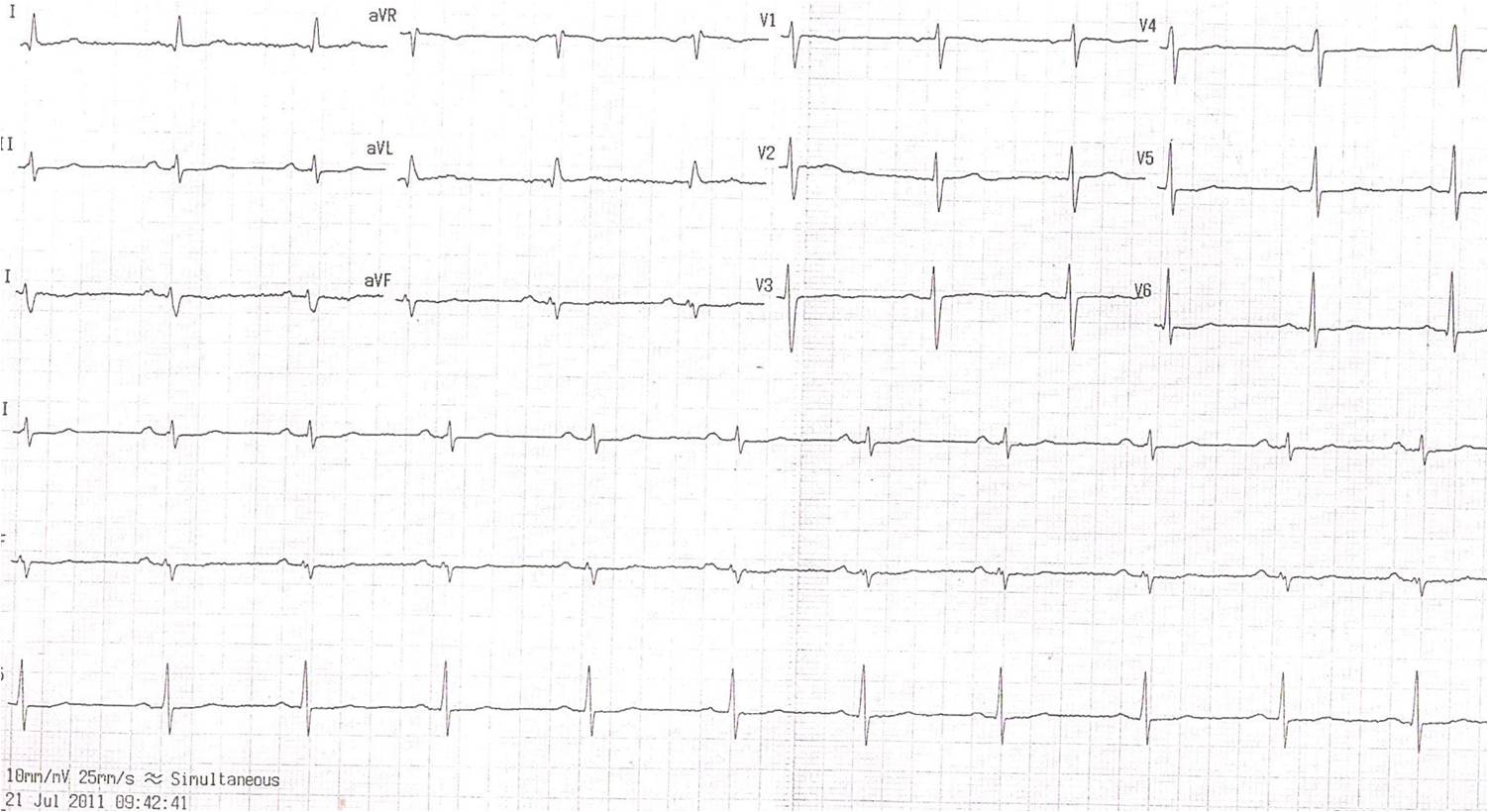
This asymptomatic women was refered for ECG opinion
The peculiar thing about T waves are , a 10 mm upright as well as 5 mm inverted T wave , both can be normal. So . there is no element of surprise to note absent T waves or a flat T wave to be called as normal .

The curious case of lost ST segment !
* T waves are recorded when K+ efflux occur rapidly out of cells . Hypokalemia can be an important cause of flat T waves.
It is still a mystery to me why some people inscribe a tall T when potassium comes out of cell and an equal number (Esp women) record a down ward T wave for the same event ! I wish I get an answer to this lingering question from any of the readers !
Is a flat T wave represent a T wave in transition to become inverted T wave later ?
Possible .But we are not sure ! A static T wave is safer than a dynamic T wave .
Final message
Flat ST segment and absent T waves represent a same spectrum of ECG findings which are referred to as non specific ST segment changes in clinical practice .Generally , they have little clinical significance.* In our experience we have found , female patients, Anemia hypothyroidism are often associated with flat ST segments . If CAD is suspected exercise stress test should be done. Some believe a flat ST segment is more likely to result in EST positivity (Not necessarily true positive !)
* Non specific ST/T changes by itself is a huge topic. Ideally the term non specific ST /T changes should be avoided , as it primarily came into vogue to denote non ischemic ST segment (Still , other pathologies are very much possible) It is estimated there are about 50 causes for non specific ST/T changes , right from a benign situation like deep respirations , to significant myocardial disorders. However , it still makes good clinical sense for a general practitioner , to refer to a cardiologist , whenever ST segment deviates without any reason .



 Dr.S.Venkatesan MD
Thanks a ton for being the teacher on this area. I enjoyed the article quite definitely and most of all enjoyed reading how you really handled the issues I considered to be controversial. You happen to be always quite kind towards readers much like me and assist me to in my everyday living. Thank you.
Thanks for your well written article on this topic. I am a cardiology fellow and sincerely enjoyed it! I totally agree with you about flat t waves and flat st segments; they are more often than not benign but we can’t just overlook them. In the case of patients that are high risk for coronary artery disease an excersize stress test is definately the next best step. Thanks again for your really useful post.
Thankyou for your comments.
Hi. Thanks for this informative article. I’m a paredic, have been for 21 years, and love cardiology. Today we were trying to figure out how to send a record of a patients ekg over to the hospital via fax on our Zoll X series and decided to do a training on it. 12 lead was required in order for the function button to appear. So I was the humble victim of choice for the experiment. To my surprise….. I have flat T waves. I could argue I have 0.5 to 1 block of depression in all inferior leads, however nearly completely flat in V1, V2, V3 and slight hump of a total of 1 block of elevation of the T wave in V4, V5, V6.
So you can imagine I’m a nervous wreck. I was thinking hypokalemia but I’m a healthy, active medic and mountain climber. I live at around 2000′ of elevation and am in good shape. I do have hashimotos, however taking ashwaganda and eliminating gluten, dairy, and alcohol from my diet has allowed my TSH (6.78, down from over 18 last year), T3, T4 to remain in control and only my antithyroid microsomal TPO antibodies are significantly elevated at 1070.3 (range <60) . I also had an elevated absolute immature granulocytes at 0.46 (range 0.0-0.1).
I notice in your writing you included hypothyroid. I know the risk of not taking credit of the thyroid could result in cardiac changes however I thought with the natural lowering of my TSH that I was in an OK place. Now I'm starting to wonder.
One additional point to consider, in 2008 I developed a pericardial effusion after an international trip to Uganda. I spent a few months working in the Bush and believe I contracted some type of parasitic infection. I never required any medical intervention and 6 weeks off work resting seemed to do the trick. The only other significant finding is that I occasionally have palpitations. I have always attributed this to my thyroid, for which I am not medicated (other than the ashwaganda). In 2006 I had a horrible reaction to yellow fever, typhoid, and live attenuated polio vaccines given all at once. I developed Gullian Barre but recovered after 6 weeks of intense chelation therapy.
I would love to send you a copy of my 12 lead for your opinion or to use it as a case study. I'll also schedule an appointment with a cardiologist in the Phoenix area asap for a full work-up.
Thanks for your article. It's very interesting and the first one I came across that actually gave insight to this oddly flat T wave.
Hi Thanks for your comments.Please send your ECG.
Dr Venkatesan
Sent via email! Thank you
Not received your ecg.send it to drvenkatesans@yahoo.co.in.