Feeds:
Posts
Comments

Archive for January, 2012

A middle-aged man was rushed to cath lab with  extensive antero- lateral STEMI   . Primary angioplasty  was planned.The coronary angiogram  showed a critical LAD and a  total LCX lesion just beyond the bifurcation . Both lesions looked irregular and hazy . RCA had insignificant lesions . Patient was  stable hemo-dynamicaly .

The moment  we  saw the angiogram,   we knew ,  we had a real problem on hand !  . First of all ,  It looked a complex lesion for  a pPCI .(A brief  thought about an emergency CABG  creeped in,  but was dropped  with   enthusiastic residents voted unequivocally in favor of  PCI . Of course , to be frank  we didn’t have a  CABG team ready either ! )

So the plan  was : To open the IRA  . . .  &   forget the non IRA (  for the time being )  which  is the current management mantra as on 2012 !

Trouble from unusual  quarters !  By the way   . . . which is the IRA  ?

Even as the consultant  was  initiating  the rituals with wires and balloons  to tackle the LCX , some one behind the consultant  mumbled  “why can’t the LAD be  the IRA ”  After all  , it  also has  a critical lesion  and  mind you  we are dealing a case of   anterior MI  !) . That mumble  was  loud enough to create buzz of confusion in cath lab .

Now everyone quipped  , ” IRA is  what ?

Is that  the critical mid LAD lesion ?

(or ) Is it the total LCX   (or ) Both ?

Logic would suggest in the setting of STEMI   any  total occlusion should be considered as IRA  . Of course  , one can not be dogmatic about it.  When a patient is having   anterolateal MI  both LAD  and  LCX can contribute to the MI .

What about  proposing a new  concept  of  “Double IRA” ?

When  multiple  plaques  are  activated suddenly in unstable angina ,  it is  possible  for multiple IRAs  to occur  in STEMI as well . But this issue is rarely discussed in literature .

Other  possibilities

The 100 %  lesion  in LCX  could  still be the primary culprit  and  a  thrombus migration into LAD   might have  resulted  in  infarct  extension into anterior wall .

Further ,  confounding may occur if a patient with chronic total occlusion  develop a  SEMI  . It  makes it really difficult to identify the  IRA.

When  the supposedly gold standard coronary angiogram   fails to identify the IRA ,  what shall  we do ?

Go to the basics . The good old ECG might help .

(Please beware in a patient  with pre- existing  multi-vesel CAD  , none of  the ECG algorithms work  to localise  IRA !(Especially   the famous Wellen’s miserably fails ! )

Still unclear ?  Look for the wall  motion defects  in echo . An echo cardiogram (Need to be meticulous )   will help match the  dysfunctional segment with IRA.

Wall  motion defects are notoriously  error prone in ACS  for  two reasons.

  • We do not have easy and accurate  methods to differentiate ischemic wall motion defect from infarct related wall motion defects.
  • Tethering artifacts  ,  differential behavior  epicardial  vs endocardial ischema on contractility   will confound  the issue .

So what is left ?

One  need to  go back  to the CAG again  . Have  a critical  look  at the lesion once more. Look for thrombus or eccentric /unstable lesions . If  present it is  going  to be the IRA in 90 % of times. Let it be a  wild guess in the remaining 10 % .

There is also a  practical solution . Poke the lesions  with your favorite  guidewire ! . The one that  gives way easily  is likely to be the  IRA !

Finally,  if the confusion still prevails ,

Stent both the  lesions. That’s what , was  done to this patient . Many would have thought ,  this should  have been the default approach instead of scratching  our heads to identify the IRA ,  wasting crucial minutes !

Final message  : 

Current  guidelines do not recommend  pPCI for non -IRA   at the same sitting  of  IRA pPCI . However the issue  of  IRA  “too close to call is  rarely addressed.I do not know  how commonly  this issue is encountered  in angiographic  core labs that deal  huge loads  of pPCI world wide .

Our  early  experience  suggest  the problem is   real ,  unique and  definitely not rare  .

What is your take ?  We argue guidelines committee   to  specifically  address  the issue of  uncertain IRA as a  branch point in the pPCI decision making  tree !
Read Full Post »

It is tempting to fix the  “Force of cardiac  contractility” ,  to be the  prime determinant  of  systolic  blood pressure* .  Rather ,  it is  influenzed heavily  by   multitude of anatomical  and  physiological factors.

                                        ”  In most  life instances  the primary determinant  blood pressure  is not the state of cardiac contractility  “

                 For many ,  this  would  appear as  shocker of  a statement !

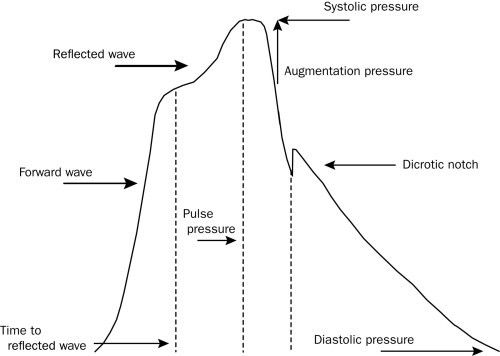
Fellows  should not be  confused with above inference  . What it means is ,  the  heart initiates  the blood pressure by a brief  period of  systole .The pulse wave attains a peak during ejection phase  . This is the peak systolic blood pressure  . There is nothing called  sustained  systolic  blood pressure .  The quantum and  duration of peak systolic pressure  contributed by the LV contraction  is  far less than we imagine .

If blood pressure is to be controlled   primarily  by  cardiac contractility , how is that ,  a  blood  pressure of   about 80mmhg is maintained throughout diastole when the heart is taking rest and the  aortic  valves  are closed  ?

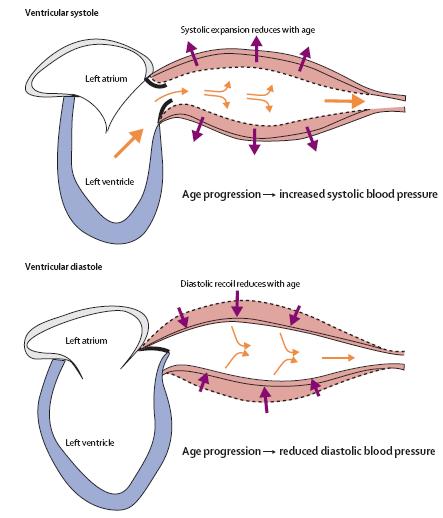
The  major elastic blood vessels  aorta and the major branches use the potential  energy gained during systole  (Like a rubber band )  into   kinetic energy as vessels recoil during diastole . This recoil  imparts an   important component  to the  diastolic blood pressure  augmentation  and maintenance.

It is  prudent to note  since  diastole is  much  longer than systole  , integrity of the vascular tree  become  much more important  to maintain the blood  pressure  till the next systole arrives.

Note

*The cardiac contractility  , might  still be  important  in determining systolic BP  in  patients  with  severely compromised  LV function** For example ,  in  dilated cardiomyopathy  with  LV failure ,  systolic blood pressure will  be directly related to LV  function.  When LV function is critically  low , the elastic  blood vessels  fail  to  amplify the blood pressure  beyond  a limit.

**Still it is not  uncommon to find high systolic blood pressure  recorded in the back ground of with severe LV dysfunction especially hypertensive individuals.

What happens during aging ?

The  aorta and it’s major branches  gets thickened , the  vascular collagen  goes  cracking  with wear and tear of  life.  In effect , these vessels become less compliant . So , when blood is rapidly ejected  from the  left ventricle  into aorta  and their branches  it’s  distensibility   is  reduced  .This  fails to dampen the  pressure  wave  and  hence systolic  pressure spiking occurs. This we refer to systolic hypertension of elderly.

It is  important to  emphasise   major elastic arteries  has a big  say in fixing the systolic pressure. For the same cardiac output systolic pressure can surge in elderly this  is why we have kept the normal  in adults as 16o mmhg.

Another key point to be understood  is  ,  Aortic compliance  has an impact on diastole blood  pressure too ! . The  stiff vessels during diastole bring  less diastolic recoil. Diastolic recoil of large elastic arteries  determines the diastolic pressure . Hence there  could be  a mild fall in diastolic pressure with physiological aging when recoil is attenuated .  Since the  reduced diastolic  recoil ensures diastolic pressure from being elevated  the entity is aptly named as isolated systolic hypertension.(ISH)

Image courtesey :Norman M Kaplan, Lionel H Opie Lancet 2006; 367: 168–76

Final message

While the traditional  teaching  ramains  as  systolic blood  pressure  would be determined by cardiac contractility  / cardiac out put , while the   diastolic pressure is determined by peripheral  vascular  resistance .This is not an absolute reality ,  rather it is  too simplistic way of teaching circulatory physiology !

The  peak systolic blood  pressure is more often determined by the integrity of  Aortic  and major arteries   rather than cardiac contractility  and stroke volume. Similarly , aortic properties do have a  say in the diastolic pressure as well !

Further reading and debate

 The net effect of aging  on blood pressure :  Is it  physiological or pathological  ?

  Should we  treat  this  raised  pressure due to aging  related systolic hypertension  ?

There is a huge controversy going around ,  regarding the need  of  treating this mild elevation of systolic  blood pressure due to arterial stiffening .This will be addressed separately in this forum .

Reference

http://www.mayoclinicproceedings.com/content/85/5/460.full.pdf+html

Read Full Post »

Medical science has grown ( and growing )  in an  astonishing pace. Many of the  inventions  which were  considered as  major break throughs   have fallen on the wayside over the years . Of course ,  quite a few  withstood the test of time .

One of  the great inventions  of last century  is per-cutaneous interventions  inside the human coronary artery .

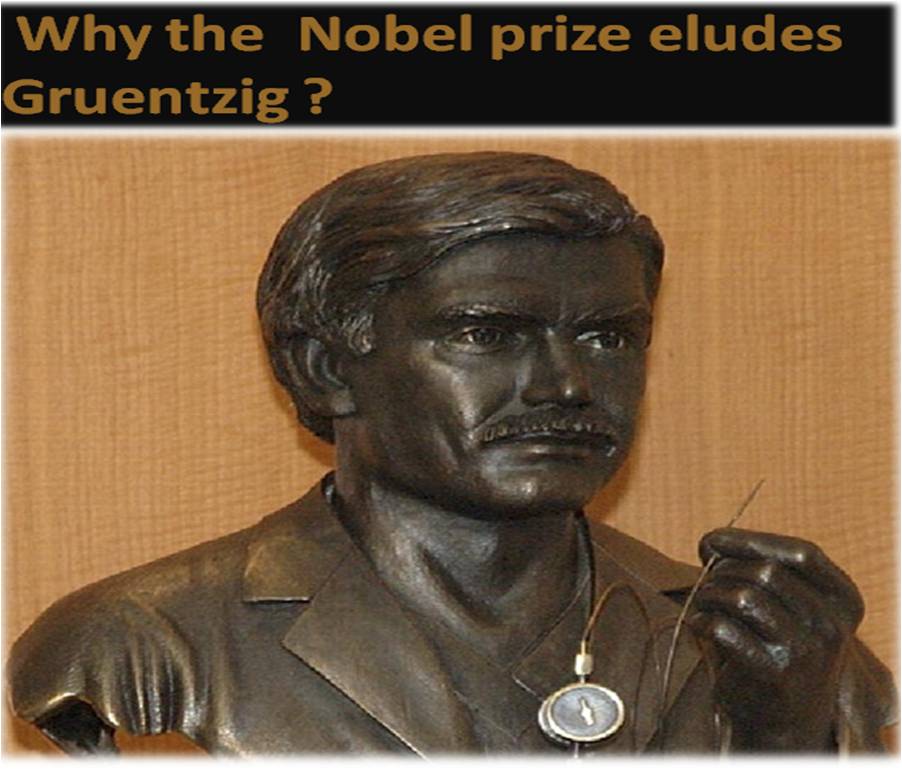
The concept was first conceived and executed by Andreas  Gruentzig  of  Germany in year 1977.  Now , at-least a  million PCIs  are done every year to tackle  CAD  with greatly  improved knowledge base, evidence ,  hardware,  techniques and expertise .

PTCA  is  an  invention worth a Nobel prize . . .well , that’s what we cardiologists feel. The Nobel committee  seems to think otherwise .

What could  be the reasons ?

  1. PTCA is  simply an extension of an old invention. Already the  inventors  of the  cadiac catheterization were  conferred with  Nobel prize (Forssman, Cournand,Richards)  . Hence , it is a sort of duplication of  invention . If Gruentzig is conferred a Nobel prize  the man who discovered the  coronary  stent (A plaque scaffolding device)  will  argue he too deserve  a  Nobel !
  2. What Gruentzig  did  was  in-fact a fundamental  human  response  by Instinct !  .When you encounter  a mechanical obstruction on the road   just try to overcome it . “Here is an obstruction impeding the blood flow , let  me  remove it”  . He did this  with  a wire and balloon . There is not much intellectual  innovation . It was  delivery of a mechanical force through a wire  .   But what the  Nobel  committee should take it to account is , he did this  in live human beating heart  and  cured of his illness most dramatically avoiding a need for surgery.
  3. Finally  comes the vital question. What is the impact of this invention in the health of mankind. ? How  many lives have been  saved when compared to other modalities to treat the   coronary artery disease ? *.This again is not convincingly answered  especially in    stable angina  , for which Geuentzig  originally developed this modality  . One popular argument  is , in terms of life saved and sufferings  relived oral rehydration  fluid  or penicillin  would beat PTCA most convincingly !

* Another possible reason is ,  the  Nobel medical committee is probably well aware of the  perennial  controversy  about  role of  Medicine vs Surgery vs PCI on the outcome   CAD  and  the  superiority of one over the other !

Final message

Whatever  be the reasoning  ,  Nobel committee has to  rethink .  Cardiologists  all over the world   would definitely  agree  if one man who have  made a  huge difference in their patient’s  life ,  it must be  Gruentzig  .

It is well-known  Nobel prize  is given  for path breaking  research that  break  new grounds like  decoding  cosmic mysteries ,  expansion of universe  , cell signalling ,  molecular mimicry  and the  stuff  like that .

Still ,  Gruentzig  definitely  deserves  a Nobel  solely  for  the novelty  in his  procedure  and in the process it helped  avoid  surgery in vast majority of heart patients.

Reference

http://www.nobelprizemedicine.org/

http://circ.ahajournals.org/content/93/9/1621.full

http://www.nobelprize.org/

Video

http://www.angioplasty.org/video/aghero.ram

http://www.angioplasty.org/video/agcomplex.ram

Read Full Post »

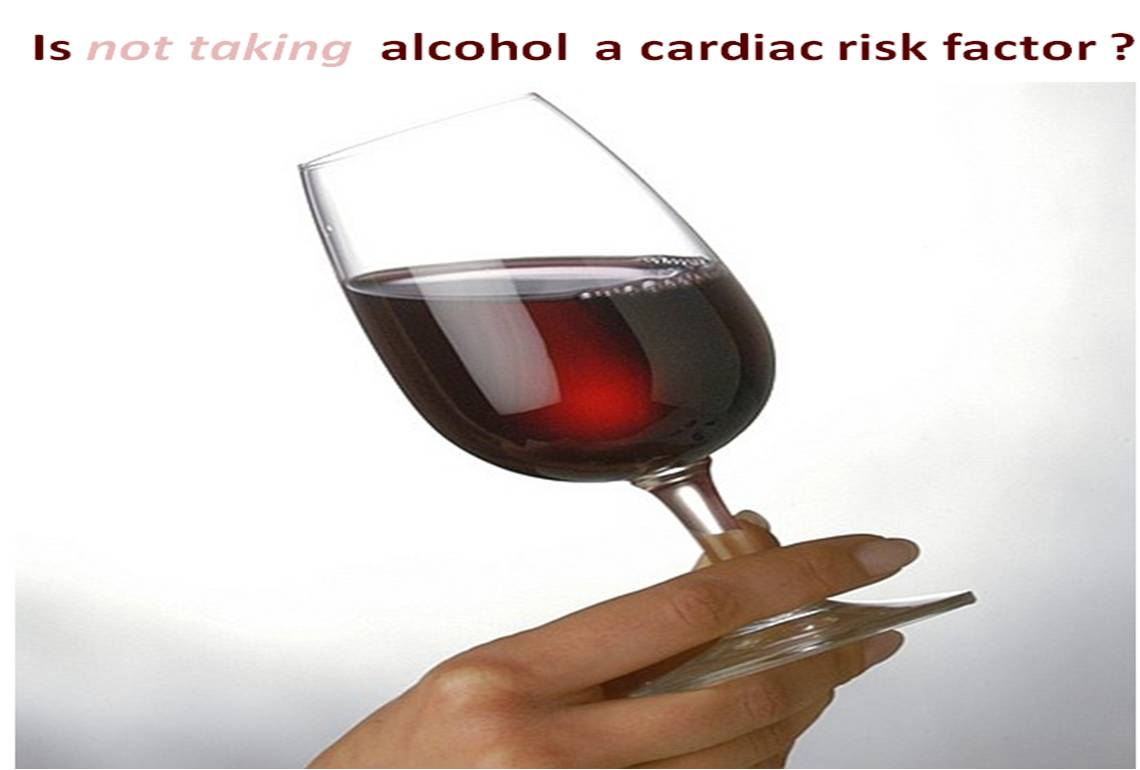
“It seems  certain . . . both  zero alcohol  intake and excessive alcohol  confers cardiac risk   “

I stumbled upon  the above   conclusion    from a respectable source*

*This  is from the  famous  INTERHEART  study published in Lancet.

Can it be true ?   What is the proof ?

Consuming  moderate   quantity of  alcohol  reduces  cardiac risk

  Does it make sense  to  skew   this   statement  like this

   . . . Not taking  alcohol   would   be a cardiac  risk  in other wise healthy individual .

Can we  profess  such a reasoning ?  My colleagues call it stupidity ?

If  it is true ,  are we justified  to use  alcohol as  a primary prevention drug ?

Which type  of alcohol we are  talking about ?

I am struggling to get specific answers .

After reading the INTERHEART study , my conviction is  the  “dangerous suggestion”   may indeed  have a significant  quantum of truth !  Readers may share their thinking .

In a country like India where alcohol is considered as a  killer chemical with a huge social stigma ,  it is  blasphemous to suggest  not taking it can be  cardiac  risk factor !

Reference

http://www.thelancet.com/journals/lancet/article/PIIS0140-6736%2804%2917018-9/abstract#

A. DiCastelnuovo, S. Castanzo, V. Bagnardi, M.B. Donati, L. Iacoviello, G. de Gaetano. Alcohol dosing and total mortality in men and women. Arch Intern Med 166;2006: 2437-2445

R. Femia, A. Natali, A. L’Abbate, E. Ferrannini. Coronary atherosclerosis and alcohol consumption: angiographic and mortality data. Arterioscler Thromb Vasc Biol 26;2006: 1607-1612

D.L. Lucas, R.A. Brown, M. Wassef, T.D. Giles. Alcohol and the cardiovascular system. J Am Coll Cardiol 45;2005: 1916-1924

Read Full Post »

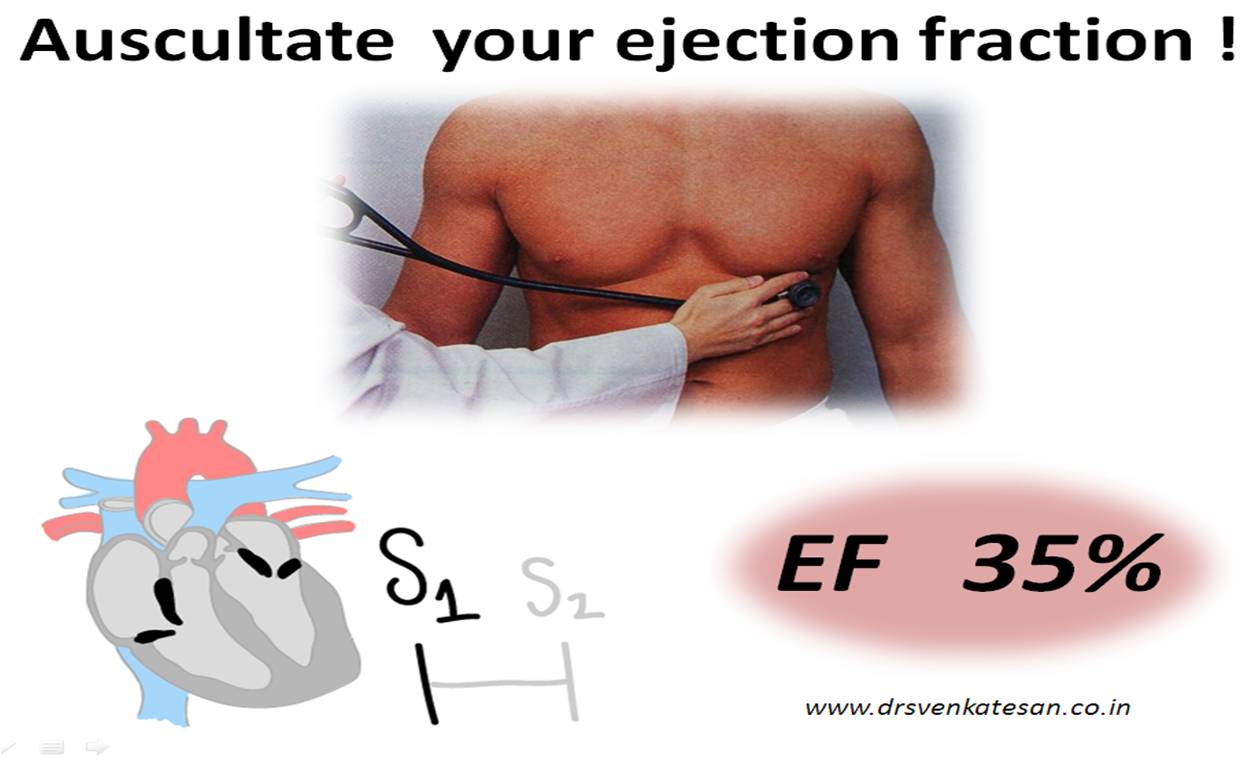
How to rapidly  diagnose  significant LV dysfunction  at the bed side ?

Look for

  1. Tachycardia*
  2. Exertional LV  S3
  3. Muffled S1
  4. Weak carotids
  5. Often inconspicuous apical  impulse

If all these signs are present EF is likely to be less than 35 % with 90 % specificity . If this is accompanied by  true cardio-megaly in X-ray chest,  LV dysfunction can be diagnosed with a  precision  reaching almost  100% .

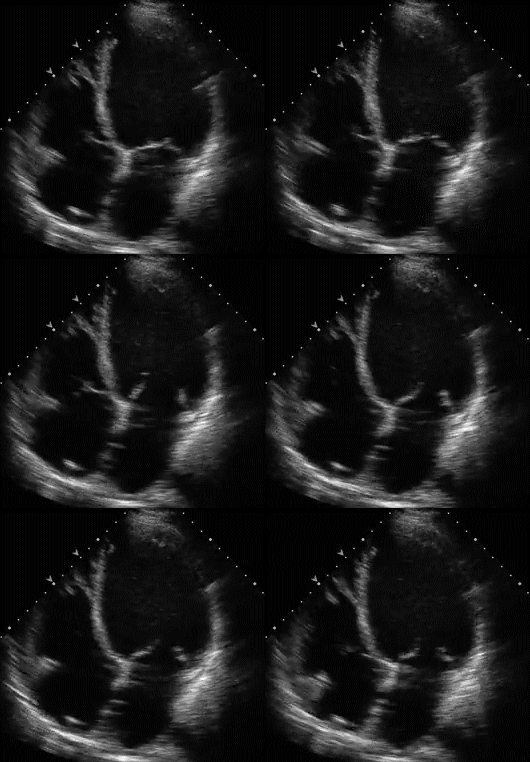
Note the sluggish motion of mitral leaflets and how closely the LV contractility is related to AML movement.This man had a soft S1 and his EF was 30 %

* Tachycardia may be  a non specific finding . Further ,base line tachycardia may  not be present  in all cases of LV dysfunction . When there is a  sudden surge in HR  even with minimal exertion , it  suggests   severe  LV dysfunction.

** The above clues  may not apply  in  valvular heart disease  , and isolated right heart disease  as multiple factors may impact S1 intensity .

*** LV failure must be distinguished from LV dysfunction (Vide infra)

Similarly , a  patient can not have significant  LV  dysfunction if  one  detects any of the following.

  • If the first heart sound is loud
  • If he feels chest thumping as palpitation.(A fluttering and audible   mitral  AML has 100 %  predictive value for normal LV function )
  • If you here an aortic ejection sound (Vascular clicks ) . Ejection clicks need significant force for it’s generation.

Final message

The most mobile structure of the heart is  anterior mitral leaflet . Fortunately it’s closure is  well heard as   S1 . Mind you, the most important determinant of  S1 intensity is  LV  contractility.  If your ear is sharp , and if you are able to  rule out other  reasons for soft S1  (Like obesity, pericardial effusion )  we are fairly  justified in suspecting significant Left ventricular dysfunction.

Further reading :

***What is the difference between LV dysfunction and  LV failure ?

Both these terms are  often  perceived  to convey the same meaning . But it  can  never be used synonymously .Cardiac failure is a clinical entity while LV dysfunction  is  a  derived  technical parameter  by and large an echocardiographic entity. Cardiac failure   is defined classically as a clinical syndrome .(elevated jvp, edema * S 3 rales etc)  Neuro hormonal activation  can occur with both.

A patient with   LV dysfunction    when destabilsed  develops   LV  failure and after stabilisation of   LV failure he is brought  back to  the baseline  LV dysfunction.

Read Full Post »

« Newer Posts