Feeds:
Posts
Comments

Archive for the ‘Uncategorized’ Category

LA dimension and volume have become vital parameters in recent times, especially, with the entity of HFpEF is becoming so common. LA not only acts as a live barometer, reflecting all that happens in LV, but it is also a chronic marker of LV diastolic function. (Funnily referred to as HBA1c of diastolic dysfunction) 

What is normal LA dimension & volume ? 

  • Normal left atrial diameter < 4.1 cm in men or < 3.9 cm in women
  • Normal left atrial volume indexed for body surface area (BSA) is 34 ml/m2 for both women and men 

Which part of the cardiac cycle do we measure? 

Ever since Wiggers introduced the overwhelming concept of LV systole and diastole, most of us ignored the fact that atria do have a separate contraction relaxation cycle, independent of what happens in the ventricle. Of course, atria and ventricles act as a single chamber in diastole. In reality, atria lack true boundaries when it acts as a conduit. The LA dimension varies considerably during the atrial cardiac cycle. Look at the  LA pressure-volume loop, which can frighten anyone, with its horizontally lying figure of 8 pattern. During every cardiac cycle, the volume reaches atleast two troughs and one peak.
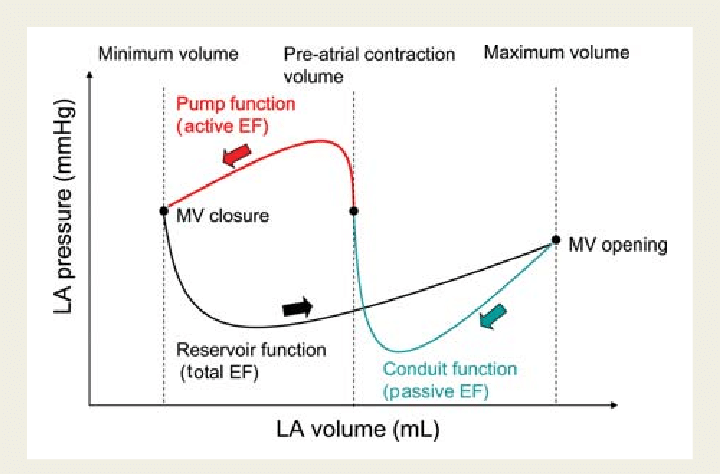
Don’t get frightened with this graph, spend some time, and you will get it right, Begin at  “3” o clock position with the onset of diastole with a downsloping green loop, that continues as the red line of atrial contraction to end up in systole. The entire black loop, that happens during ventricular systole depicts the true reservoir function. with MV closed. ,
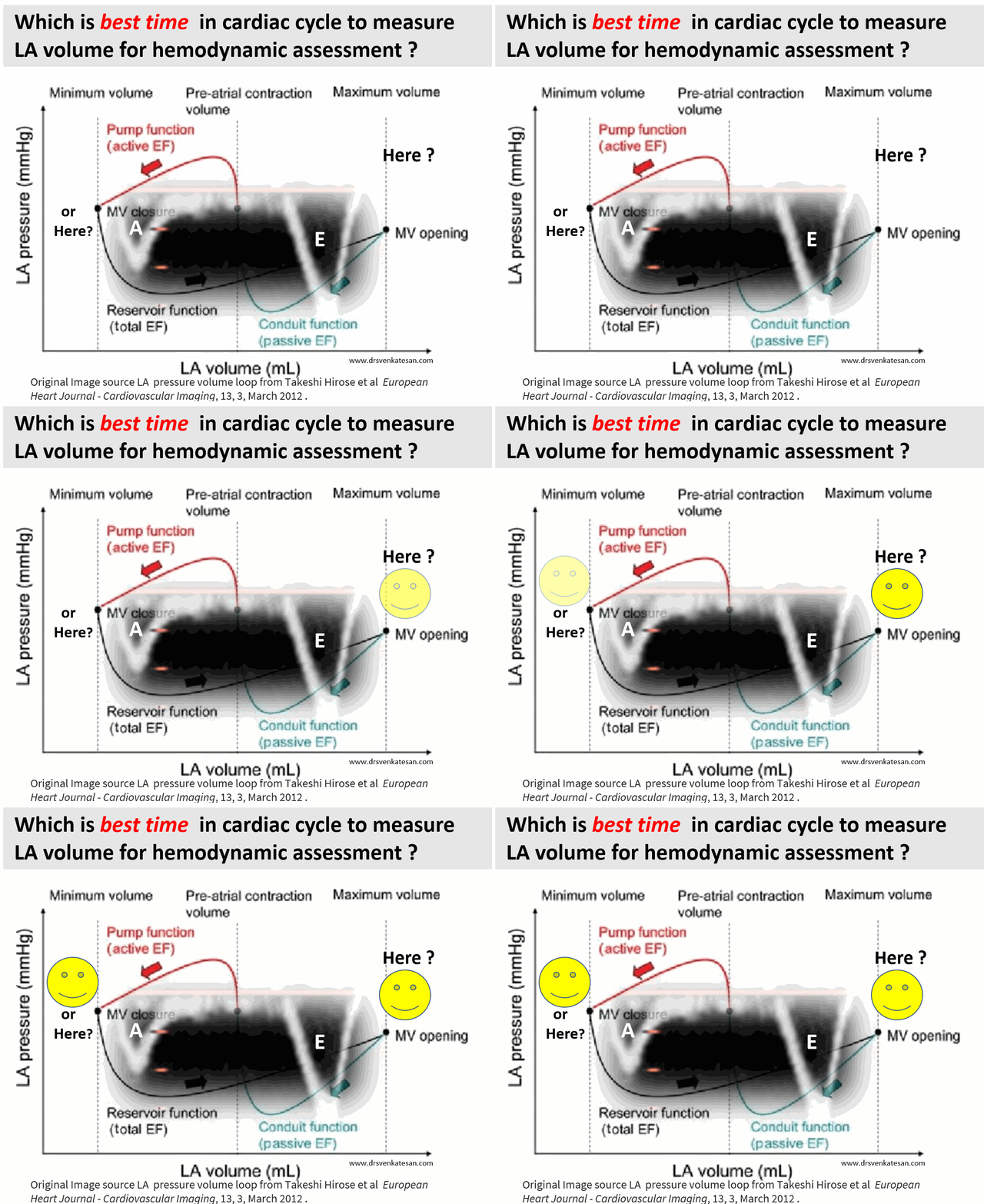
 

As of now, we have a consensus, LA volume is measured typically in LV end-systolic frame. ( Rather, we measure it at maximum LA volume ) However, we have 4 different LA  volumetric components to assess, as this article excellently depicts. (Hoit BD. Left atrial size and function: role in prognosis. J Am Coll Cardiol. 2014 Feb 18;63(6):493-505.)

What could be the limitations of the traditional end-systolic measurement?

No single measurement will give an overall LA function assessment. But still, Somehow, we have measured the maximum LA  volume as a reference of true diastolic function. This happens in LV end-systolic point where atria reach the maximum size. But, here is a catch, we assess the left atrial function before its main physiological function of emptying takes place.

How about assessing  LA efficiency after it completes its job, ie end diastole? 

In LV function end-systolic dimension has pride of place as it is devoid of influence from loading condition. If applying the same logic, the “end atrial” systolic dimension(Which is the same as LV end-diastolic point/or post A ) should be perfect. It can also help measure the residual LA volume after its systole.

A potential advantage of LV end-diastolic dimension (The Heart & Soul study )

Maybe, this is less affected in the presence of MR systolic jet will spuriously elevate LA volume. In AF also this parameter is less likely to be influenced by LA preload.

Final message

Suddenly, we are debating a fundamental Issue, ie timing of LA measurement. While the end-systolic size/volume is the current standard, the LA dimension in the end diastole also provides useful info. There are at least 4 different LA volumes, at different parts of the LA cycle that need to be studied for a proper understanding of diastology (Unlike LV which has only two).

Now, we may need to ponder, if there is a mean LA volume, measured with the 3D volumetric analysis or MRI, that could be representative of the global LA function. 

Reference
Thadani SR, Shaw RE, Fang Q, Whooley MA, Schiller NB. Left Atrial End-Diastolic Volume Index as a Predictor of Cardiovascular Outcomes: The Heart and Soul Study. Circ Cardiovasc Imaging. 2020 Apr;13(4):e009746. doi: 10.1161/CIRCIMAGING.119.009746. Epub 2020 Apr 20. PMID: 32306763; PMCID: PMC8846436.


Read Full Post »

Myocardial infarction, a gross pathological entity renamed now as STEMI for clinical purposes, continues to be the most famous medical emergency that triggers a series of calls, right from 911 to the ER, that eventually ends up in CCU or a 24/7 cath lab. The heart, can’t wait for all these external responses when it is challenged with a vascular accident. The moment ATO occurs, two things happen. The endogenous fibrinolytic led by native tissue PA (Tpa) tries to get rid of the thrombotic plug by all its means. It succeeds in 15%. We call it spontaneous lysis or aborted MI. Many lives are lost in the remaining before they reach the hospital..

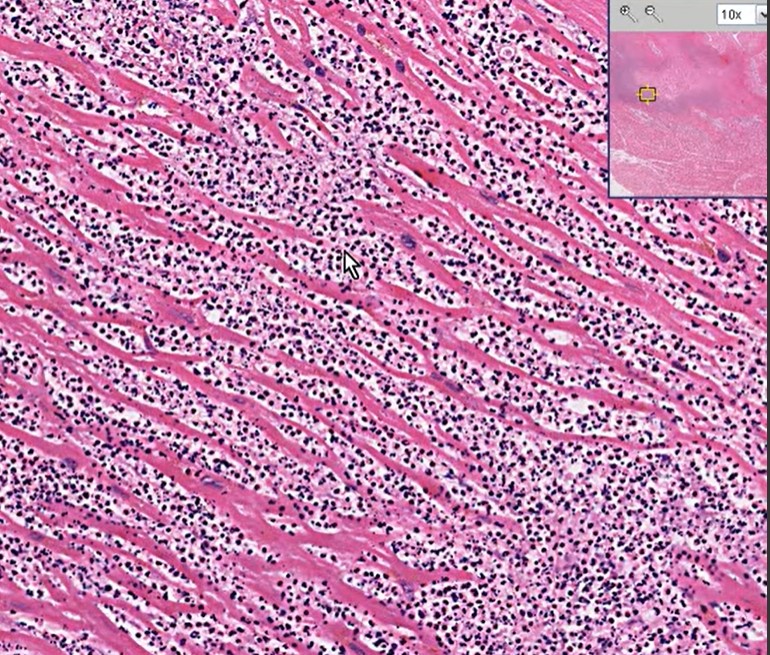
Meanwhile, the immune high-command deputes scores of neutrophils to the ground zero Fig 1) to supervise what is happening and try to heal the injury. It is worth, understanding, that activated WBCs, sort of convert myocardial infarction from a vascular event to inflammatory pathology, as the hour progress.


Fig 1  Infarcted myocardium Invaded by neutrophils


What do these neutrophils do?  

It will be our ignorance, if we think, they simply crowd around the myocytes helplessly, that is hit by ischemia. They are sent with a specific purpose to protect and heal the myocardium. Very often it fails in its mission is a different story. These fighting neutrophils send a subtle signal  of their presence with a mild increase in temperature during ACS  ( Patel  Prognostic usefulness of white blood cell count and temperature in acute myocardial infarction  Am J Cardiol. 2005 Mar 1;95(5):614-8. )

Is neutrophil invasion good or bad for the myocardium?

These are pro-inflammatory cells. meant to promote healing and mitigate Injury. Interleukins and Leukotrienes do have a healing power as well. But, what happens, in reality, is, still a mystery. As of now, it is tempting to think, it does more damage than good. Its role changes over time. 

 Acute reperfusion Injury in Primary PCI 

Neutrophils are quiet obedient cells generally, but once activated, their behavior can’t be predicted. It may start attacking the host cells, We know reperfusion injury is real and poorly understood. Delayed reperfusion, is well known to cause myocyte softening and lysis. What we know for sure is, primary PCI, induced accelerated flushing of these angry neutrophils is definitely related to no flow, microvascular plugging, and cardiogenic shock.  (The fact that no-reflow and reperfusion injury is less of a problem in fibrinolysis  demands introspection)

Diagnostic & prognostic value of neutrophilia 

Neutrophilia is such a nonspecific response, faces ridicule for its clinical utility. But, In reality, it can be a worthy parameter, to time the age of the infarct (or even confirm* the ACS ) in otherwise equivocal clinical presentation.(Ref 2) More importantly, it provides prognostic information. One more potential use is Neutrophil count to guide the timing of surgery post-MI (as in VSR) A neutrophil count could help avoid the active phase of inflammation.

*I recall my surgical professor’s emphasis on leukocytosis to confirm acute appendicitis during the first clinical year. 

Final message 

There is no academic by-law, that forbids full-blown interventional cardiologists from having an affair with basic science. Unless the core science is irreversibly bonded to the bedside, we can never reap the true benefits of translational research. Hematological aspects in STEMI is one such underrated discipline. Also, we must encourage every postgraduate student in pathology/biochemistry/physiology to visit the CCUs or sit in the cath lab gallery more frequently. Watching the cardiology stalwarts plowing through the blocked coronary arteries, racing against time, is sure to kindle young minds, for a potential molecular breakthrough in cell survival and healing following myocardial hypoxia.

Reference

1.Ma Y. Role of Neutrophils in Cardiac Injury and Repair Following Myocardial Infarction. Cells. 2021 Jul 2;10(7):1676. doi: 10.3390/cells10071676. 

2. Thomson SP, Gibbons RJ, Smars PA, Suman VJ, Pierre RV, Santrach PJ, Jiang NS. Incremental value of the leukocyte differential and the rapid creatine kinase-MB isoenzyme for the early diagnosis of myocardial infarction. Annals of internal medicine. 1995;122:335–341. [PubMed] [Google Scholar]

3.. Cannon CP, McCabe CH, Wilcox RG, Bentley JH, Braunwald E. Association of white blood cell count with increased mortality in acute myocardial infarction and unstable angina pectoris. OPUS-TIMI 16 Investigators. Am J Cardiol. 2001;87:636–639. A610. [PubMed] [Google Scholar]

4. Bhatt DL, Chew DP, Lincoff AM, Simoons ML, Harrington RA, Ommen SR, Jia G, Topol EJ. Effect of revascularization on mortality associated with an elevated white blood cell count in acute coronary syndromes. Am J Cardiol. 2003;92:136–140. [PubMed] [Google Scholar]


Read Full Post »

Pardon ,this video is nothing to do with cardiology. It is from the archives of the United nations library .This can teach some important lessons in art of communication , sharing to all folks, especially medical students. It was recorded in 1959 in Newyork, UN head quarters.Four 17 year old school girls & boys were invited for a debate on a complex topic. Does God exist ? How do you pray ? and what is the purpose of different religions ?

I keep wondering , how these youngsters accumulated so much wisdom and express it in such a polite manner too. Mind you, this was recorded , when learning happened with out any digital aids.The word Internet was unheard off. No ego, no bluntness, no diatirbes that has become a norm in many debates now. I got a punching lesson from this clip, be gentle when taking extreme views in any topic.

I wish, every medical debate in class rooms should happen this way.The key to succesful debate is, to accumulate knowedge, willingness to question the convention, and respecting the oppositie point of view.

The high point of talk show, was, when the Brazilian girl(due respects, she should be nearing 80 years now) tell us casually some things are not meant to be understood in life .I tell the same when some patients ask too many questions about their illness which may not have an answer.

Read Full Post »

Management of recurrent ventricular tachycardia has developed a lot in recent times. Anti-arrhythmic drugs(AADs) were a cornerstone for most recurrent and refractory VTs till recently. Surgeries including CABG,  repair of the aneurysm, and subendocardial resection has helped to control many post-MI ischemic VTs. Soon they became obsolete. Realistically, PCIs had little impact on post-MI VT for some unknown reasons. However, with the advent of ICDs and RF, ablation, a new dimension is added to this field. 

ICDs, though an attractive device, don’t prevent a VT but vow to nullify the consequence of VT. This is problematic. ICDs in spite of their ability to prevent SCD effectively, it has little say in preventing non-sudden deaths of in any form of cardiomyopathy. (In fact, there is some evidence ICDs might increase myocardial damage with inappropriate shocks )

Hence, RF ablation can be called as true curative therapy by extinguishing hot spots of VT genesis. Still, we need to understand ablation is technically creating new dead myocardium (in alreadly  damaged myocardium) and hence, can’t avoid a consequence. More importantly, ablation as a modality is technically more demanding. We have accumulated huge experience with the help of electro-anatomic imaging and cutting-edge hardware in the last few decades. Still, we find it difficult to zero in the target area of RF ablation, with all available techniques of mapping (Activation, substrate, entrainment, and pace mapping) The reason is,  VT circuits can be really complex ones. Not only different loops but also it can travel deep into the myocardium (Intramural or epicardial) making a single approach endocardial often futile. Success rates vary between 60 -70% (Some may claim 90 +)

This post wants the young fellows to take on this fundamental issue and learn in-depth about the arrhythmia circuit.(Get Inspired by Dr. Samuvel Asirwatham of Mayo clinic work )

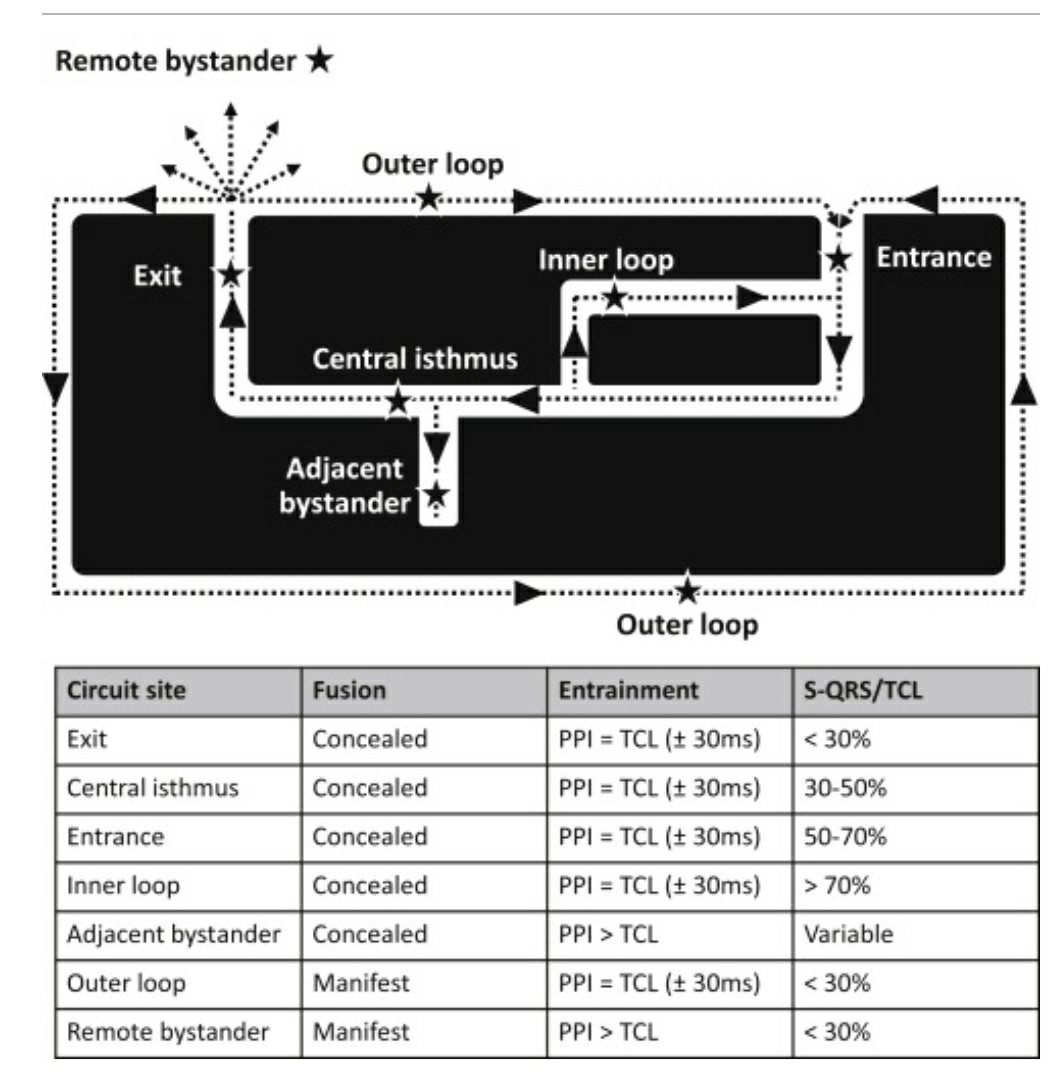
What is the best site to ablate ventricular tachycardia?

  1. Exit point 
  2. Central isthmus
  3. Entrance 
  4. Inner loop
  5. Outer loop
  • Though logic would tell us we can intercept an arrhythmia by ablating anywhere in the circuit. But the issue here is we need to permanently ablate it. not just interrupting. 
  • The best site to ablate is the exit point or entry point. Maybe isthmus. I am not really sure. But, one thing is clear, the outer and inner loops are not important. Further, live tissues are the culprits and not the scars and infarcted zones. 
  • One more possible answer is to try to ablate all (or maximum) points in the circuits.

How to identify entry points and exit points?

Not a simple answer .EPs apply their life experience to do that, assisted by technology. Not everyone who has a Carto -GPS can do that.

One simple answer for the fellows is, in entrainment mapping,  critical sites can be somewhat arbitrarily labeled as exit, central isthmus, or entrance on the basis of the Stimulus-QRS interval relationship to the TCL. Exit sites will show an S-QRS interval < 30% TCL (QRS onset shortly after pacing), central isthmuses will show an S-QRS interval of 30% to 50% TCL (some delay in QRS onset after pacing), and entrance sites will show an S-QRS interval of 50% to 70% TCL 

Ruairidh Martin et all Circulation: Arrhythmia and Electrophysiology. 2018;11:e006569

Final message 

Key to the successful ablation of VT is the accuracy in choosing the target site. Locating the target is meaningless if we can’t reach that site. Reaching the site is again futile unless we are able to deliver adequate burning or icing with sufficient contact.

Meanwhile, AADs can never be ignored in spite of the apparent side effects, for the simple reason they reach the VT circuits without any fuss. The Pharma industry has almost lost its interest in AAD research and the hyper-talented EP guys are squarely responsible for this unintended consequence.

Future directions

RF energy modification and newer catheter designs will help. While cryoablation shows a promising advantage over RF, it is still to prove its sustained efficiency. Meanwhile, other ablation modes are being tried. Transvascular ethanol ablation and stereotactic radio ablation have both shown promise for arrhythmias that fail other ablation strategies.

Some more questions

  • What is the difference between arrhythmia focus of origin and entry point? 
  • Once the VT is set in, what is the relevance of its origin? 

Reference

One of the very good reviews on the topic.

1.Gustavo S. Guandalini, Jackson J. Liang, Francis E. Marchlinski, Ventricular Tachycardia Ablation: Past, Present, and Future Perspectives,
JACC: Clinical Electrophysiology, Volume 5, Issue 12, 2019, 1363-1383,
2;,W.G. Stevenson, H. Khan, P. Sager, et al.  Identification of reentry circuit sites during catheter mapping and radiofrequency ablation of ventricular tachycardia late after myocardial infarction Circulation, 88 (1993), pp. 1647-1670


3.M.E. Josephson, L.N. Horowitz, H.L. Waxman, et al.Sustained ventricular tachycardia: role of the 12-lead electrocardiogram in localizing site of origin Circulation, 64 (1981), pp. 257-272

Read Full Post »

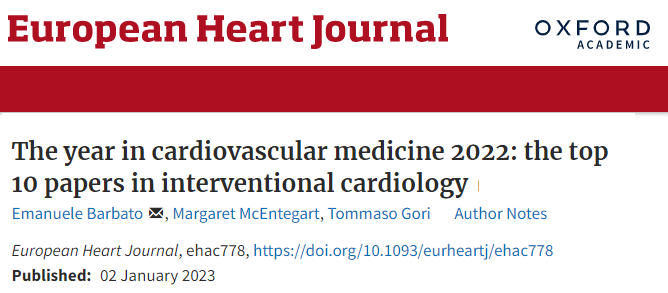
EHJ has listed the top 10 papers in cardiology in the year 2022 in its current issue. 

Kindly go through this when free. While each of the 10 has its own importance, one meta-analysis, I thought was a  real bright spot. Though the message it conveys is nothing new,  it reaffirms an important management principle in ACS. Getting curious? Before going into the paper, a mini pretest

What is your take on these 4 statements on ACS?  True or False

1. STEMI is an emergency, NSTE-ACS* is not an emergency

2. Both are true emergencies.

3. STEMI is definite, yes, but  NSTE-ACS may or may not be (Mind the GRACE score dude !)

4. Even STEMI can be a non-emergency if the patient reports after 24 -48 hours.

(Remind you, NSTEACS = UA+NSTEMI , still often used interchangeably)

Hope we don’t have difficulty in identifying the wrong response. Whatever the answer to this somewhat insulting question to our intellect, forget it. Now, read this paper, which is listed as one of the most read last year. It is about the impact of early invasive strategy in NSTE-ACS.

Kite TA, Kurmani SA, Bountziouka . Timing of invasive strategy in non-ST-elevation acute coronary syndrome: a meta-analysis of randomized controlled trials. Eur Heart J. 2022 Sep 1;43(33):3148-3161.

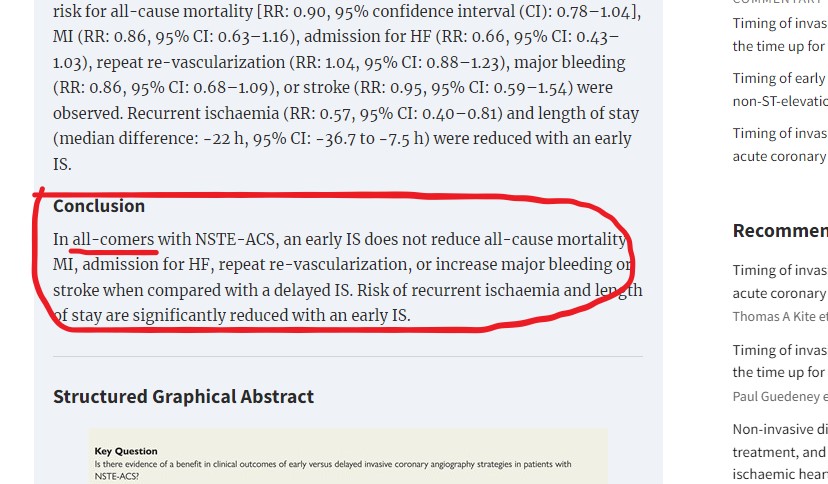
Conclusion is pasted for the busy guys.

Post-test

  1. What is overall NSTEMI in-hospital mortality? (Everyone knows for STEMI it is around 4-8 %, no one seems to be sure about NSTEMI. I think it can’t be estimated accurately, guess it is 1 -2% )
  2. Is there a primary PCI equivalent situation in NSTEMI?  What are they? (Left main UA with AVR ST elevation comes first on the list)
  3. Based on the urgency to treat how does the ultimate outcome change? (This is what this meta-analysis by Kite et all proved.It is not a new revelation though . Recall the landmark ICTUS study  of 2010 which was largely kept in the dark )

Final message

One lay definition of STEMI is, It is a mass of myocardium under fire. True UA/NSTEMI is, a mass of myocardium, that is threatening to go on fire. When firefighters are able to reach a smoky building before the onset of a fire, no doubt, it looks like a great & awesome response, Isn’t it? Unfortunately, the myocardial landscape is different and NSTEACS is such a heterogenous entity that doesn’t welcome unsolicited aggressive, emergency rescue missions. That’s one of the messages we get (at least I got )from this top-read paper in 2022. 

Reference

1.Emanuele Barbato, Margaret McEntegart, Tommaso Gori, The year in cardiovascular medicine 2022: the top 10 papers in interventional cardiology, European Heart Journal, 2023;, ehac778https://doi.org/10.1093/eurheartj/ehac778

2.Kite TA, Kurmani SA, Bountziouka V, Cooper NJ, Lock ST, Gale CP, Flather M, Curzen N, Banning AP, McCann GP, Ladwiniec A. Timing of invasive strategy in non-ST-elevation acute coronary syndrome: a meta-analysis of randomized controlled trials. Eur Heart J. 2022 Sep 1;43(33):3148-3161.

3.Damman P, Hirsch A, Windhausen F, et al. 5-Year Clinical Outcomes in the ICTUS (Invasive versus Conservative Treatment in Unstable coronary Syndromes) Trial. J Am Coll Cardiol. 2010 Mar, 55 (9) 858–864.https://doi.org/10.1016/j.jacc.2009.11.026

Read Full Post »

Happy new year & memories of 2022 !

Wishing every one of you an Enlightening New year. As we begin a new journey around the sun, yet another time, let us re-dedicate ourself, to use science, for the welfare of our planet & people.

Thank you , for visiting this site and make all its worth.

Just one memory of 2022, lingers ! Retired and left Madras medical college,Chennai after 3 decades, which grew me up as a Cardiologist.

Read Full Post »

I will go with the last response. As for as I understand, we have never quantified Atrial muscle mass properly even in normality. One may be tempted to think there is no purpose to measure it, other than academic reasons. The fact that the incidence of atrial fibrillation in mitral stenosis is not linearly correlating with LA size makes us think, LA mass (Virtual LAH) may have a say in triggering AF.

This post is meant for cardiology fellows. Maybe someone can do a study on this by measuring LA mass pre and post-PTMC, we might get an idea about regression as well. Meanwhile, we are well versed with infiltrative diseases like atria like amyloidosis that can mimic LAH. Currently, we realize fatty infiltration of LA is the common trigger for AF in varied populations.

By the way, readers are welcome to post any specific formula to measure LA mass if they come across .

Reference

A good review of LA anatomy.

Read Full Post »


Read Full Post »

HF is the inability (or reduced ability) to supply oxygen and other nutrients to fulfill the body’s demands. In the process, the heart either fights or flights, and results in symptoms due to hemodynamic alterations, or adversities of neuro-hormonal activation.

Now, what is Anemia? Anemia is a condition with reduced or dysfunctional RBCs. that directly interferes with oxygen delivery to tissues. It is not at all a coincidence, the core functions of the heart and blood are strikingly similar and intertwined. While the heart is the powerhouse of the circulatory system, without good-quality blood, the greatness of this vital organ becomes redundant.


A failing heart & compromised blood, throws up a double challenge, to the fundamental function of the circulatory system and results in impaired cellular oxygen delivery.


Fortunately, RBC and Hemoglobin have an adequate reserve, and real metabolic issues happen only after a 30 %  reduction in hemoglobin. During this time the heart works more to compensate by maintaining high output. When HB falls less than 6 to 7 grams the heart itself suffers from hypoxia and goes for intrinsic failure. So, when anemia coexists with cardiomyopathy imagine the tissue’s plight.

Anemia in Heart failure 


While there are many links between anemia and heart failure few things are worth emphasizing. It can be discussed in 4 categories.

  1. Primary anemia that results in heart failure is a separate topic and comes under high-output HF.
  2. Anemia as a part of the same disease process as heart failure. (Anemia of chronic illness) 
  3. Nutritional anemia associated with common forms of heart failure (Ischemic and non-ischemic DCM) 
  4. Anemia of CKD and coexisting heart failure 

*Category 2 is often missed, while category 3 is often ignored

Prevalence of anemia in HF.. Up to 30%. (Iron deficiency anemia is the most common)

Diagnosis: Criteria Ferritin less than100 or 100-299 μg/L with transferrin saturation <20%). 

What is the optimal Hb %?  Should be 13 grams

Iron deficiency is much more than anemia 

It is worthwhile to go back to the basics, anemia is just one aspect of iron deficiency. Humans live their life, essentially inside the breathing chambers of mitochondria in each of the 12 trillion cells.  Without an adequate iron supply, the citric acid cycle will come to a creeping halt. It is now recognized, altered mitochondrial function is one of the key peripheral defects in HF. (Ref 1) Iron deficiency could be an Incidental marker for a more important tissue deficit elsewhere. 

What do the trials say about the role of routine Iron supplements in HF?

As usual, trials blink with data on either side of the truth. Small studies suggested benefits. But large studies with Iron supplements and Erhytopoitn analogs failed to show benefits. IRON-OUT, RED -HF (Ref 2,3) . But in a popular study from the Lancet , showed ferric carboxymaltose improved the outcome. (Ponikowski P,l. Lancet. 2020 Dec 12;396(10266):1895-1904).

Final message

We, as modern-day cardiologists are always pre-occupied with measures to improve LV ejection fraction at any cost (Since we fell into a false knowledge trap of defining HF solely on the basis of  EF% ) To make HF patients walk 30 meters extra in a 6-minute walk test we have complex and costly procedures like CRT, Mitra clips, and IAS flow regulators,  etc.

However, experience tells us there are many parameters other than EF that can improve functional capacity and quality of life. Breathing exercise is the best example. Let’s add one more to this list. A simple correction of anemia with iron can make your cardiac failure patient walk many blocks more. Trials are not consistently confirming this though. Don’t bother them,  just have a try. If prescribing tablet iron without evidence bothers you with scientific guilt, ask your patient to take a diet with rich iron content and see the difference.

For advanced readers

Anemia and  Aortic afterload: The apparent advantage

There is one curious concept. Anemia makes the blood thin. Reason lowered viscosity. As a consequence afterload falls. , hypoxia-induced peripheral vasodilatation and enhanced nitric oxide activity also contribute to this.  Vasodilatation also involves the recruitment of microvessels and, in the case of chronic anemia, stimulation of angiogenesis. So, anemia apparently has a double edge, and one of them seems to be beneficial.

We must also beware, the risk of iron overload is genuine in some of these patients with HF. This makes us wonder, in ancient times venesection was used for so many undisclosed illnesses, which might include heart disease as well.

Reference

1. Melenovsky  V, Petrak  J, Mracek  T,  et al.  Myocardial iron content and mitochondrial function in human heart failure.  Eur J Heart Fail. 2017;19(4):522-530

2. Lewis GD, Malhotra R, Hernandez AF, et al. Effect of Oral Iron Repletion on Exercise Capacity in Patients With Heart Failure With Reduced Ejection Fraction and Iron DeficiencyThe IRON OUT HF Randomized Clinical TrialJAMA. 2017;317(19):1958–1966. doi:10.1001/jama.2017.5427

3. Swedberg K, Young JB, Anand IS, Cheng S, Desai AS, Diaz R, Maggioni AP, McMurray JJ, O’Connor C, Pfeffer MA, Solomon SD, Sun Y, Tendera M, van Veldhuisen DJ; RED-HF Committees; RED-HF Investigators. Treatment of anemia with darbepoetin alfa in systolic heart failure. N Engl J Med. 2013 Mar 28;368(13):1210-9. doi: 10.1056/NEJMoa1214865. Epub 2013 Mar 10. PMID: 23473338.


Read Full Post »

Read Full Post »

« Newer Posts - Older Posts »