Feeds:
Posts
Comments

Posts Tagged ‘ers pattern in ecg’

This is an ECG of a 25-year-old, recorded in master health check-up. 
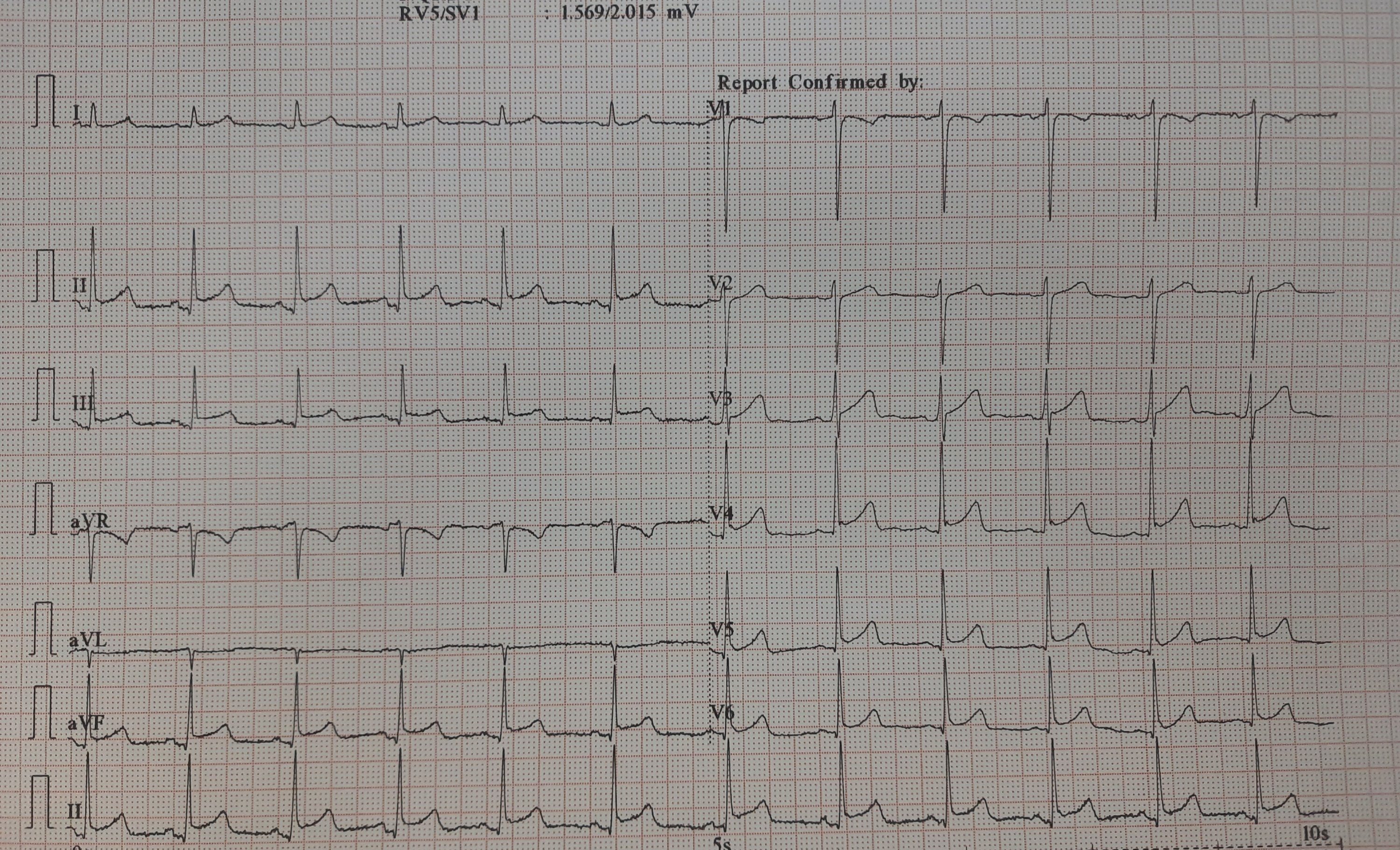
 It would be mind-boggling to know the prevalence of such ERS patterns in the general population. One estimate suggests it could be anywhere between 3 to 13  % depending upon the criteria used. Let us assume the mean as 5 %. Then, it would be 30 crores of human beings in our habitat show this ECG pattern. If applied, in my city Chennai alone 5 lakh people could carry this tag.

While it is true, some forms of ERS and J wave syndrome can be markers of serious ventricular arrhythmias, either spontaneous or at times of Ischemia. Currently, It has become a fad, in cardiology academic circles*, to propagate the idea that ERS is no longer a benign condition. This is not acceptable at any degree of cognition. This happened mainly after few studies in powerful journals created some alarmist views. (*Maybe there is a bit of truth there. I still have doubts about whether we interpreted the Michel Haïssaguerre  study properly)

Final message

ERS is a widely prevalent normal ECG variation with a minuscule risk. High-risk subsets need to be screened only if the J waves encroach and spill dangerously into the ST segment as well. Of course, this pattern is of serious concern if there is a family history of young SCDs has occurred.

Reference

Here is a good review of this topic by
Read Full Post »

Possibly yes !

In a preliminary analysis of 50 consecutive ECGs with ERS pattern, only  3  were females .An  astonishingly low incidence of  6 % is it not ? . The 94 % exclusivity in males  demands a  detailed  EP analysis of this entity.


How often you see an ECG such as this one in young women ?

This finding may not be a  surprise ,  if  we  link  another fact  namely  ,  the   longevity of    QT interval  in  women. Repolarisation  begins   when  rapid  sodium channel extinguishes and  potassium  channel starts  firing and  efflux  this cation   from within the  cell  .This happens  during  interface between phase 0 and phase 1. This point  corresponds to the onset of repolarisation.

The onset of repolarisation is not entirely  related to K+ efflux  (Rather  K +  determines largely  the duration of  repolarisation).QT interval is prolonged in females because repolarisation is slow  in women .In men it is early ,  short  and swift .

The mysteries surrounding the ion channels especially the  K+  with vast genetic and gender  heterogeneity  is yet be unraveled. Influence of  sex hormones on  right from the early days of  fetus could be  one  such area for research.

Other  related  gender specific ECG findings include

  • In women T waves rarely grow beyond 5 mm. In young men tall T waves are the  rule
  • An iso- electric or even inverted T waves  especially in leads V 1 to V4  are  quiet a common finding in women.

Link  to  another article  on  Early repolarisation syndrome from this blog

Final message

It is a well recognised  fact  ,  repolarisation  is  brisk  in men  and slow in women  .It is  now  realised ,  the onset of repolarisation is also earlier in most men .  This has a direct bearing  in  the  impact  of ischemia  on fibrillation threshold . Arrhythmias  induced by EADs  are logically more common in  persons with ERS.

Statistics again reveal men are more likely  to have primary VF  during  STEMI  . ( Male Gender  by itself a  CAD risk factor !) .Recently Hassagure  et all   elegantly   documented  ,  ERS is  indeed a risk factor for primary  VF at times of ischemia

Reference:

In the above article , the  incidence of ERS was 72%   in males , considerably lower than our observation . Still ,  the male dominance is confirmed. We still feel  in our country true  ERS occurs in a negligible minority of women. This finding need to be  confirmed  with  data from other centers .

Read Full Post »