Feeds:
Posts
Comments

Posts Tagged ‘mode switching’

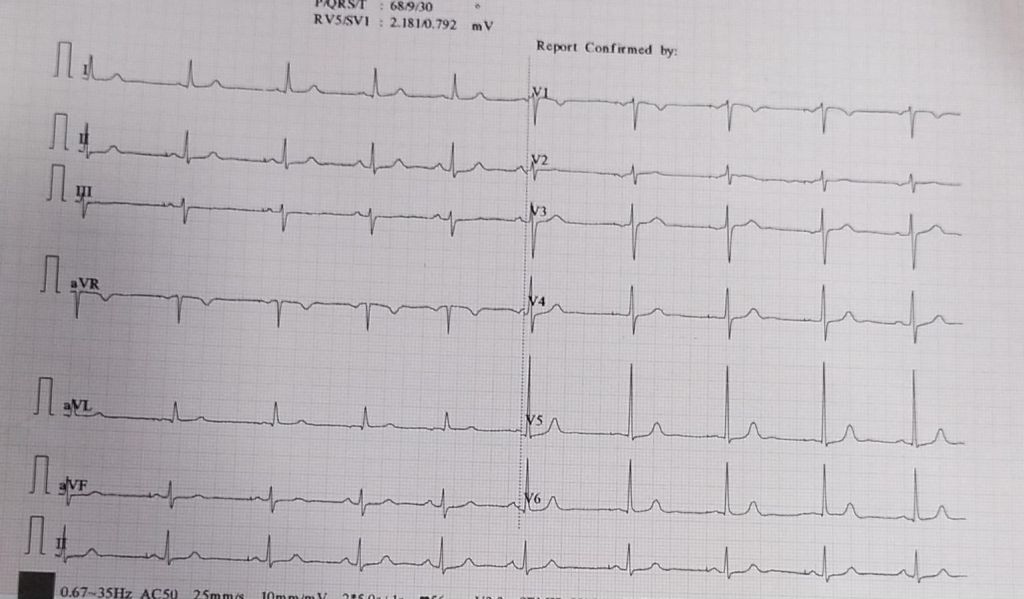
This pateint has

A. Single lead AAI pacemaker

B. DDD in AAI mode* (A pace V sense )

C.Single lead AAIR pacemaker

D. Can never answer this question without X ray or the implantation records.

Answer : I think, we can’t answer this question with this ECG strip. So we can only guess it is DDD, as single chamber AAI pacemaker is not in vogue , even though it is the most physiological pacemaker possible in ideal conditions.( If any one has any points to differentiate , please comment)

* A pace V sense in DDD, though  equivalent to AAI mode , can not be compared to AAI pacemaker, for the simple reason, ventricles just don’t have a lead in the later.

Final message

This post might appear as a EP parody. The purpose was different. It is sad to note AAI pacemaker might be dead , but the AAI as a mode will always be a great concept.It can beat on any day , the much hyped LBBBp in bulk of the pateints with SND in terms of physiology and synchrony.Fellows should realise single lead AAI can be most physiological , while, the DDD can become a pathological pacing , if it frequently switches to VVI mode , inspite of good AV conduction.


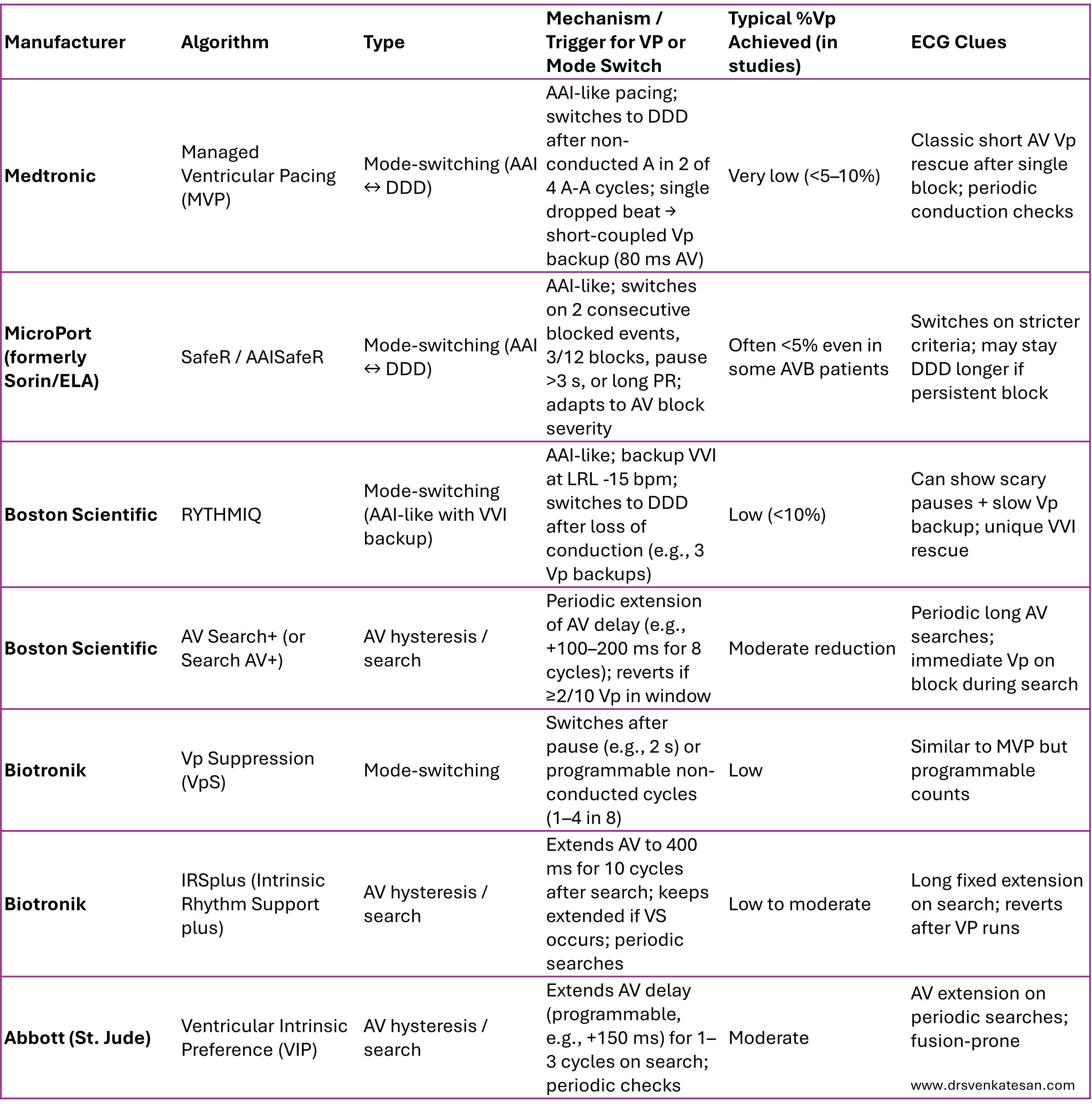
Part 2 : How do modern day DDD pacemakers reduce ventricle based pacing ?

Pacemaker vendors  have unique   proprietary algorithms designed to minimize unnecessary right ventricular pacing (%Vp) while maintaining atrial-based pacing (effectively mimicking AAI/R behavior) in patients with intact or intermittently preserved AV conduction (e.g., sinus node dysfunction without significant AV block). These algorithms promote intrinsic ventricular activation to avoid dyssynchrony, reduce atrial fibrillation risk, and potentially improve long-term outcomes.

There are two main categories:

  1. Mode-switching algorithms (AAI(R) ↔ DDD(R)): Operate primarily in atrial-based mode (AAI-like) with ventricular backup; switch to full DDD when AV block criteria are met.
  2. AV hysteresis / search algorithms: Stay in DDD(R) but dynamically extend the AV delay to search for and favor intrinsic conduction.

Annexure : Company brands and different modes and algorithms (Compiled by Grok)
Read Full Post »

In pacemaker science ,  any pacemaker that maintains AV synchrony is often referred to as physiological pacemaker. This is  of course , a  wrong reasoning .None of the pacemakers available today can be claimed to  be completely physiological .All  pacemakers  which paces the right ventricle  induces IVS dysynchrony (Including  the modern DDD)

Single chamber physiological pacing

AAI

Paradoxically ,  the most primitive of pacemakers AAI can be the near perfect physiological  pacemaker . The simple explanation  is ,  In AAI mode , expect for the origin of pacemaker impulse the entire depolarisation and repolarisation  is through the normally existing physiological conducting system .(AV node, HIS, Purkinje etc)

(It not only has atrio ventricular synchrony but also  has ventriculo ventricular and intra ventricular synchrony )

So, technically AAIR  is most physiological pacemaker possible .But  the practical utility of such a pacemaker is limited.It can be used  only in  isolated sinus node dysfunction with intact AV conduction . (The problem is the AV nodal conduction can develop later )  To over come this DDDR pacemaker can be programmed to AAIR as a default mode.

VVIR

This rate adaptive pacemaker  ,  to a  certain extent  can be termed physiological as the heart rate can improve with exercise . (Still it is unphysiological as it  paces the RV )

VVD

This is based on the concept ,  for pacing to be physiological , it  requires  atria  to be  at least sensed not necessarily paced.This mode which has a floating sensor attached to the lead as it crosses the atria.This facilitates atrial sensed ventricular pacing .But many believe  the atrial sensing is not consistent in VDD mode.Currently this mode is not popular.There is scope for improving the atrial sensor technology .

Dual chamber physiological pacing

DDD, DDRR

Both  these are the prototype dual chamber physiological pacing modes.

Bi-Ventricular or triple chamber pacing  ( one atria two ventricle)   are our  elusive answers for attaining perfect physiological pacing . it need to be realized, we simply ,  can not mimic the natural cardiac  conduction system.It is  estimated to be more than 10 miles long specialized fibers .

Final message

In our quest for physiological pacemaker we often forget the fact  , AAI is the most physiological pacemaker mode  available .(It even has  VV synchrony !  )

We should use it liberally whenever possible .Of course ,we cannot use it in complete heart block .Still 50 % the  permanent pacemaker  we implant is for sinus node dysfunction. Many of them could be candidates for AAI mode .If current generation cardiac physicians feel out dated to insert a AAI pacemaker, at the least they should program the DDDR into AAI mode with a mode switching to ventricular pacing modes whenever required.

In spite of all  advantages ,  why atrial based pacemakers are not gaining popularity ?

  • Ignorance
  • Lack of expertise
  • Technical difficulty of fixing atrial  lead
  • Perceived fear of lead dis-lodgement.
  • The fact remains  the  ventricular based pacing  is always safe  in case of sudden AV block due to any reason .

Read Full Post »
