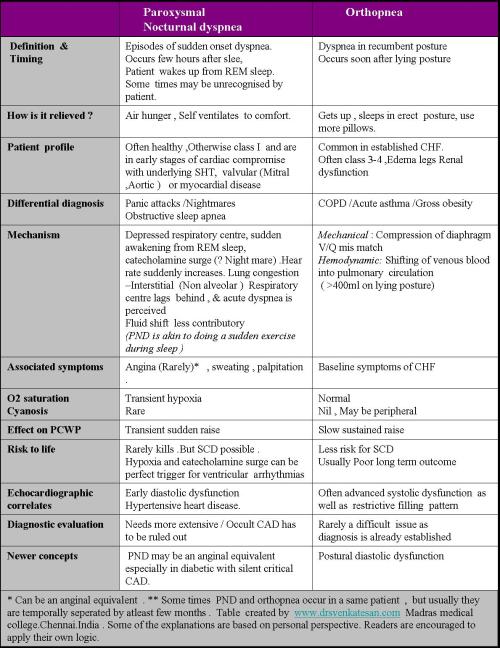
Some Infrequently asked questions in (iFAQ) in PND
What gives relief from PND?
The classical description is, the patient wakes up from sleep. sits up, often to stand up, and go to the nearest window and try to breathe fast and an episode of dyspnea settles down in a few minutes. The relief is completely in many unless the ongoing trigger and baseline cardiac defect overwhelms the reserve mechanism.
What is the hemodynamics behind relief?
Since symptoms are due to sudden unexpected congestion during sleep, assuming erect posture slows down the venous return of 400 ml instantly. It is equivalent to an IV diuretic push. Further standing up (even sitting up is sufficient) brings the left atrium in its natural superior position, compared to LV. The gravitational forces emerge* and aid in LV filling and improve stroke volume and relieve the congestion backlog. Apart from this two more factors contribute. V/Q mismatch improves as more lungs get perfusion in an erect posture . Finally seeking the window is spontaneous, in search for better fractional oxygen content from the atmosphere. (One more related question. How do pillows give relief of dyspnea in acute LVF? Few of the above mechanism operates)
*Postural changes in LA mean pressure is a complex topic of physics involving lungs, pulmonary circulation, and LA mean pressure.
Is basal rales mandatory during episodes of PND?
Yes. Most will have. But it should be emphasized in orthopnea patients, rales are rare since it takes some time for lung congestion take place. If rales appear immediately after lying down it may Indicate severely compromised LV function.
PND vs Orthopnea: Which is a reproducible symptom?
Obviously orthopnea. PND can never predict which day its going to come as there is CNS component to the circuit in triggering this. (REM sleep, Dreams etc)
How many episodes of PND can occur in one night?
Usually one. Because PND requires a time lag of at least few hours.Usually, these patients will not sleep thereafter or the usual wake-up time ensues.
Can episodes of PND be prevented?
Since its a volume-dependent pulmonary hemodynamic stress, a diuretic at dusk will prevent these episodes in many.
What is the sensitivity of PND for predicting heart disease?
It has low sensitivity( <30% ) but up to 75% specificity to diagnose heart disease.(Class 3 Non-Expert Evidence)
Is PND sign of advanced heart disease?
No.It has very low sensitivity to predict severity of heart disease.
Can PND and Orthopnea occur at same patient at same time a same day ?
Orthopnea has no time lag.It occurs immediately hence it is obviously more severe. Many of these patients, however, do get into sleep after some time as some sort of compensation or adaptation to neural signals of dyspnea take place.
These patients, later on, can get into the same cycle of PND . However, as heart disease (as in cardiomyopathy ) worsens the pulmonary interstitium shows some reactive fibrotic changes resist water logging in the lungs.
Since PND and orthopnea share a close relationship in terms of pathophysiology, we cluster it together in symptomatology. However, they are temporally separated in most patients in natural history.
PND : is it equivalent to acute heart failure?
Yes, it can be called so (If it is due to heart disease*) . It fulfills all criteria of cardiac failure. LV/LA filling pressure raised, forward output (Cardiac Index may still be normal ) .PND is a transient, acute, left-sided failure that results in acute oxygen debt for the body which is self-corrected usually.
* In volume overloaded, CKD patients PND can occur
What is the relationship between RV dysfunction to PND /Orthopnea?
There is a complex fluid regulatory mechanism in the failing heart. The lung can be congested if and only if the RV function is adequate enough to flood the lungs and at the same time LV function matches it with its inadequacy resulting in persistent congestion. In other words, a very high RVEDP is protective against pulmonary edema (However the patient will feel the dyspneic still due to hypoxia /VP VQ etc !)
Its prudent to give importance to PND/Orthopnea with reference to the balance of RV and LV function. One may recall why pericardial disease where right heart filling is impeded rarely lead to lung congestion.
Can PND be associated with Angina ?
Yes, it can but generally its not. Angina occurs due to nocturnal sub-endocardial Ischemia. This combination occurs in critical Aortic valve disease.(Both AS/AR)
Is PND a cardiac emergency?
Difficult question. Most times, no. Since its self-limiting especially if the patient knows he is going to settle with his past experience. But it can trigger dangerous events in severely compromised hearts.As expected, the first episode creates much panic and invariably elicits an emergency alert.
PND has sinister significance if is due to nocturnal ACS.Its a sign of ischemic LVF and requires immediate care.
Which is the most benign form of PND and Orthopnea ?
Students should know, medicine is a funny science. PND as a symptom is benign in some, while it denotes impending death in others.
Benign PND : Obese men, women, in pregnancy may experience terrifying dyspnea at night when they turn around or stretch. This is due to the upward movement of the diaphragm encroaching lung space.
If you record mitral inflow Doppler filling pattern during an episode of PND what will you find?
It’s quite simple logic. You do it yourself and find it as a learning exercise.(Please don’t make the patient suffer by doing echo at times of distress. One of your colleagues to attend to him as you simultaneously do an echo for academic purpose)
Try calculating LVEDP with various echo formulas.
Read Full Post »



 Dr.S.Venkatesan MD