Feeds:
Posts
Comments

Posts Tagged ‘pace journal’

For right or wrong reasons, the world of electrophysiology has pushed us into a belief system that, if it is AF, the culprit must be pulmonary veins. In fact, non-pulmonary vein origins can be a staggering 70% in some series. (See below) It can be in the free walls of the left atrium, LA appendage, IAS, IV, SVC junctions, coronary sinus, ligament of Marshall, crista terminalis, etc. (Ref 2)
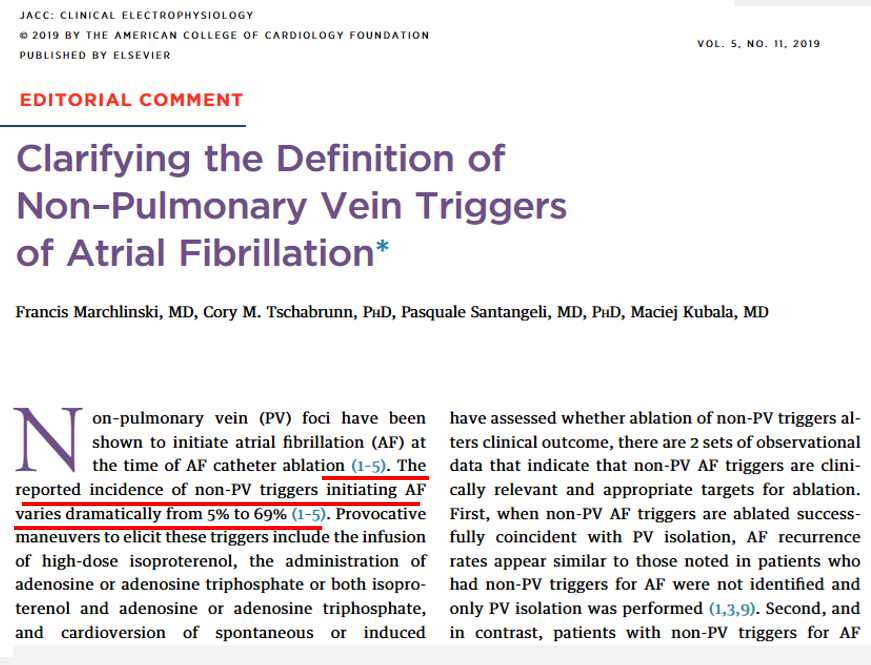
For example , where will be the initial focal trigger for AF in a pateint with COPD ?

Can you ever think of ablating PVs in a patient with AF and COPD, where the right atrium is under stress and strain? It doesn’t require any extraordinary intelligence to conclude any chronic focal atrial tachycardia can get degenerated to AF in the long run. In that case, the famous atrial tachycardia localizing map from Peter Kistler et al from Australia JACC 2006 holds good for location AF focus too.
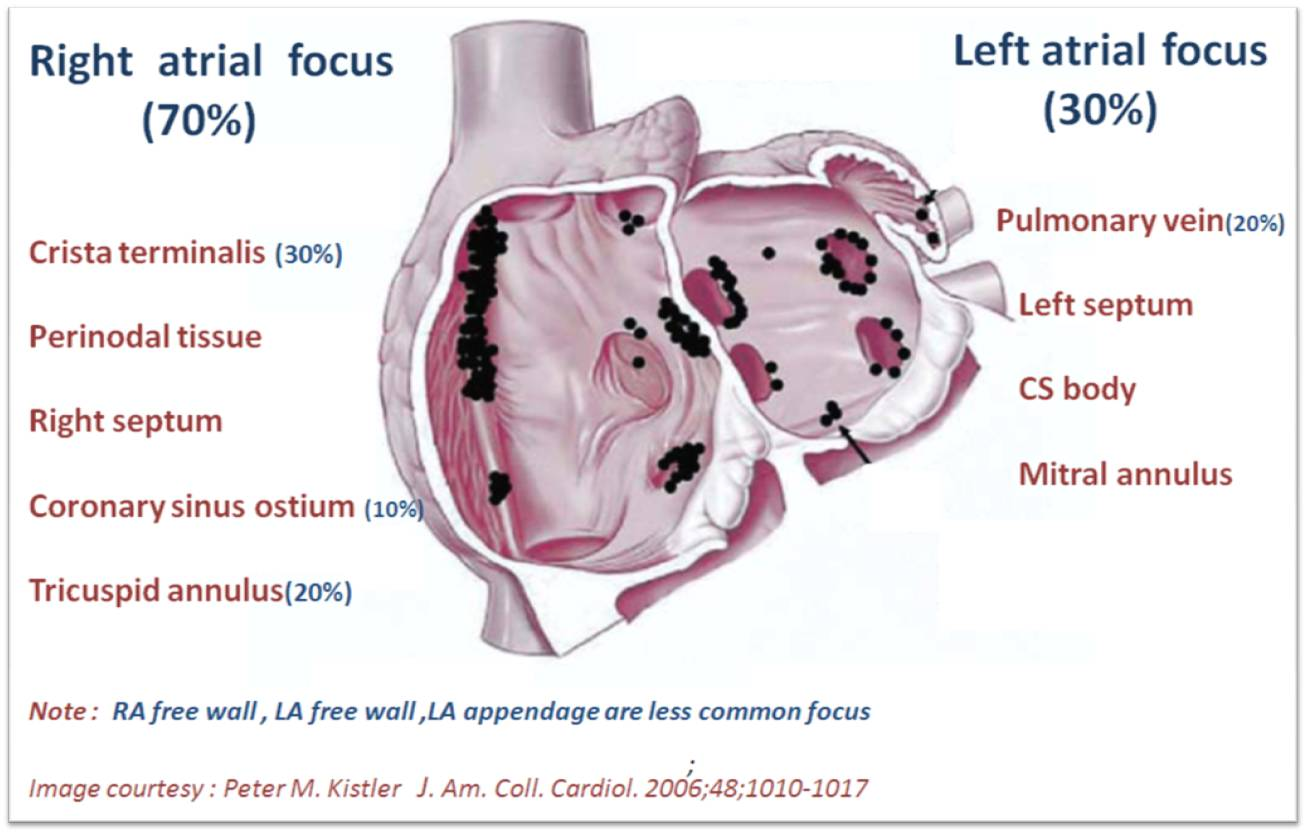
If we look at the above map,RA prevails over LA convincigly in termes of focal atrial tachycardia. Only 20% of focal AT arise from pulmonary veins. I guess, the same should be true for AF.

Focus-less Atrial fibrillation

Right from the days of James Mckenzie, when AF was refered to as delirium cordis or ataxia of pulse, AF was always considered as a chaotic, focus-less arrhythmia. It is still true in many cases. The recent pulmonary vein triggers are just a small revelation and need not be a revolutionary paradigm shift , as we are taught. There are innumerable patients who develop de-novo AF without any focus. Hypoxic or acidotic milleu of a single atrial myocyte can iniitiate an AF, alosan episode of atrial ischemia, diffuse inflammation as in atrial epi-myocardiits can trigger AF from any spot on the atrium.

Reference
1.Francis Marchlinski Cory M. Tschabrunn Pasquale Santangeli , Maciej Kubala J Am Coll Cardiol EP. 2019 Nov, 5 (11) 1328–1330

2.Yang, S.Y., Cha, MJ., Oh, H.J. et al. Role of non-pulmonary vein triggers in persistent atrial fibrillation. Int J Arrhythm 24, 7 (2023). https://doi.org/10.1186/s42444-023-00088-0

3.Aronson JK. One hundred years of atrial fibrillation. Br J Clin Pharmacol. 2005 Oct;60(4):345-6. doi: 10.1111/j.1365-2125.2005.02501.x. PMID: 16187965; PMCID: PMC1884824.

Read Full Post »

Wide qrs tachycardia has a unique place in clinical electrocardiography .It is  a much fancied and glamorous entity for the simple reason , it continues to be the  cardiologist ever solved puzzle .For over three decades of research, clinical debates , symposiums , seminars have effectively failed to take away the uncertainties in decoding the wide  QRS  tachycardia . (Specifically ,  VT vs SVT with aberrancy)

Some wondered , should we really waste our efforts in differentiating the two . In emergencies it never matters , in fact one need  not attempt to do this often futile exercise !

Few dedicated criterias like Brugada etc have helped us .

While the difficulties in differentiating between VT and SVT with aberrancy remain over the decades .A less reported  , but more common issue is  confronting  us .

It is  the big question of  differentiating a  wide  QRS tachycardia from a narrow QRS  tachycardia

wide qrs tachycardia vt svt aberrancy

This  occurs  more often than we realise  ,because we define wide  QRS  tachycardia in a vague manner

  • Normal qrs width between Up to 80 / up to 100 ms acceptable  ?*
  • Narrow qrs tachycardia 80 ms?
  • Wide qrs tachycardia i> 120ms  ?
  • Definitely wide qrs >140msec

* The confusion is mainly because 20ms difference between limb leads and chest leads .

In reality one may not be able to all  tachycardia into narrow or wide .

There is big  overlap zone that need to be labeled a intermediate qrs tachycardia

If we can  triage the tachycardias into three instead of two it may help us arrive  fast  ,  to the  correct diagnosis

Narrow QRS tachycardia ( qrs 80ms)

  • Sinus
  • All svtS (avnrt etc)

Intermediate QRS tachycardia 90-120

  • Most of the SVT with  aberrancy  ( Except antidromic SVTs which are really to wide !)
  • Septal VTs*
  • Fascicular VTs*
  • VT in PPM and ICD /CRT patients **

*  Any VT that arise near the major conducting system of ventricle conduct  fast and hence qrs are relatively narrow.

**These are rare entities where  base line wide QRS getting narrower with the onset of VT . (Ref : http://europace.oxfordjournals.org/cgi/content/full/eun254v1)

Wide qrs tachycardia >120ms

  • Most of the genuine VT (Ischemic , myocardial origin)
  • Post MI VTs
  • SVT aberrancy especially AVRT
  • Any SVT with preexisting BBB
  • Marked electrolytic disorders

Unresolved questions

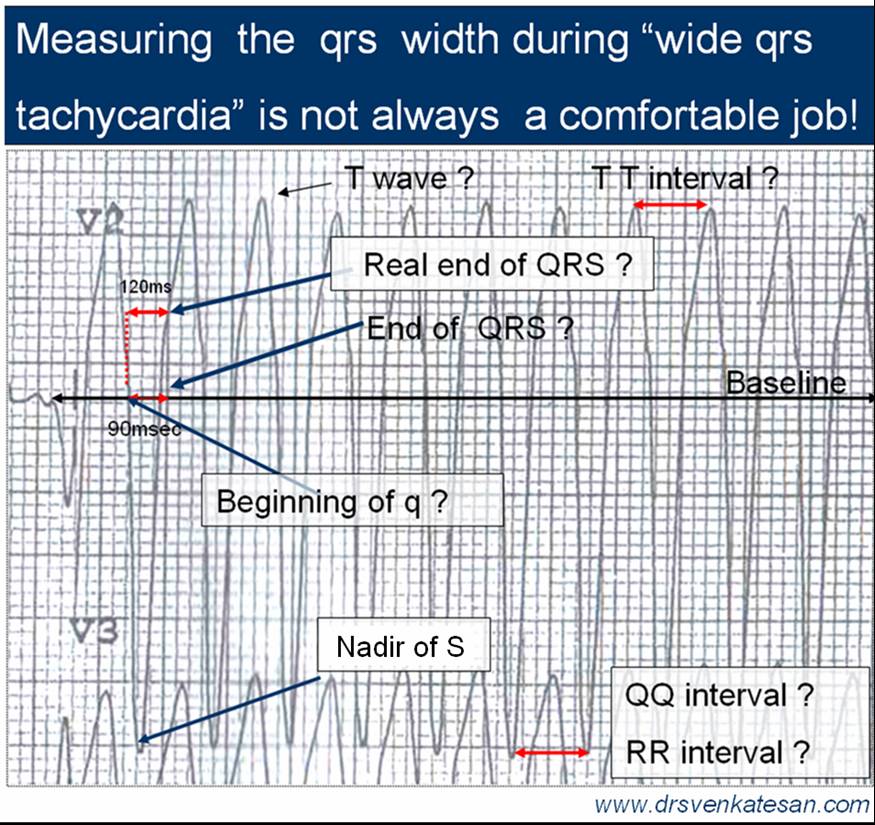
  • Which lead we should look for measuring the width of qrs ?
  • Should we take the narrowest qrs or widest qrs or should we take the average ?
  • Should we calculate how much the tachycardia has widened the qrs from the baseline  width of a given patient ?  Is it not possible , what is wide for some may be normal for another !
  • If  there is no isoelectric line  and ST segment  blends with qrs complex  how to mark end of qrs ?
  • If  limb leads show a narrow qrs and chest leads shows  wide qrs what is the significance  ?
  • In precardial leads  if one lead alone shows a narrow qrs , what is the significance ?
  • Can a narrow qrs VT conduct  with aberrancy and making it  really  wide ?

Final message

When we are  able to solve   complex electrophysiological  problems  , we must also realise  even   simple  tasks can be demanding in medicne ! It is proposed to create a  new  group “Intermediate QRS tachycardia “that can help solve the issue where we have difficulty in labeling these  tachycardias which fall  in the  greyzone .We can try &  apply the modern EP based VT criterias  to this group and find out the hidden truths !

Read Full Post »
