Feeds:
Posts
Comments

Posts Tagged ‘pulse field ablation’

“Medical care is sought after and delivered with all sincerity and kindness. It is never meant to be sold over the counter” My mentor and respectful professor used to tell us, many decades ago during our undergraduation days. That was a bygone era. Forget it, let us come to the real world.

This ad came two days ago in a India’s leading daily :The Hindu
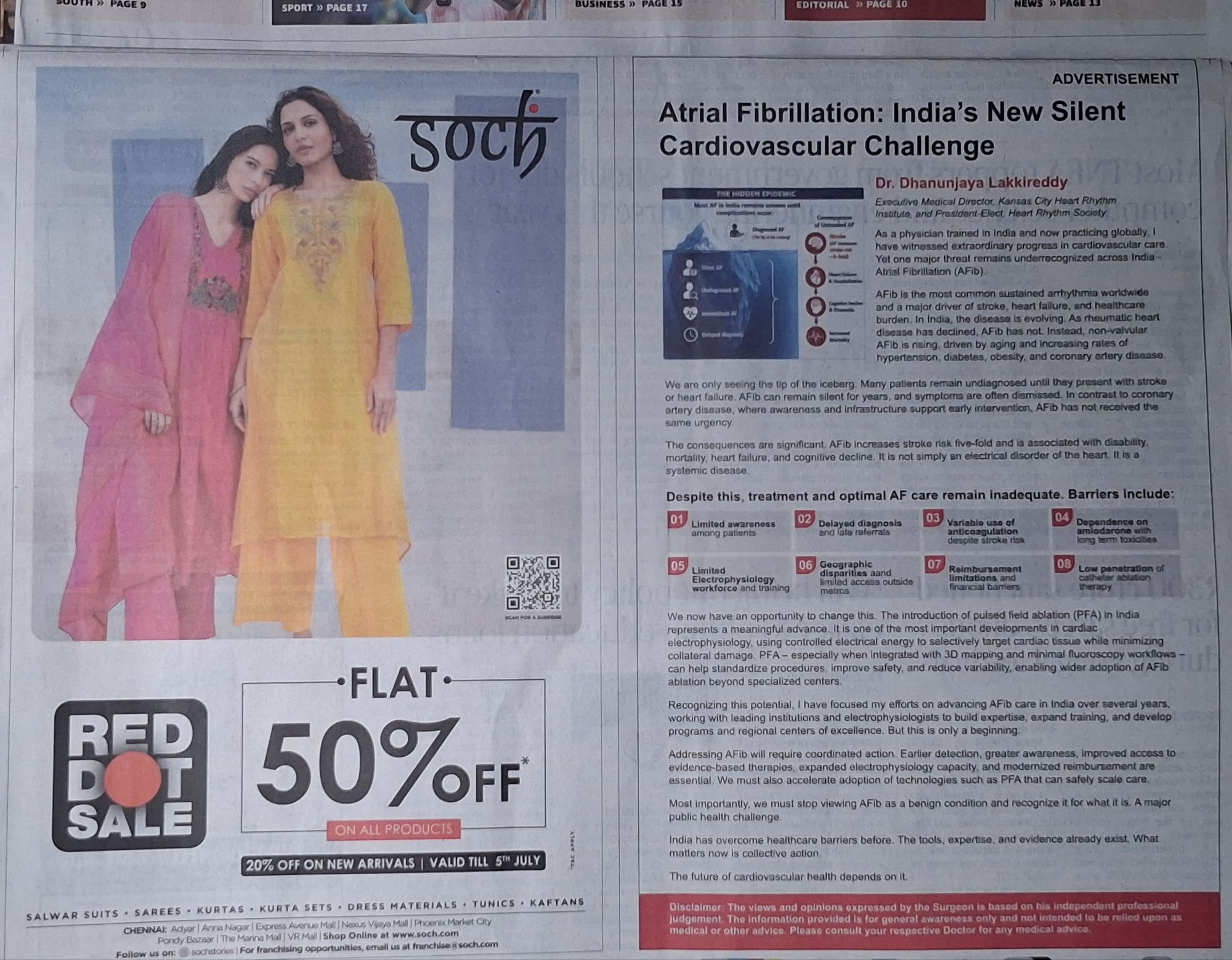
With all three limbs of the medical profession, namely patient care, teaching, and medical research, under the clutches of commerce and industry, there is  no surprise at all, to find this ad in the mainstream media.

How big is the AF burden ?

Atrial fibrillation is a common arrhythmia of the elderly. In that sense, it is more prevalent in the western population where life expectancy is high. AF is more of a nuisance arrhythmia in an otherwise normal heart, which requires stroke prevention strategies like antiplatelet agents or OAC/DOACs. In a hemodynamic perspective it is largely benign arrhythmia , 95% of which can be managed with simple rate modulating drugs like Digoxin and Beta blockers .The costly and often riskier catheter based rhythm restoring modalities still have questionable value except in a fraction of the AF population.

What could be the aim and intention of the above advertisement?

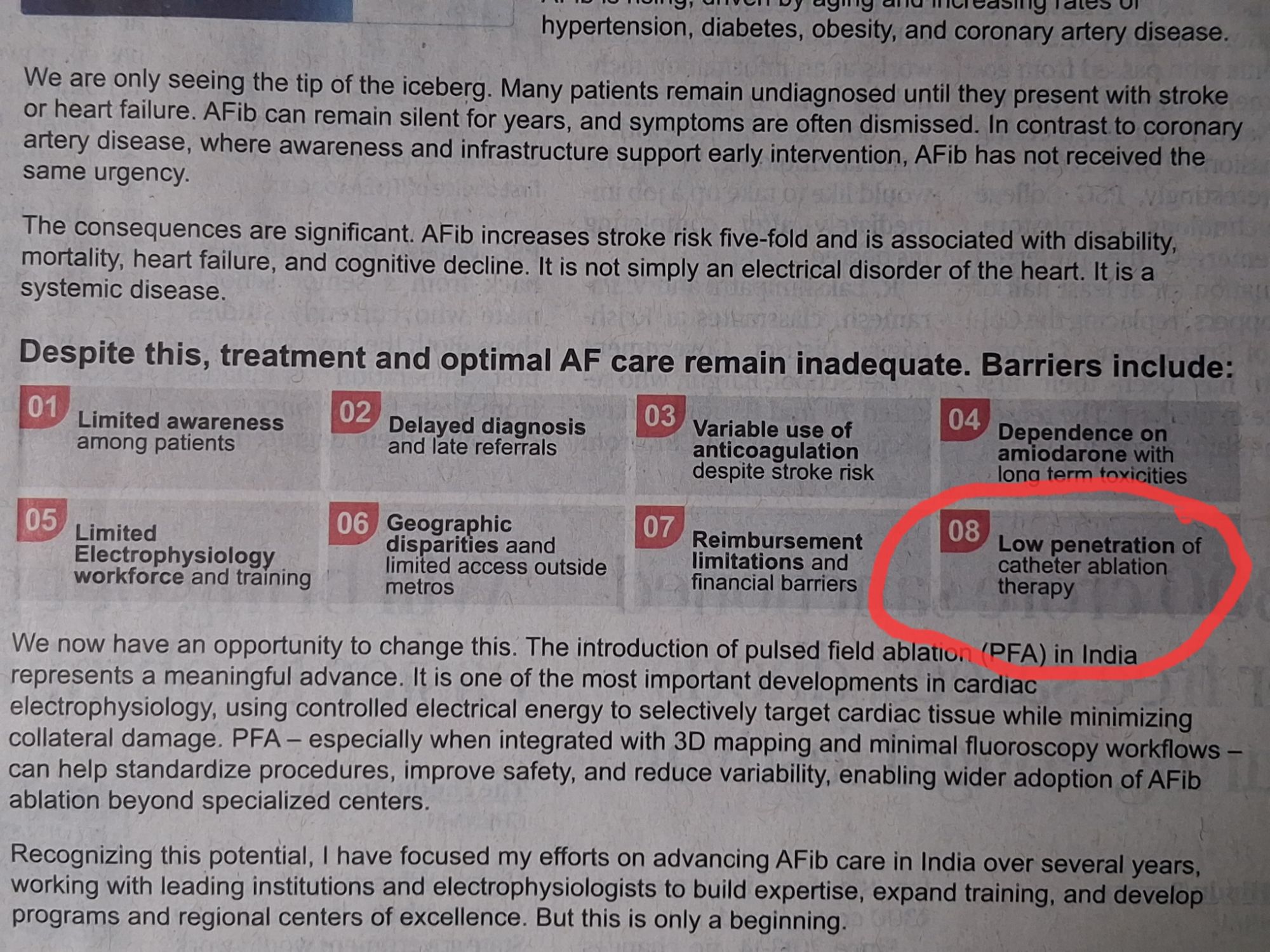
Big companies want to sell complex medical devices and procedures for AF directly to the public.The funny  thing in the ad is , while India is grappling with the task of providing basic health amenities  like ECG machines in every primary health center  , yet this ad expresses serious concern about the low penetration of a new, cost-ineffective, technology called “pulse field ablation” to treat AF.
Final message

I think, Govt of India should seriously consider banning such adverse health Influencing ads. direct to public.
Read Full Post »

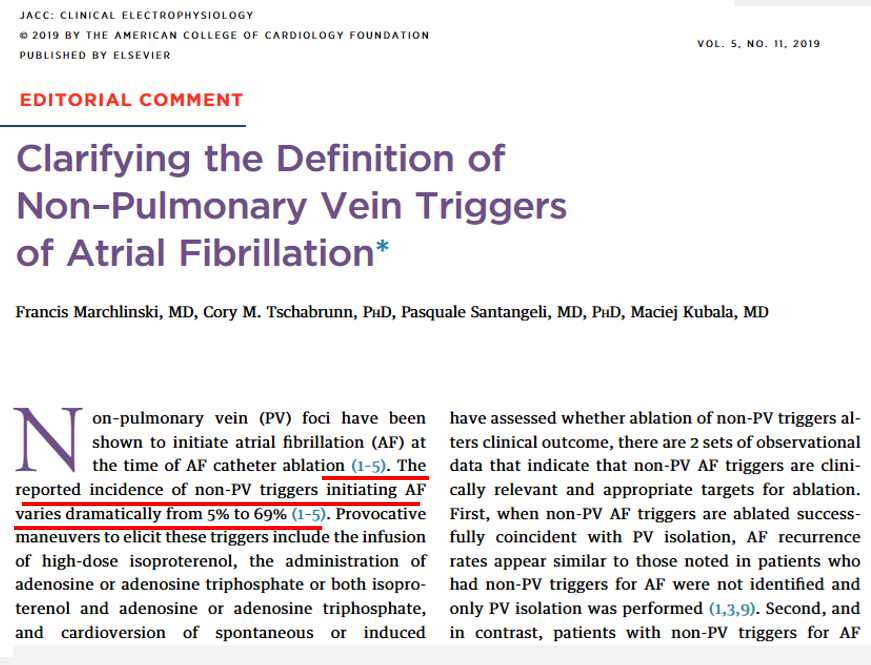
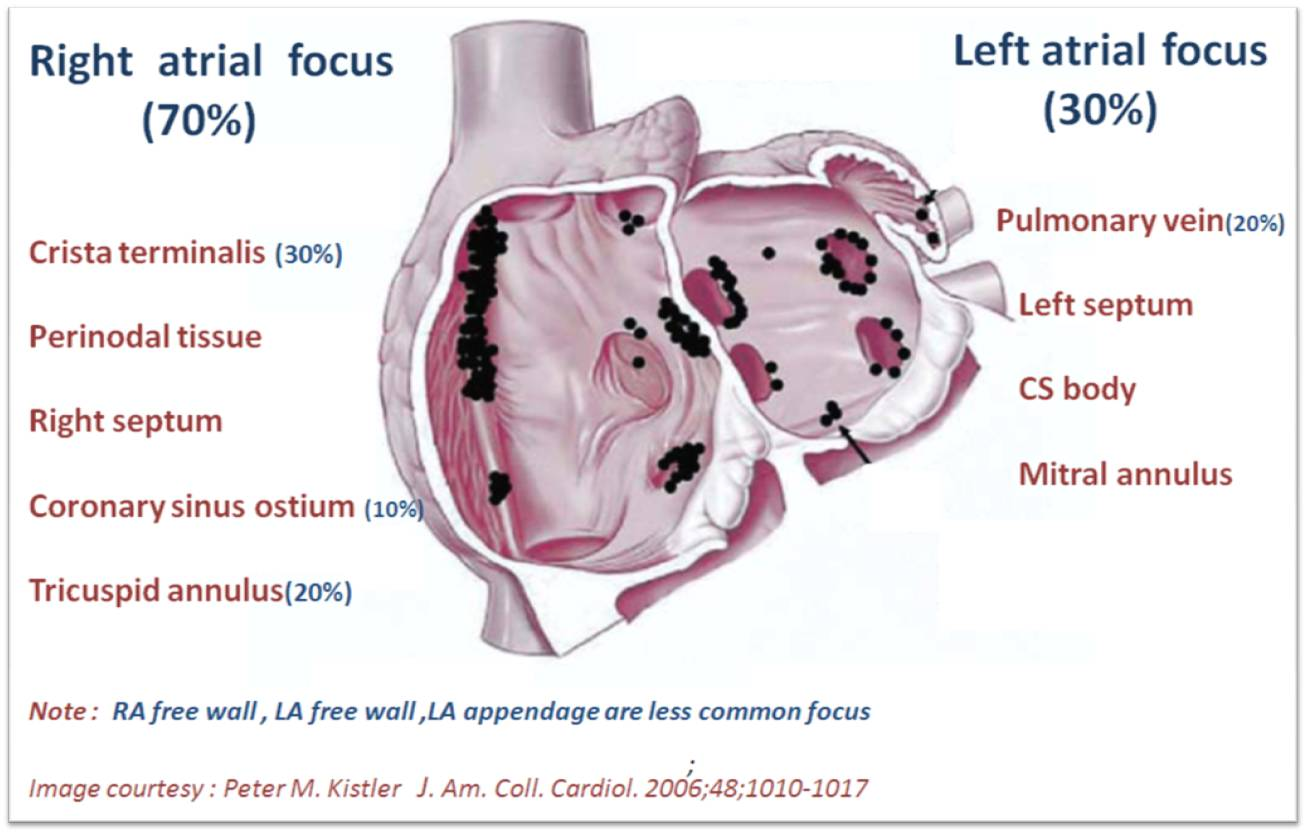
For right or wrong reasons, the world of electrophysiology has pushed us into a belief system that, if it is AF, the culprit must be pulmonary veins. In fact, non-pulmonary vein origins can be a staggering 70% in some series. (See below) It can be in the free walls of the left atrium, LA appendage, IAS, IV, SVC junctions, coronary sinus, ligament of Marshall, crista terminalis, etc. (Ref 2)

For example , where will be the initial focal trigger for AF in a pateint with COPD ?

Can you ever think of ablating PVs in a patient with AF and COPD, where the right atrium is under stress and strain? It doesn’t require any extraordinary intelligence to conclude any chronic focal atrial tachycardia can get degenerated to AF in the long run. In that case, the famous atrial tachycardia localizing map from Peter Kistler et al from Australia JACC 2006 holds good for location AF focus too.

If we look at the above map,RA prevails over LA convincigly in termes of focal atrial tachycardia. Only 20% of focal AT arise from pulmonary veins. I guess, the same should be true for AF.

Focus-less Atrial fibrillation

Right from the days of James Mckenzie, when AF was refered to as delirium cordis or ataxia of pulse, AF was always considered as a chaotic, focus-less arrhythmia. It is still true in many cases. The recent pulmonary vein triggers are just a small revelation and need not be a revolutionary paradigm shift , as we are taught. There are innumerable patients who develop de-novo AF without any focus. Hypoxic or acidotic milleu of a single atrial myocyte can iniitiate an AF, alosan episode of atrial ischemia, diffuse inflammation as in atrial epi-myocardiits can trigger AF from any spot on the atrium.

Reference

1.Francis Marchlinski Cory M. Tschabrunn Pasquale Santangeli , Maciej Kubala J Am Coll Cardiol EP. 2019 Nov, 5 (11) 1328–1330

2.Yang, S.Y., Cha, MJ., Oh, H.J. et al. Role of non-pulmonary vein triggers in persistent atrial fibrillation. Int J Arrhythm 24, 7 (2023). https://doi.org/10.1186/s42444-023-00088-0

3.Aronson JK. One hundred years of atrial fibrillation. Br J Clin Pharmacol. 2005 Oct;60(4):345-6. doi: 10.1111/j.1365-2125.2005.02501.x. PMID: 16187965; PMCID: PMC1884824.

Read Full Post »
