Feeds:
Posts
Comments

Archive for May, 2026

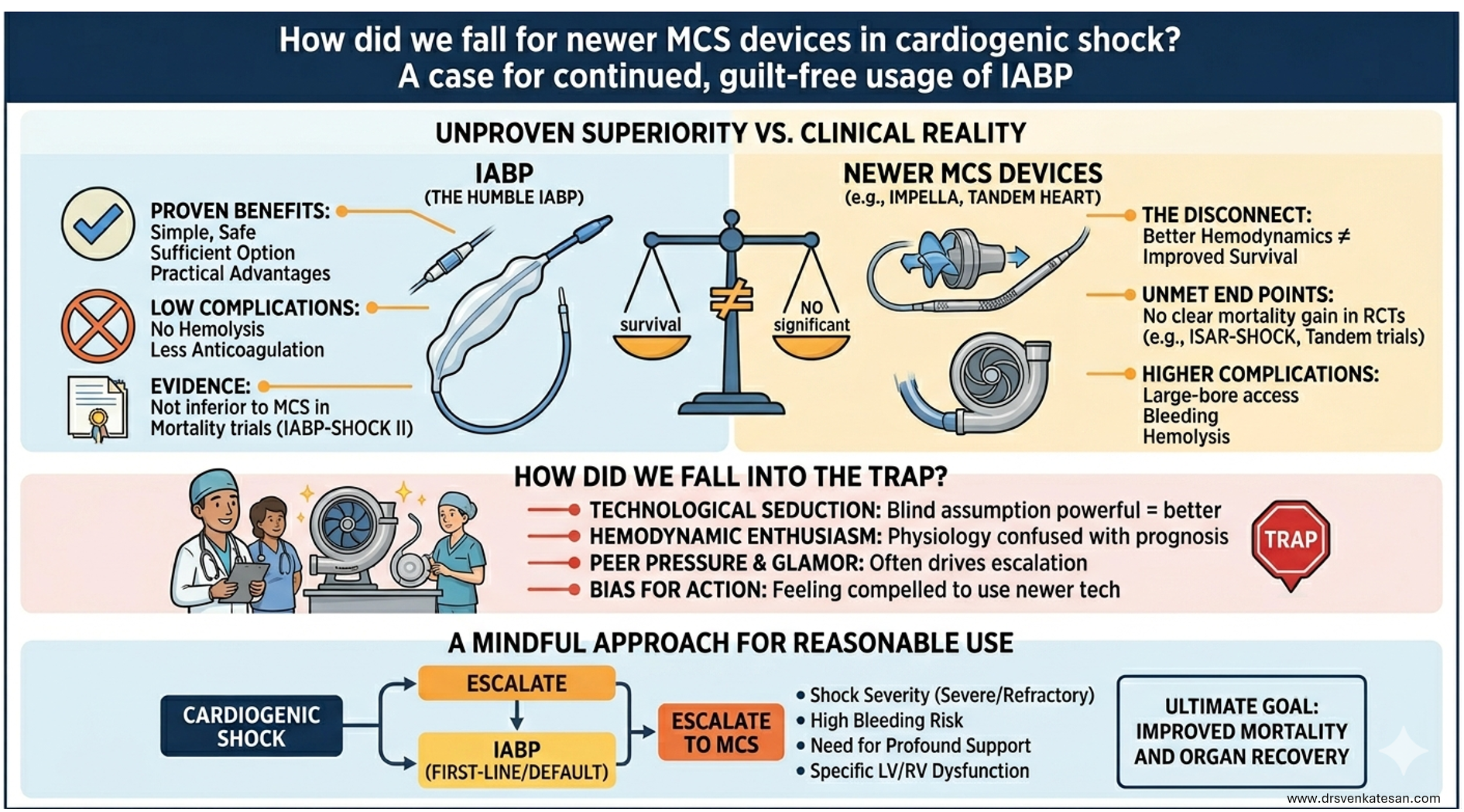
The rise of percutaneous mechanical circulatory support (MCS) in cardiogenic shock is phenomenal.  This has happened inspite  of the fact no RCTs proved, that they are superior to the humble IABP. For most patients, IABP remains a simpler, safer, and often sufficient.

How did we fell into the trap?

Cardiogenic shock is a setting where technology can appear decisive even when evidence is uncertain. Devices that generate more flow and better filling pressures naturally attract attention, but physiology is not the same as prognosis. The real question is whether a device improves survival, organ recovery, and quality of life. Newer MCS devices have not convincingly reached that end point over IABP.

What do the evidence for Impella and Tandem heart tell us ?

Though IABP-SHOCK 2, trial pulled the IABP down,  there were significant flaws in the design. In ISAR-SHOCK, Impella improved early hemodynamics, but 30-day mortality was unchanged. The Tandem Heart trial showed better hemodynamic support than IABP, but no survival benefit. Meta-analyses show the same pattern, better hemodynamics, no clear mortality gain. This the shocking truth from Shock trial, still not good enough to touch the conscience of most of us.

Where is the Disconnect ?

This disconnect comes from the fact that, cardiogenic shock is much more complex than simple interruption of blood flow from the heart. Timing of onset of shock , infarct size, right ventricular dysfunction, inflammation, renal failure, bleeding, and access complications all shape outcome. A device that improves pressure may still be too late or too harmful to change survival. Hemodynamic superiority alone is not enough.

Are the advantages of IAPB real ?

IABP retains practical advantages. It is easier to implant, widely available, less expensive, and less demanding in expertise and monitoring. It avoids large-bore access and the same intensity of anticoagulation and hemolysis surveillance. In many patients with moderate shock or early response to reperfusion, it provides adequate bridge support. The issue is not whether IABP is the most powerful device, but whether it is good enough for many patients. Often, it is.

Where should we use the newer MCS?

A more mindful approach is needed. Newer devices should not be dismissed, but routine escalation should not be the default strategy.. Device choice should be based on shock severity, vascular risk, anticipated support duration, right ventricular function, and the chance of meaningful benefit.

Why we have fallen for these newer MCSs?

The uncomfortable truth is we have fallen for technological seduction . Other factors are peer pressure, glamor and pride Randomized trials remain the best test of survival superiority, and so far they have not shown that newer MCS beats IABP in CS.

References

  1. Thiele H, Zeymer U, Thelemann N, et al. Intraaortic balloon pump in cardiogenic shock complicating acute myocardial infarction: long-term 6-year outcome of the randomized IABP-SHOCK II trial. Circulation. 2019;139(3):395-403. PubMed
  2. Seyfarth M, Sibbing D, Bauer I, et al. A randomized clinical trial to evaluate the safety and efficacy of a percutaneous left ventricular assist device versus intra-aortic balloon pumping for treatment of cardiogenic shock caused by myocardial infarction. J Am Coll Cardiol. 2008;52(19):1584-1588. PubMed
  3. Burkhoff D, Cohen H, Brunckhorst C, et al. A randomized multicenter clinical study to evaluate the safety and efficacy of the TandemHeart percutaneous ventricular assist device versus intra-aortic balloon pumping for treatment of cardiogenic shock. J Am Coll Cardiol. 2006;48(11):1925-1932. PubMed
  4. Ouweneel DM, Eriksen E, Sjauw KD, et al. Percutaneous mechanical circulatory support versus intra-aortic balloon pump in cardiogenic shock: a systematic review and meta-analysis. J Am Coll Cardiol. 2017;69(3):278-287. PubMed
  5. Hochman JS, Sleeper LA, Webb JG, et al. Early revascularization in acute myocardial infarction complicated by cardiogenic shock. N Engl J Med. 1999;341(9):625-634. PubMed

Read Full Post »

The primary treatment for end-stage heart failure is heart transplantation, but due to organ shortage and the poor progress in our pursuit for total artificial hearts, LV assist device (LVADs) have evolved from being a bridge to transplantation to destination therapy. Currently, the HeartMate 3 is the leading device in its third generation of LVAD. This fully magnetically levitated centrifugal LVAD reduces shear and thrombosis, outperforming HeartMate II with fewer pump thrombosis events, strokes, and improved 5-year outcomes. Landmark data from the MOMENTUM 3 trial shows that the median life expectancy has surpassed 7 years, with some patients living 9 years or more.

Can LV assist be destination therapy ?

The answer seems be definite yes

How does it compare with transplantation ?

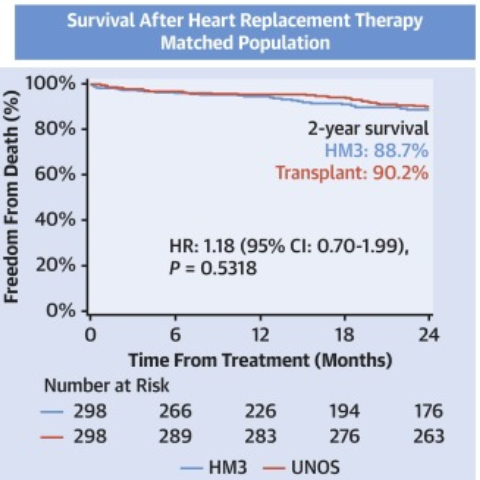
Good , in fact very good for atleast for the first 2 years.See below

Data from : Uriel N, Sayer GT, Elad B, Fried JA,. Heart Replacement Therapy in Young Patients: A Comparative Analysis of HeartMate 3 LVAD and Heart Transplant Using MOMENTUM 3 and UNOS Registry. JACC Heart Fail. 2026

How many Heart mates device are implanted world wide every year?

About 40 to 50,000s HeartMate devices are implanted every year

Is Heartmate 3 availbe in India ? Whts is the csot ?

Yes , Heart mate 3 is available in India . The complete surgical procedure and device typically cost between ₹75 Lakhs and ₹ 100Lakhs ($75,000 to $100,000). While cost is one issue , patient’s involvement , commitment , family support is equally or if not more important to administer this therapy.

Is the expertise to mange LVAD avaiable in India ?

The device is available, but expertise in device management is still not optimal , even in large hospitals due to low case volumes.

Any alternative to Heart mate 3?

Medtronic HeartWare HVAD were recalled by FDA for major technical issues in 2021.Another device Eva heart from Japan with a pulsataile pumping technology shows some promise. .Ref Allen COMPETENCE Trial: The EVAHEART 2 continuous flow left ventricular assist device. J Heart Lung Transplant. 2023 .The superiority of pulsatile vs continuous pumps is a different debatable topic )

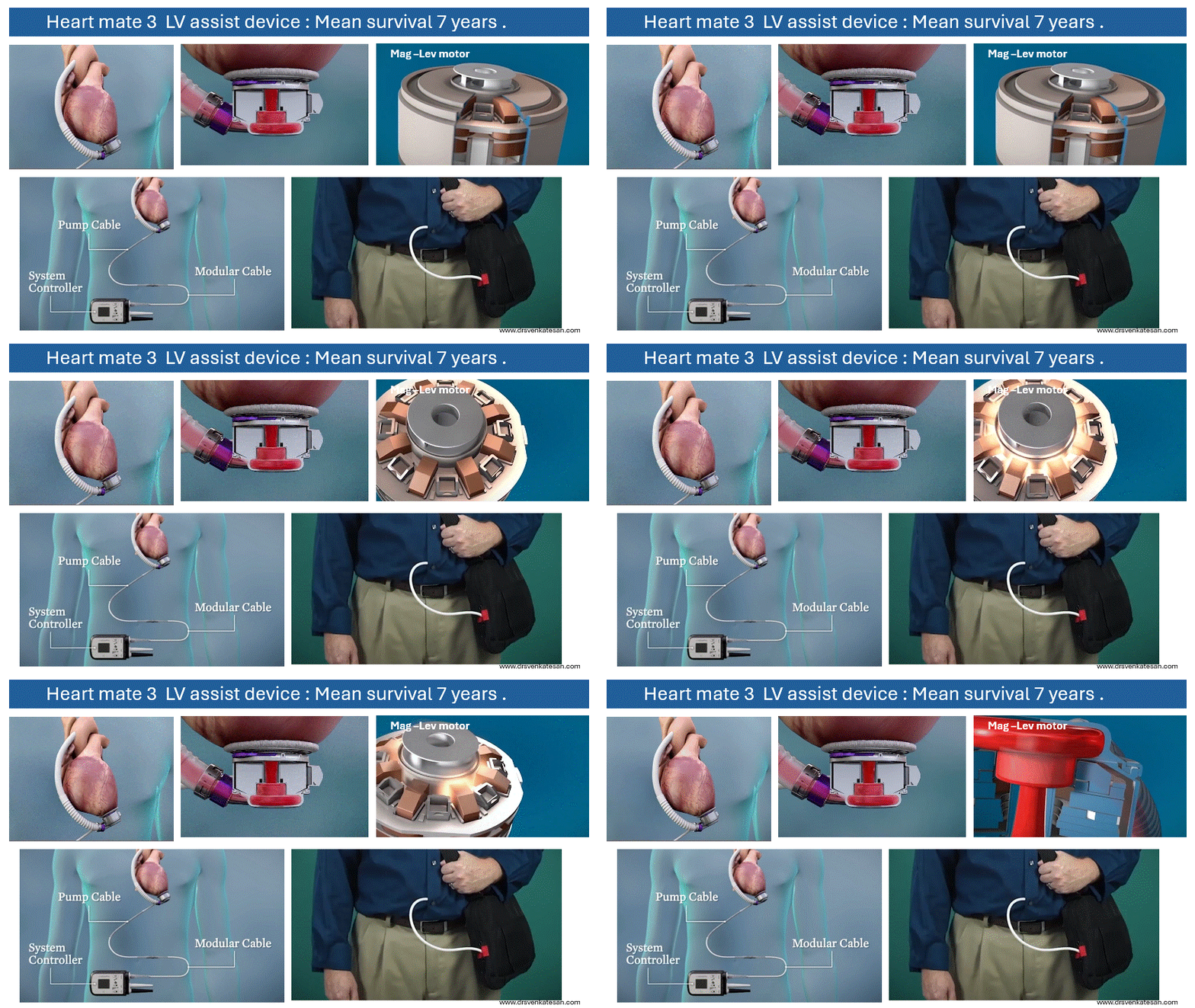
An illustration  about Heart mate .

A true story from a patient on Heart mate 3

Final message

Published studies show that modern LVADs (by default means Heart mate-3) trying to compete with heart transplants. Transplanted hearts has its own un-limited energy to pump ,LVADs are like maintaining a live automobile inside the chest , requiring constant monitoring and energy resource. Also, most importantly LVADs can’t look beyond LV ,and overlook RV function, while heart transplants replace all four chambers, unlike HeartMate, which assists only one chamber.( Of course, isolated LV failure is the culprit in 80% , that’s why LVADs , still could be a good option in many)

Reference

1.Legtenberg S, Ter Maaten JM, Erasmus ME,et al Long-term outcomes of patients implanted with a HeartMate 3 left ventricular assist device-a real-world, single-centre, observational study. ESC Heart Fail. 2026 Mar 3;13(2):xvag074. doi: 10.1093/eschf/xvag074. PMID: 41812231; PMCID: PMC13036835.

2.Mehra MR, Uriel N, Naka et al MOMENTUM 3 Investigators. A Fully Magnetically Levitated Left Ventricular Assist Device – Final Report. N Engl J Med. 2019 Apr 25;380(17):1618-1627. doi: 10.1056/NEJMoa1900486. Epub 2019 Mar 17. PMID: 30883052.

3.Boburg RS, Marinos SL, Baumgaertner M, Rustenbach et al Nine Years of Continuous Flow LVAD (HeartMate 3): Survival and LVAD-Related Complications before and after Hospital Discharge. J Cardiovasc Dev Dis. 2024 Sep 30;11(10):301. doi: 10.3390/jcdd11100301. PMID: 39452272; PMCID: PMC11508271.

Read Full Post »

Here is a brand new study on Digoxin from AIIMS-India , in 2026 that triggered this post. (Ref 2)

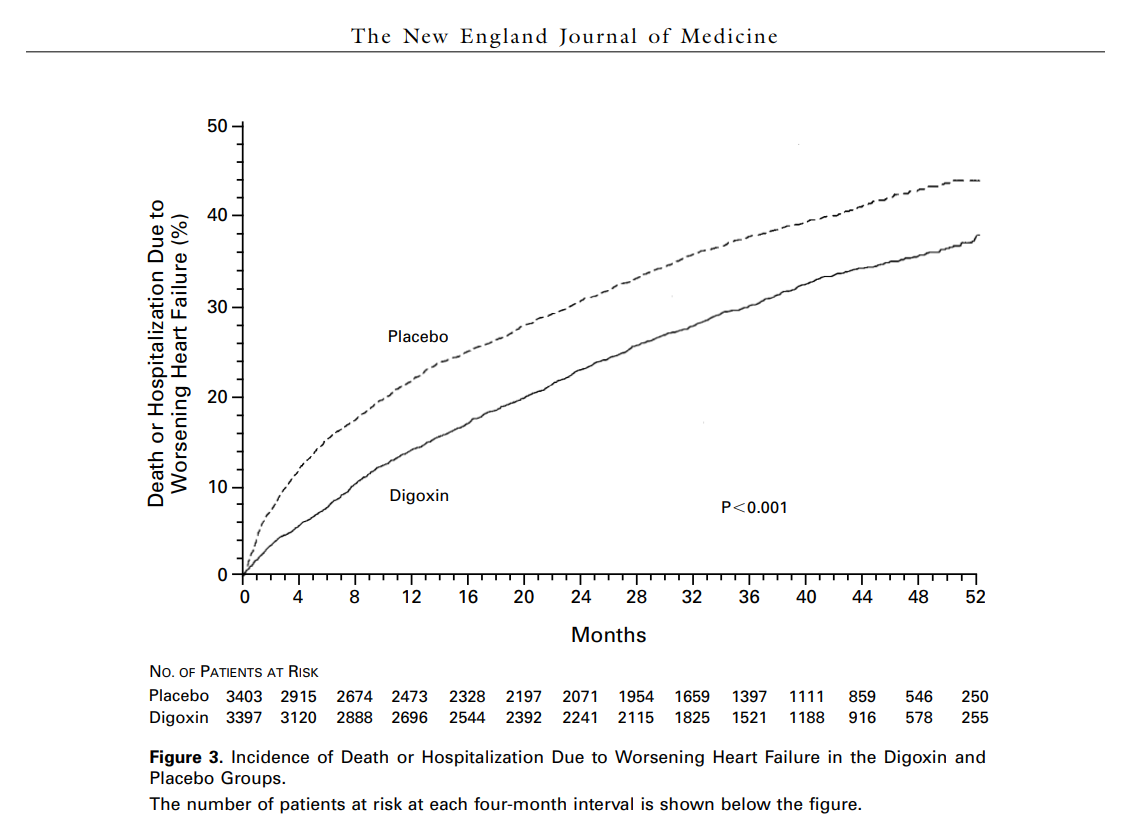
The DIG trial published more than 3 decades ago,(1997) was a landmark study, that applied a disruptive break on the widespread usage of digoxin in heart failure for all the wrong reasons. It is one of the good examples of , how badly the mainstream academia could interpret a study. Though the study showed a consistent reduction in worsening heart failure and hospitalization, yet no overall mortality benefit was accrued in the full trial population. This apparent paradox deserves a more careful interpretation. We need to ask one simple question.

Did the DIG trial reported how many acute deaths (In hospital) occurred among patients who were on digoxin and who weren’t ?

The answer is No. While the paper details how many patients were hospitalized and how many died of  heart failure, it does not specify which of those heart failure deaths happened specifically while the patient was admitted in- hospital. Then, DIG trial also played the same old game of all major RCTs. Death and worsening heart failure was clubbed as a combined end point, for  analysis. So, we don’t know the exact acute deaths, that were prevented by Digoxin. Why no one asked this question for so long ?

Did we mis-understand the DIG-Trial ?

Further, it is plausible Digoxin’s   life-saving role probably  lies in  preventing the decompensated episode itself.

Of course,  patients ( Who were non on digoxin)may still survive because modern therapy , with powerful diuretics, ventilation, inotropes, and intensive care .Still, we  know there is a specific (could be high ) mortality rate in all acute decompensated heart failure cases despite the best treatment. The statistics ignored those lives that were lost due to decompensation , because of non-administration of digoxin.

Modified version of for DIG-Trial conclusion

“Digoxin may save lives by reducing the frequency and severity of decompensated heart-failure episodes, thereby preventing some acute deaths and the need for ICU care. However, DIG trial failed to show an overall mortality benefit in the study population in long term. This is understandable, as heart failure is a progressive disease.”

Final message

It doesn’t make sense to make a blanket statement that Digoxin doesn’t prevent deaths in heart failure. However huge/ popular a study may be, it need to undergo scrutiny  beyond evidence and  statistics. How ? They should be subjected to the vigorous test of bedside trial on individual patient* , common sense and experience.(* Recall N-1 study Ref 4)

Reference

We are gathering more evidence in favor of Digoxin in recent times.

1.DIGIT-HF study

2.Karthikeyan G, Devasenapathy N, Ghosh A, et al. Digoxin in Patients With Symptomatic Rheumatic Heart Disease: A Randomized Clinical Trial. JAMA. Published online May 10, 2026. doi:10.1001/jama.2026.7335

3.Digitalis Investigation Group. The effect of digoxin on mortality and morbidity in patients with heart failure. N Engl J Med. 1997 Feb 20;336(8):525-33. doi: 10.1056/NEJM199702203360801. PMID: 9036306.

4.Duan N, Kravitz RL, Schmid CH. Single-patient (n-of-1) trials: a pragmatic clinical decision methodology for patient-centered comparative effectiveness research. J Clin Epidemiol. 2013 Aug;66(8 Suppl):S21-8. doi: 10.1016/j.jclinepi.2013.04.006.

Read Full Post »

1977 : Andreas Grüntzig’s made history and stunned the world by opening up a coronary stenosis with a hand made balloon in his now iconic Zurich cath lab .No stent, no drugging. It was called POBA then. His famous patient had a patent coronary artery for the next 18 years. This is the beginning of the era of PTCA. By 1990s stents were made almost mandatory fearing reocclusion. They were bare metals then . By year 2002, stents were drugged to prevent restensois. That was the era of DES. The bare metal stents died a premature death. Curiously, by mid 2010, DES also became a suspect , Bio absorbable scaffold  came in (A short lived self demising stent) It got into serious  problem of patchy reabsorbtion and prohibitive events.Thus,again DES became the undisputed tool in PCI.

Fast-forward to 50 years:  Some good samaritans decided to take on the fight with stents , and are  trying to restore  the bygone, balloon era now.But, they didn’t have courage to use Gruntzig’s  POBA. They wanted something more. It came in the form of DEB. Now, it  has become omnipresent. Suddenly, even in complex  lesions  including left main, bifurcations, ACS, and distal lesions, DEBs are rendering stents as “enemy.”

The real question to the cardiology community should be this . Is DEB truly revolutionary, or is it just a DOBA (drug-on-balloon angioplasty) a plain old balloon angioplasty (POBA) with a false crown ?

Logically and realistically ,every DEB transforms into POBA within 24 hours as the anti-proliferative drug dusted over the coronary lesion get washed away. There may be a dozen studies , that vouch for the DEB’s ability to prevent restenosis. But , the true efficacy of the DEB-PCI is accrued from the “B not from the D”. What we require is , an astute , discrete balloon dilatation at the right place and time. Yet in India, we have fallen for the DEBs that cost ₹3,0000 more to shed its metal jacket.

Final message

DEB has some evidence for benefit only in  ISR. There is no single large one to one study that compared POBA vs DEB in denovo coronary lesions.So,the apparently provocative title of this post, is largely a fact.

False science coated with commerce can be as addictive as a narcotic. The cardiology community is experiencing this on a regular basis. At the least, one must realise this , forget about coming out of it.

Post-amble

Distal D-Wash after a POBA a perfect new PCI

A cheaper ,unconventional coronary intervention is proposed by the author, called Distal D wash. After performing a POBA over an intermediate lesion, push and inflate the same balloon distally to the maximum in the RCA/LAD, inject sirolimus locally with a dwell time of 1-2 minutes to allow a rinse*. This method could treat not only the lesion and protect entire vessel from future atherosclerosis , at a fraction of the cost of DEB.(A truly cranky Idea, but might be perfect for a new start up)

*Like surgeons wash the wounds while dressing with mixture of antibiotics etc.

Read Full Post »