Feeds:
Posts
Comments

Posts Tagged ‘starr edwards valve’

This post was written after coming across a case report  Oxford medical case report.


What is the life of a prosthetic Aortic valve?

The standard answer needs to be, mechanical valves can last up to 25  years or more. But, we are in a techno-conflict era.  Instead of working on the longevity of the valve, ( with concerns for long-term OAC )  we fell for the biological valves. Curiously, this has made the durability of the valve, a less relevant discussion in many centers. We get excited when some company brings out a long-lasting bio-prosthetic valve that can live up to a maximum of 15 years.

Now, the biological valve comes in a new avatar ie TAVI, in a big way. Soon, we may celebrate an event free 10 years after TAVI. Going percutaneous is transformative. But at what cost? Fusion of metallurgy, chemistry, and pharmacology should make it possible for in-vivo metal valves to be safe for 75 years of human life span. The irony is we almost had one, One valve’s longevity was consistently exceeding the patient’s life span,(at least as far as we observed in the Rheumatic heart disease)  This has been the star of all valves. We know what happened to that valve.
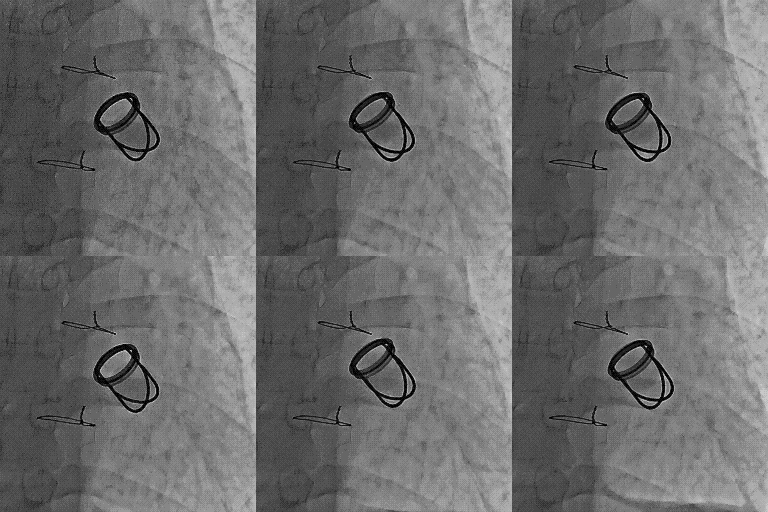
This SE valve in the mitral position

Final message

Most SE valves are implanted in the mitral position. Starr-Edward in an Aortic position working for 50 years is a big proof of reality. Of course, we can’t extrapolate with a single case report. We have stopped the production of these valves. So, there is no way to test it either. Anyway, cardiologists, cardiac surgeons, and finally the generation X, TAVI Innovators have something to learn from this case report. Forget Starr-Edwards, It looks like, there are some invisible forces that work against mechanical valves in recent times, which may not be good for our patients as of now. (There is something interesting related to this in Ref 2)

Future directions: Past need not be past

 Nothing is impossible for our hyper-talented scientists, except probably in the “faculty of looking back”  the past-Innovations (falsely labeled as obsolete) and bringing them again to optimal usage.  If cardiologists feel surgical AVR injures their interventional pride, how about a percutaneous cage delivered at the root of the aorta, after ablating native leaflets, followed by an inflatable silicone ball?

Reference 

1,Sabouni MA, Baumeister RH, Traverse P. 49 years of normal functioning Starr-Edwards aortic valve prosthesis. Oxf Med Case Reports. 2020 Feb 24;2020(2):omz141. doi: 10.1093/omcr/omz141. PMID: 32123569; PMCID: PMC7037059.

A current 2023, opinion from the renowned Dr. Catherine Otto on this Mechanical vs biological valve , Indications, current usage pattern, the cut-off age, etc 

2.Otto CM. Optimizing Age-Specific Outcomes After Mechanical vs Bioprosthetic Prosthetic Heart Valve Replacement. JAMA Netw Open. 2023;6(5):e2314628. doi:10.1001/jamanetworkopen.2023.14628


Read Full Post »

The prosthetic cardiac valve which saved so many lives  in the later half of 20th century is no more. A valve which is not only  known for its excellent durability  but also  devoid  of sudden  mechanical  occlusion , unfairly  lost its place  by the rival  mechanical  bileaft valves. (Supposedly superior hemodynamics !)

Here is a nice video  from Indian surgeon  which  describes the hardware of  Starr Edwards valve .

Please read a related article from my site

Who killed Starr Edwards valve ?

Read Full Post »

Prosthetic valve implantation has revolutionized the management of  valvular heart disease . The original concept valve  was a ball in a cage valve  , still considered as a  fascinating discovery.  It was conceived by the young Dr Starr and made by Engineer Edwards  .This was followed   by long hours of arguments,  debates and  experiments that ran into many months . The  silent corridors of  Oregon hospital Portland USA remain the only witness  to their hard work and motivation.  At last,  it happened , the first human valve was implanted in the year 1960. Since then . . . for nearly  50 years these valves  have done a seminal  job for the mankind.

With the advent of  disc valve and bi-leaflet valve in the  later decades of 20th century , we had to say a reluctant good-bye to this valve.

There is a  lingering question among many of the current generation cardiologists and surgeons why this valve became extinct ?

Starr and Edwards with their child !

We in India , are witnessing these old warrior inside the heart functioning for more than 30 years.From my institute of Madras medical college  which probably has inserted more Starr Edwards valve than any other  during the 1970s and 80s by Prof . Sadasivan , Solomon victor , and Vasudevan and others .

It is still a mystery why this valve lost its popularity and ultimately died a premature death.The modern hemodynamic  men  working from a theoretical labs thought  this valve was  hemodynamically  inferior. These Inferior valves worked  like a  power horse  inside the hearts  the poor Indian laborers  for over 30 years.

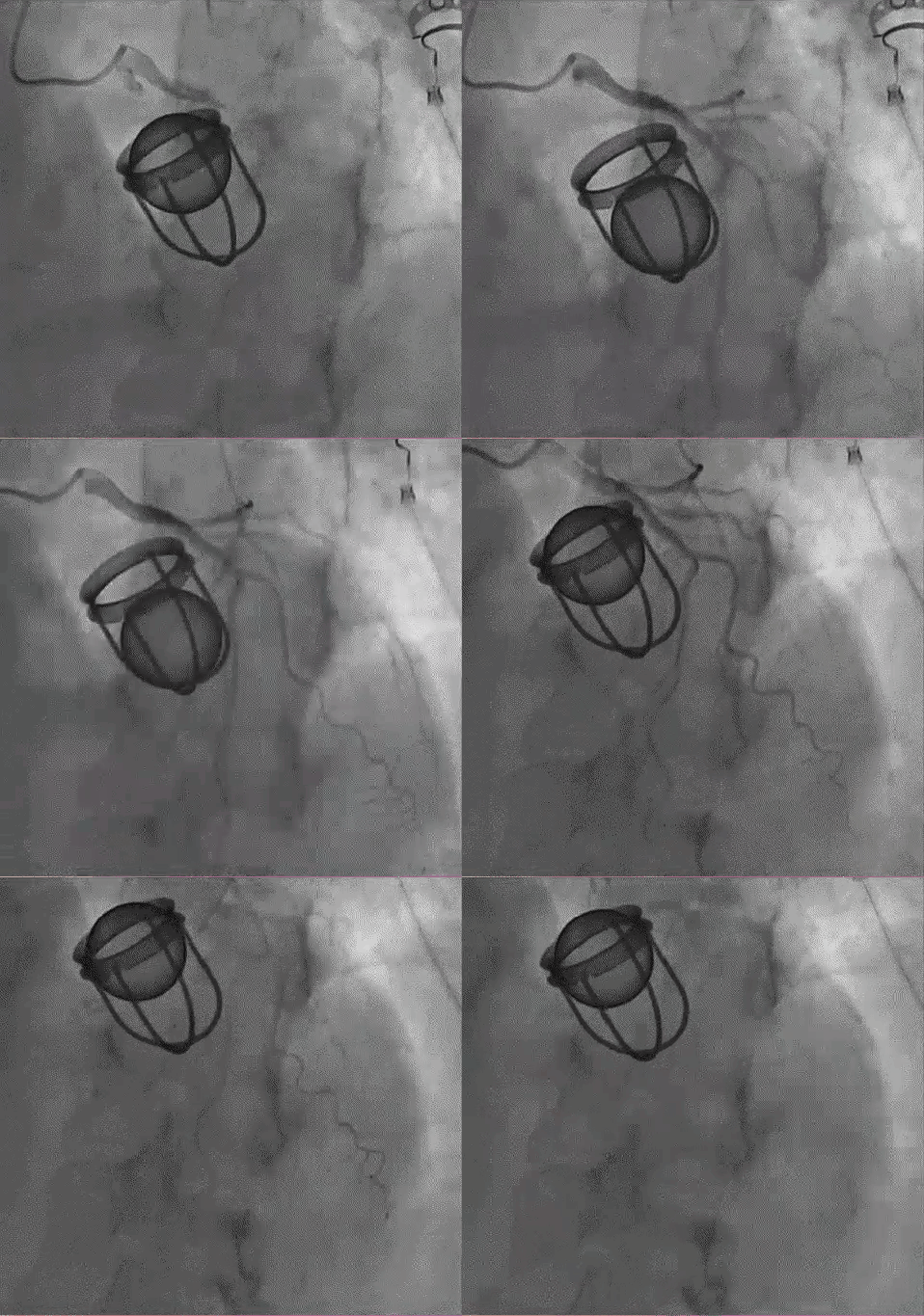
A Starr Edwards valve rocking inside the heart in mitral position

The cage which gives  a radial support* mimic  sub valvular apparatus, which none of the other valves can provide.

* Mitral  apparatus has 5 major  components. Annulus, leaflets, chordae, pap muscle, LV free wall.None of the artificial valves has all these components.  Though , we would love to have all of them technically it is simply not possible.  The metal cage of Starr Edwards  valve partially satisfies this  , as  it acts as a virtual sub valvular apparatus.Even though the cage has no contact with LV free wall, the mechano hydrolic  transduction of  LV forces to the annulus  is possible .

Further , the good hemodyanmics of this valve indicate , the cage ensures co axial blood  flow  across the mitral inflow throughout diastole. .Unlike the bi-leaflet valve ,  where the direction of  blood flow is determined by the quantum of leaflet excursion  in every beat . In bileaflet valves  each leaflet has independent determinants of valve  motion . In Starr Edwards valve the ball is the leaflet . In contrast to bi-leaflet valve , the contact area  of the  ball and the blood in Starr Edwards  is a smooth affair  and  ball makes sure  the LV forces are equally transmitted to it’s surface .

The superiority of bi-leaflet valves and disc valves  (Over ball and cage ) were  never proven convincingly in a randomized fashion . The other factor which pulled down this valve’s popularity was the supposedly high profile nature of this valve. LVOT tend to get narrowed in few undersized hearts.  This  can not be an  excuse , as no consistent  efforts were made to miniaturize this valve which is  distinctly possible.

Sudden deaths from  Starr Edwards valve  .

  • Almost unheard in our population.
  • The major reason  for the long durability of this valve is due to the  lack of  any metallic moving points .
  • Absence of hinge  in this  valve  confers  a huge mechanical  advantage with  no stress points.
  • A globe / or a ball  has  the universal hemodynamic advantage. This shape makes it difficult for thrombotic focus to stick and grow.

Final message

Science is considered as sacred as our religion Patients believe in us. We believe in science. A  good  durable valve  was  dumped from this world  for no good reason. If commerce is the  the main issue ( as many still believe it to be ! )  history will never  forgive those people who were  behind the murder of this innocent device.

Cardiologists and Cardio thoracic surgeons are equally culpable  for the pre- mature exit of this valve from human domain.  Why didn’t they protest ?  We  can get some solace  ,  if  only we can impress upon  the current valve manufacturers  to  give a fresh lease of life to this valve .

http://www.heartlungcirc.org/article/S1443-9506%2810%2900076-4/abstract

Read Full Post »