Thrombolysis is specifically indicated when there is ST elevation in ECG. ST elevation is a surrogate marker for total coronary occlusion. It occurs due to current of injury flowing towards* the lead facing the infarct territory . There is only one situation where you can safely and effectively administer thrombolysis in the presence of ST depression ie

Note : There is no accepted terminology to label a MI as ST depression MI . Here it is used to emphasise ST elevation is not the only indication for thrombolysis .In posterior MI there is infact ST elevation but it is failed to pick up by standard 12 lead ECG.
NSTEMI is a different entity altogether and thromolysis is never indicated.
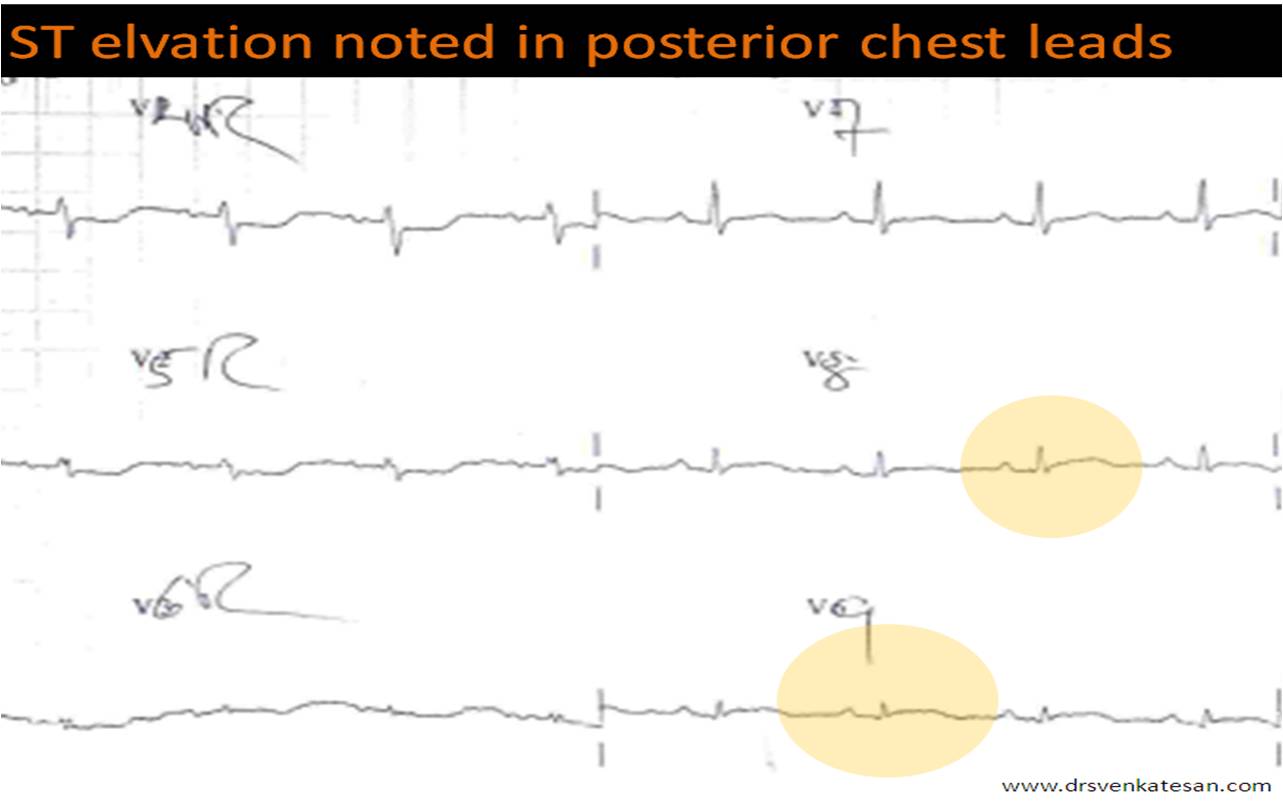
Isolated ST depression in V1 V2 V3 .It almost always indicate isolated posterior STEMI. This can be confirmed by posterior chest ECG leads V7-V10 .
*One will be surprised, to know the mechanism of ST elevation in STEMI is still not fully elucidated .Technically speaking the net movement of current is away from electrode as there is only a baseline diastolic shift which gets neutralised in systole mimicking an ST elevation .(Electro-optical illusion !)
How sensitive is these leads to detect isolated posterior STEMI ?
Fairly sensitive. Both scapula and para spinal muscles can be a significant electrical barrier that can prevent ST elevation from inscribed .In case of doubtful ST elevation in posterior leads , mit is always better to rely on the clinical presentation.Acute chest pain , consistent with ACS and a new onset ST depression >2mm V1 to v3 is a definite indication for thrombolysis .
Link between posterior MI and RV MI ?
They are closely linked entities .In fact posterior surface of heart is contributed significantly by RV.
What is the angiographic correlation of isolated ST depression in V1 to V3 ?
It almost always localise the lesion to left circumflex artery . If it is dominant , it can involve lateral and RV territories.
Is isolated posterior MI less dangerous ?
May be yes , but only after the patient reaches the hospital as electrical risk is same in every STEMI .
The area of infarct is less , LV failure is less common. While conduction disorders and ischemic mitral regurgitation can occur significantly.
Also read , Why thrombolysis is contraindicated in UA/NSTEMI ? in this blog



 Dr.S.Venkatesan MD