Feeds:
Posts
Comments

Posts Tagged ‘constrictive pericarditis’

If you understand the pericardial anatomy fully, you can call yourself real master of clinical anatomy. (Ref 3,4) We know, it is a complex protective cover over the heart , that has three layers with a unique relation with one another. The outer one is tough conical bag .It has an embryologically distinct origin .It develops from septum transversum and sits over the diaphragm tightly, to which it shares the same embryological origin. While the inner serosal layer (rather cavity) splits into two layers and encloses the heart .Though this serosal layers develop from a different mesenchymal tissue , it is biological wonder both fuse in perfect harmony. , The developing heart bends, folds and loops within the serosal cavity.

The inner one embraces the heart fully forming epicardium (otherwise called visceral pericardium) and reflects back after covering great vessels .While reflecting back it is firmly attached to inner surface of fibrous pericardium forming the pericardial cavity . Never confuse parietal layer of serous pericardium with the thick outer fibrous pericardium, though both are gelled together. Since heart is not a strict globular organ, the hug of visceral pericardium over the heart is not uniform and complete , especially over the great vessels enter or leave the heart (Hilum of the heart). Hence it folds , and forms two sinuses and recesses.

What happens with pericardial Inflammation ?

Inflammatory pericarditis can occur in differential fashion. For example, the most common chronic pericarditis tuberculosis affects the fibrinous layer. Post MI pericarditis involves the epicardium. It is vital to understand epicardium is thin and transparent sheet of tissue , one may not split it from the heart. It is also important to know coronary arteries run under this thin visceral pericardium( ie sub epicardial) So anatomically , In constrictive pericarditis , the immediate target would appear to be the coronary artery , than the myocardium . But, what really happens ? Let us Introspect on this.

In CP which layer exerts the force of constriction ?

Macroscopically ,It would be a dramatic sight to see the heart caged within hard shell of pericardial mass. To be frank, we can never make a distinction between the three layers once its thickened. Which layer is the triggering force, that promotes adhesion and compression is also not clear. We presume, the thick fibrous layer is villain de chief. (This we learnt , by observing rheumatic heart disease pathology ,wherein pericarditis , never evolve into constriction as it doesn’t affect the thick fibrous layer) .The inflamed exudative pericardial fluid doubling up as a glue to stick all three layers is a true possibility.

Whatever happens, once the inflammation become chronic, it goes on steadily and begin to compress (rather restrict in diastole). At this stage, anti- inflammatory drugs like NSAIDS, colchicine or specific anti-tuberculous drugs along with a bit of steroids can arrest or slow down the pathological process and prevent this deadly disease. The phenomenon of transient constriction with normal thickness pericardium is also reported.

The normal and the pathologically thickened constrictive pericardium

The quantum of constrictive force widely varies in different areas of the heart. Obviously, the thickened pericardium hurts the heart in diastole . Right side of the heart is more vulnerable because of its thin wall and the low pressure beneath . However the constriction process continues over, anterior, lateral , posterior and even the AV groves The sinus the recesses can also become obliterated .

Does the coronary artery gets compressed ?

When the whole heart become as hard as a cricket ball , what do you expect the fate of coronary artery would be ? Fortunately, it escapes in many . But, the threat of compression or calcific (ice-berg) injury is always there. There has been many reports of patients with angina in CP (Ref 1). Here is case report from India , where a calcific pericardium exerts a vice like tightening over LCX. (Ref 2)

This is not surprising, when we know, at late stages the pericardium can even infiltrate the myocardium.

Video showing diastolic compression in constriction source : Christopoulos G, Stulak JM, Oh JK, Prasad A. Diastolic Coronary Artery Compression in Constrictive Pericarditis. JACC Case Rep. 2020 May 6;2(5):825-827. doi: 10.1016/j.jaccas.2020.01.009. PMID: 34317356; PMCID: PMC8301696.

How do the coronary artery often escapes in CP ?

One important reason is , unlike myocardial bridge here the artery gets compressed in diastole , with a passive distending pressure from LV cavity rather than active constrictive force.(See the above video) The diastolic coronary arterial pressure rarely goes below intrapericardial space pressure , which in fact is obliterated. Still, the point to be noted is, mass effect can still result in non hemodynamic compression.

Final message

Fortunately, coronary arteries often escape from serious pressure effects of constriction but the threat is real especially in late stages .It can happen either by the calcific spurs in the pericardium or diffuse pressure effect or tight ring like localized constriction. While de-nova coronary Involvement is far less common, the operating surgeon needs to take extreme care to avoid it during surgery . Surgical pericardiectomy is either partial or total caries considerable mortality even today. Total pericardiectomy is myth at best. Few pieces of adherent pericardium are left over especially in the posterior aspect.

There is a landmark study from Mayo clinic, with data from over 1000 pericardiectmy surgeries ,over eight decades . Every cardiologist and cardiac surgeon must read this to understand the nuances of pericardial surgery (Murashita Ann Thorac Surg. 2017) Now Robots are being tried to assist in this delicate surgery (CTS-NET 2023 Total Robotic Pericardiectomy for Constrictive Pericarditis)

Reference

1.Mahé I, Braunberger E, Bergmann JF. Angina caused by calcific constrictive pericarditis. Ann Intern Med. 2002 Dec 17;137(12):1012-3. doi: 10.7326/0003-4819-137-12-200212170-00036. PMID: 12484734.

2.Rajagopal, MD, DM • Sreenivasa Narayana Raju, MDConstrictive Calcific Pericarditis Causing Coronary Artery Compression Radiology 2021; 299:539 • https://doi.org/10.1148/radiol.2021203726

Two Excellent reference for comprehensive knowledge in pericardial anatomy
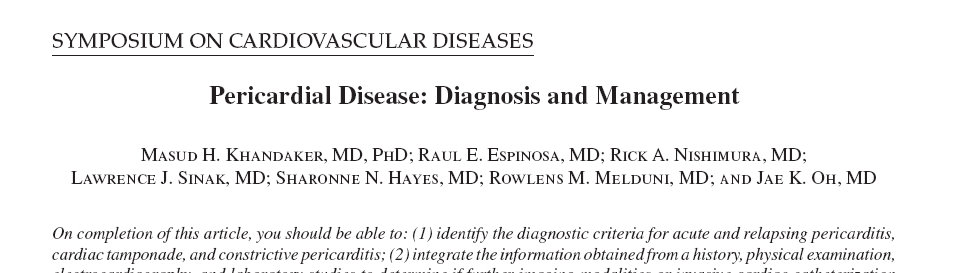
3.Rodriguez ER, Tan CD. Structure and Anatomy of the Human Pericardium. Prog Cardiovasc Dis. 2017 Jan-Feb;59(4):327-340. doi: 10.1016/j.pcad.2016.12.010. Epub 2017 Jan 4. PMID: 28062264.

4. E.Rene Rodriguez ,Carmela D.Tan Structure of the human pericardium and responses to pathological processes JACC 2016

Read Full Post »

Pulmonary valve should open shortly after the onset of RV systole , when RV pressure exceeds the PA end diastolic pressure which  will  be around 10-15 mmHg.

We know  cardiac valves open and close with reference to the pressure difference across the valve .So, in any part of cardiac cycle , if RV pressure exceeds  the pulmonary  arterial pressure , pulmonary valve is bound to open. (The pulmonary  leaflets simply doesn’t bother whether  RV is in systole or diastole )

What are the situations RV pressure may exceed PA pressure during diastole ?

Yes, if  RVEDP raises for any reasons beyond 15 mmhg it can prematurely open the pulmonary valve in late diastole. This often coincides with right atrial  contraction  that make the   RVEDP to spike  just before systole.  In chronic right heart dysfunction  the premature opening can occur  much earlier in diastole and not dependent on RA contraction. It can even be noted with AF if the mean RVEDP exceeds PA pressures.

This typically happen in constrictive pericardits and any  isolated RV failure  without pulmonary hypertension.(Please note , for premature  pulmonary valve opening to occur  one important prerequisite is,  PA pressure should be normal or low and hence its precluded in significant pulmonary hypertension )

Conditions associated with premature PV opening

1. Constrictive pericarditis.

2. Isolated RV restrictive cardiomyopathy (Lofflers etc .Note :Biventricular restriction would prevent premature opening  as PA pressure is raised. )

3. Ebstein anomaly

4.Some  patients with with RSOV .(Acute raise in RVEDP)

5.Post tricsupid valvotomy


Reference


Read Full Post »

A  patient who presents with predominantly right  heart failure  is  an interesting clinical challenge . Constrictive pericarditis (CP)  remains  a popular diagnosis in this setting. However  in the bed side clinical  examination (and in cardiology Board exams )  the following  differential diagnoses are  to be  considered .( And ruled out one by one)

  1. Restrictive cardiomyopathy* especially Right  sided .In India endo myocardial fibrosis tops the list
  2. Primary Tricuspid valve disease( Tricuspid stenosis / Carcinoid etc)
  3. Chronic cor-pulmonale in terminal RV failure
  4. Silent Mitral stenosis with right heart failure
  5. Ebstein anomaly
  6. Severe forms of valvular pulmonary stenosis with RV dysfunction
  7. SVC obstruction
  8. Cirrhosis of liver
  9. Porto pulmonary hypertension

( The list is not complete , readers may contribute )

Bed side clues

  • Remember  a deep “y” descent  is  the bed side counter part of   Square root sign  recorded by  invasive RV pressure study
  • Similarly , pericardial knock is the auditory   equivalent (You hear the square root !  . . .yes  )as the ventricle thuds the rigid thickened pericardial shell in very early diastole !)
  • Pulsus paradoxus and kussmal sign can occur in both CP and RCM.
  • If a good LV apex , is  palpated it  goes against CP .
  • Please be reminded , even restrictive cardiomyopathy  will ultimately dilate their chamber pre-terminal and clinical features may be confounded with that of DCM.
  • Silent heart would suggest CP.
  • AV valve regurgitation would favor RCM
  • Features of  Pulmonary hypertension will help confirm Mitral valve disease , Cor pulmonale,
  • Deep  “y”descents  are against  any form of  Tricuspid stenosis.
  • Opening snap of mitral valve is to be distinguished from pericardial knock.( Opening snap high pitched  and occur later than   pericardial knock in diastole   , best heard in expiration )
  • Cirrhosis liver with hypo- proteinimic   fluid retention is  a traditionally close mimicker  .It  may be ruled out by the careful history taking as exertional dyspnea is an exception , if  at all , it is a very late event  in cirrhosis.
  • The issue gets further weird   as chronic constriction can lead on to chronic congestive liver and cardiac cirrhosis .
  • Severe  forms of constriction can invade the myocardium and result in features of myocardial dysfunction .It is more common than we recognise.

How to confirm ?

Following should be performed in that order

  • ECG
  • X -Ray
  • Echocardiogram
  • CT scan
  • MRI

*Cath study is no longer done (Only for academic purpose )

Final message

Even in this era of sophisticated  medical  imaging  , clinical examination  remains the key . One should  realise the importance  of  meticulous  clinical history  ,  sequential examination and interpretation .It  will   “rule out  or rule in”  majority of  cardiac disorders .

The hi tech imaging  modalities should be used only to confirm , risk stratify and  plan management . If you skip the clinical  part , one  may still arrive at a correct  diagnosis  but there is  high chances of erring in  management.

(Cardiac pearls lie in the bed side not in cath labs !   Here is  one such pearl  . Not every constriction  require surgery !

Please note about 20 % of constrictive pericarditis are  transient !)

Read Full Post »

A must read for all clinical cardiologists  and fellows  .   A comprehensive review on pericardial diseases.

It also  highlights a new diagnostic parameter in cath lab to differentiate constrictive pericarditis  from  restrictive cardiomyopathy .The area subtended by RV pressure curve and LV pressure curve moves discordantly in constrictive  pericarditis   while it moves concordantly     in restrictive  cardiomyopathy

Source : Mayo Clin Proc. 2010;85(6):572-593


Read Full Post »

Fluid retention is  a classical sign  of  cardiac failure . (Elevated JVP, hepatomegaly , edema legs ) The mechanism of fluid retention are many .But, traditionally we have given importance to   venous back pressure  (Hydrostatic pressure)  . Equally important (if not more !) is the renal sodium  and  fluid  conservation  in response to reduced effective renal blood flow.

How common is ascites in cardiac failure ?

While we see hydrothorax  little  more frequently  it is rare to  get ascites in cardiac failure .However ascites often manifests late  in the pre terminal phase of cardiac failure *. This is due to congestive hepatomegaly, secondary hyperaldosteronism and renal dysfunction .

When does ascites come early before edema of extremities in cardiac failure ?

It is  classically  reported in  constrictive pericarditis. The reason why ascites precedes edema legs is  long  been speculative . Now we have evidence , the pericardial pathology , has a direct effect on the hepatic venous morphology. There can be a  selective  , partial constrictor effect on at least one of the hepatic vein as it enters the right atrium .In fact , the entry point of hepatic vein is  delicately  close to IVC/RA junction.

*It should be remembered in the current era we are expected to diagnose cardiac  failure even before  the onset of edema !

Anatomical   constriction has a mechanical effect on the hepatic venous drainage  and subsequently alters the hepatic function . Segmental hepatic dysfunction is thought to  ooze out the   ascitic fluid  from the surface of liver .Ultimately severe raise of hepatic venous pressure results in congestive hepatomegaly and could result in now obsolete , cardiac cirrhosis.

Other mechanisms of ascites  in constrictive pericarditis , include

  • Hypoprotenimia
  • Common infection of  peritoneum and pericardium( like tueberculosis)

Is ascites precox an exclusive feature of constrictive pericarditis ?

Not necessarily so  . Even though , it was first described in this condition ,clinical experience  suggest, any  congestive cardiac failure with predominate right sided  pathology like organic tricuspid valve stenosis or regurgitation, right ventricular  endomyocardial  fibrosis  , all can result in significant ascites which may precede edema  legs.

What is  effect of  of severe TR on hepatic venous  hydrodynamics ?

TR like MR  can be eccentric and some times hits upon  the hepatic veins directly

and result in disproportionate elevation of hepatic venaous presure than even IVC pressure

which  may contribute to early ascites in organic tricuspid valve disease.

Read Full Post »

Detection of  pericardial effusion was  the earliest  clinical application of echocardiography. Diagnosing  large effusions is a non issue .Assessing  minimal effusions (Systolic vs diastolic echo free space) and associated  thickened pericardium is tough even after 50 years of echocardiography.

Mainly , we are limited by the resolution power of echo. Further , lack of echocardiographic landmark for visceral  layer of pericardium (It is same as epicardium !) makes  diagnosis of  thickened pericardium a real tough exercise.It is said , normal pericardium is less than 4mm .

Where to measure it ?  how to measure is still not clear.

Why differentiating  minimal  pericardial effusion from  thickened pericardium  is important ?

  • Mild  pericardial effusion is  largely a benign finding in vast majority.
  • But , even a minimally thickened pericardium  due to active inflammation  can be significant.
  • Sticky pericardial effusion predispose to thickening and constriction.
  • Early recognition of this dreaded pericardial pathology is essential to interrupt the inflammatory process.
  • In CRF (With or without dialysis) even a  minimal pericardial  effusion can denote a dismal outcome .

Here is a link to Horowitz classification of mild  pericardial  effusion ...

http://circ.ahajournals.org/cgi/reprint/50/2/239

It could help us understand, How thickened pericardium presents in echo. Of course, CT and MRI now have increased sensitivity for diagnosing  pericardial thickening.

Read Full Post »

The LV angiogram that stunned me  !

See how a heart is encased within the pericardial shell , still fighting hard

Thanks to circulation for it’s greatness  to offer such great video free

http://circ.ahajournals.org/content/vol118/issue16/images/data/1685/DC1/CI191060.DSmovie2.AVI

Read Full Post »