Apart from acute coronary syndrome, cardiac failure is the most common clinical presentation of CAD. Cardiac failure , classically present with dyspnea on rest or on exertion , while angina is the dominant presentation in ACS.
What if , both these occur together in an acute fashion ?
Yes , if it occurs together it is called ischemic cardiac failure . Fortunately , this is quiet uncommon . It has an adverse outcome, especially if it occurs as a companion of NSTEMI . Let us see how . . .( Most of the episodes of cardiac failure in CAD means only LV failure )
For cardiac failure to occur , there need to be a mechanical contractile dysfunction or defect . In CAD population , this can occur in one of the following way.
- Loss of LV muscle (Acute Myocardial infarction as in STEMI)
- Mechanical defects (Mitral regurgitation/VSR etc)
- An arrhythmia (Commonly VT or AF / CHB ) can precipitate cardiac failure
Apart from these three , there is an important mechanism of acute LVF, namely ischemic stunning of major part of LV resulting in severe mechanical dysfucntion.This is a dangerous form of cardiac failure (Pathologivcclaly it is thought to represent contraction band necrosis !) this occurs in global ischemic situations manifested as gross global ST depression.
So, there are two types of ischemic LVF . STEMI occuring due to infarct( ± ischemia ) Other one (NSTEMI)entirely due to ischemia.
Logically , one may n’t refer STEMI related LVF as ischemic LVF at all , as infarct has already occured. While , NSTEMI related LV could be the ” True ischemic LVF “
What are the differences between cardiac failure that occur in STEMI and NSTEMI ?
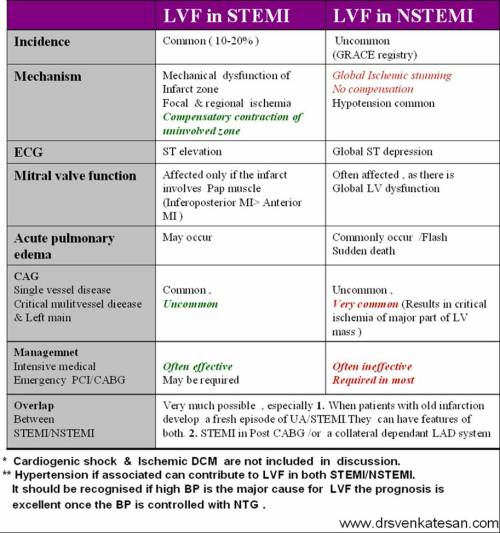
Is post infarct failure ( The commonly used terminology , now out of vogue ! ) a type of ischemic LVF ?
In the strict sense , it is not . Here the dead myocardium , is responsible for the failure .To label a LVF , as ischemic , ongoing ischemia must be documented and further it should be shown to contribute for the mechanical dysfunction .
This is of vital importance , if you wrongly attribute ischemia as a cause for the LVF , the patient may be taken up for emergency revascularisation .It is not going to help much (Infact , it may worsen !) as this cardiac failure is not going to be corrected .What we require , here is an aggressive medical management protocol .



 Dr.S.Venkatesan MD
Dr. Venkatesan,
I am the managing editor of EP Lab Digest, a monthly medical journal that publishes articles in the field of cardiac electrophysiology (EP). I am writing today because I recently came across your website and blog, and think they are really well put together. Would you be interested in participating in a brief interview about this for an upcoming issue of EP Lab Digest? If you have any questions or if you would like to participate in the interview, please contact me at “jelrod@hmpcommunications.com” as soon as possible. Thank you very much for your time and consideration!
A. If aldosterone levels are high, but renin is low,
the patient may have primary hyperaldosteronism. From the functional point of view the heart may beat too fast or too slowly, or irregularly.