Feeds:
Posts
Comments

Archive for February, 2025

Yes, definitely it is. The risk is very high in patients with DCM and other structural heart diseases. (Typically bundle branch reentry-BBR Ref: Mazur A, Kusniec Indian Pacing Electrophysiol J. 2005)

What about in normal hearts?

However, In normal hearts without LV dysfunction the risk is dramatically lower, but still not totally risk free. (The term normality can be undermined now , because, in true sense , an echocardiogram is not sufffice to rule out a structural myocardial disease. MRI has become a basic requirment to R/O concealed or localised scars , which may not alter wall motion and show up in echocardiogram)

So, do you want to say all LBBBs are risky ?

No. But we can’t say they are not risky as well. This is because the slowing of conduction, mild prolongation of the QT interval (contributed more by prolonged depolarization), and desynchrony still are the common denominators. These changes increase vulnerability to arrhythmias under specific circumstances—like electrolyte imbalances, drug effects, or extreme stress. This can trigger a VT in potentially inappropriate circumstances.

Final message

Cardiac electrical highway from SA node to Purkinje fibers is expected to be smooth flowing without any bumps and humps. Any interruptions in the electrical circuit are a potential invite for misbehavior. Fortunately, most times the adjacent cells compensate and adapt to the subtle diversions.

Read Full Post »

Restrictive LV filling is an advanced form of diastolic dysfunction. The mean LA pressure is high, and LVEDP is also correspondingly elevated (need not be linear though, as LA reservoir/conduit dysfunction can independently hike the LA pressure). This clinical scenario of restrictive LV filling usually occurs as part of HFpEF, though it can occur in HFrEF as well. (25% of DCM have restrictive filling)

Image source and courtesey : Sean Haney, Denise Sur and Zijian Xu The Journal of the American Board of Family Practice May 2005, 18 (3) 189-198; DOI: https://doi.org/10.3122/jabfm.18.3.189

Pre-load reduction is the mainstay in relieving pulmonary congestion, but it has a trade-off at a particular point, as it impacts the stroke volume and forward cardiac output. Diuretic excess, ultimately worsens the symptoms, especially fatigue, though they keep the lungs dry.

So, dear fellows , remember prescription of diuretics in restrictive LV filling is a tight pharmacological rope walk.It requires continuous monitoring of symptoms and E/E” in echocardiography.

Whether to push the LA blood with more preload or bring it down to redcue pulmonary congestion is the question

Some physicians use the E-DT as a visual guide (Deceleration time of E velocity, which is inversely related to the degree of restriction). Normal is more than 150 ms. In most restrictive filling, it is 100 ms or less. Diuretic dose can be adjusted based on E-DT.

The usual daily dose of frusemide is 80 mg. There is a huge upper limit.It will be useful if the dose of frusemide is somehow indexed to the LV filling parameter.

I have tried a personal working formula for optimal diuretic dose. It can be titrated upwards ,twice the value of E-DT when it is less than 100 ms.(Eg if E-DT is 80ms Frusemide can be 160mg, but, note there is an U curve in this .If DT is too short, diuretics will worsen the hemodynamics .At 60 ms E-DT diuretics need to be reduced to 120 mg )

I keep tellling my fellows to do an authenticated study on this. Hope some one pursues(Mayo clinic guys are well equipped to do this , may be with the help Dr Jae.K OH or Sherif F Nagueh from Methodist, Houstan, the pioneers in the field )

Final message

We realise, treating restrictive LV filling is a delicate and often difficult task.There are no specific drugs to improve the lusiotropic property of LV. Further, since LV contractility is normal in HFpEF, there is no point in using LV inotropic agents. The only available parameter to manipulate is LV preload. However, It would be a stunning discovery , if some one discover a atria specific LA inotropic agent to overcome the LV restriction .

Meanwhile, it is critical to treat associated HT, CAD, or infiltrative disease like Amyloid*. We may soon have LA sensors , that can throw LAP to your iPhone . Till then, treating restrictive LV filling is essentially a hemodynamic/clinical pharmacological guess game. Ofcourse ,*We do have protein unfolders and declutters like Tafamidis & Patiseran to clear interstitial amyloidosis. Also, IAS flow regulators are new devices being tested to decompress the LA in HFpEF. (Paitazoglou et al Ther Adv Cardiovasc Dis. 2020 )

Read Full Post »

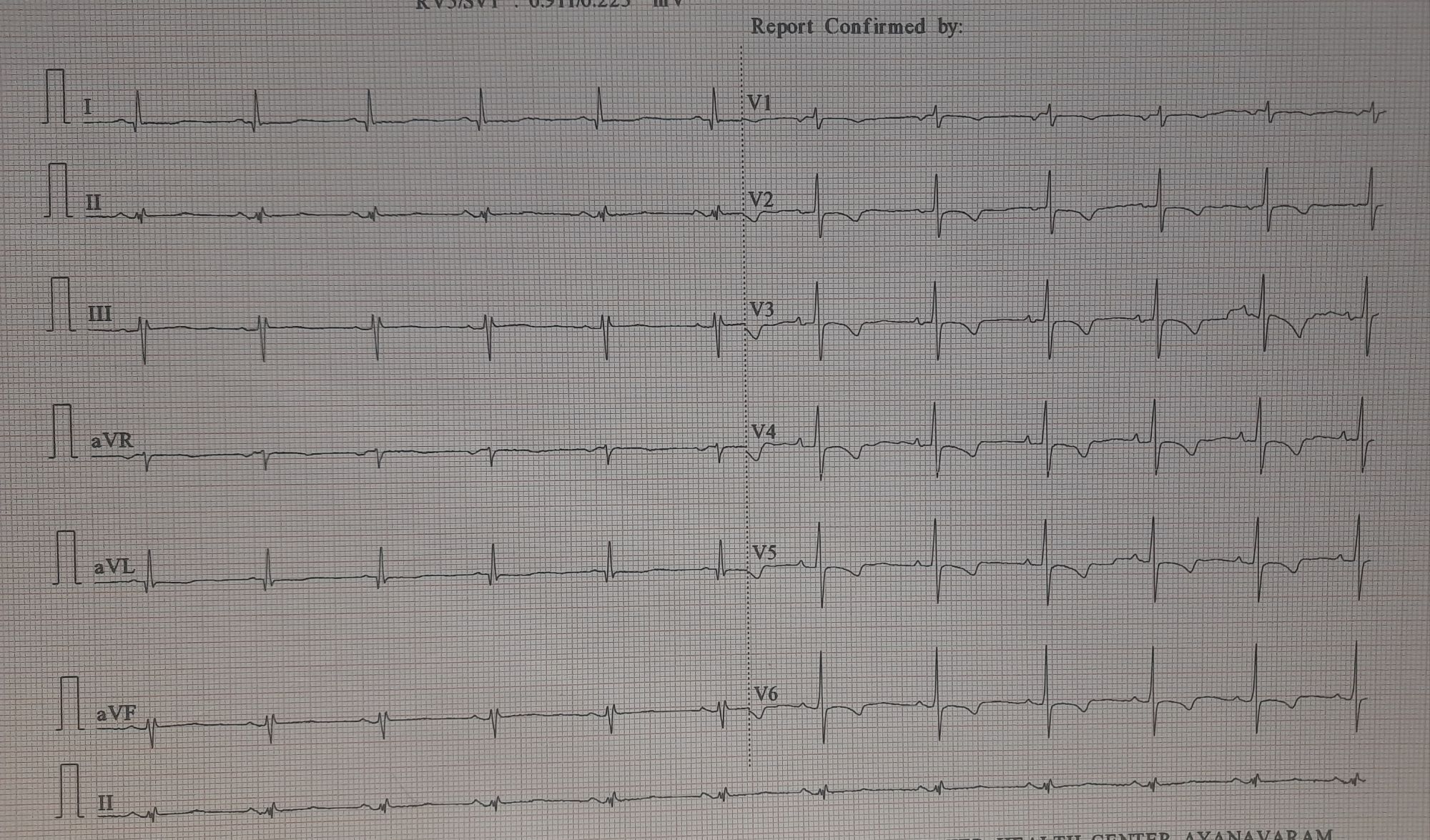
How do you report this ST segment ?

A. Isolated ST depression

B. Isolated T Wave Inversion

C. Combination of both

D.Primarily T wave Inversion ,with secondary ST dragging

Answer: Response C, is logical, but applying some ionic sense to the various repolarisation currents in the left shoulder region of action potential , it is the clash between late phase 2 and the premature phase 3 activity, that deforms the initial limb (forward) of T waves , dragging and effacing the ST segment mimicking ST depression. This we have proposed to call it as ST drag effect by T waves. (ST drag is generally more benign , than ST segement depression that begins at J point.

Clinical significance of such ST segment

Without knowing the symptoms or the reason for which this ECG was taken, we shouldn’t interpret this ECG. In this case, it was taken in a 36-year-old woman, routine health check and who has no specific symptom. This almost rules out an ACS or even a CCS. Firther, the fact that the heart rate is normal rules out demand side ischemia as well. Very likely, it should be LVH or anemia or some other systemic medical conditions. (Rarely, neuro-adrenergic-emotional signals from brainstem can tilt the ST segment like this. (Tansient Tako-subo equivalents)

Next step

However, we can’t leave her alone. She needs an echocardiogram to rule out any subclinical myocardial disease. TMT would seem to be a necessity, but false positivity is very likely.( A flamboyant cardiologist would order a CT angiogram either striaghtaway or a day-care radial angiogram. Nothing wrong with that, as long as the patient insists on reaching the bottom of the truth)

What will you do?

Will sit with the patient for atleast 15 minutes, listen to her daily activity ,past history and look for any subtle symptoms, and then decide. It needs lots of courage (or Ignorance) to leave her without any further Investigation. Echocardiogram is a must. (Have seen a HCM variants like this ).TMT is redunant, if her excercise capacity is excellent.

Final message

One more concept on ST segment can be extrapolated by curious observation of some of the ECGs who present at ER. . It is the secondary ST sagging by primary T wave downward forces. (Pushing ST up is also possibe , as we already know it as ERS pattern )

Postamble.

We know, the S point (Technically J ) in ST segment is well defined , while the end of ST segment is hidden in deep mystery in many clinical situations.Mind you, a flattish ST segment, with absent T wave can be an aboslute normality. Here, you can’t measure either ST segment or even the QT interval.

Reference

1.D’Ascenzi F, Anselmi F, Adami PE, Pelliccia A. Interpretation of T-wave inversion in physiological and pathological conditions: Current state and future perspectives. Clin Cardiol. 2020 Aug;43(8):827-833. doi: 10.1002/clc.23365. Epub 2020 Apr 7. PMID: 32259342; PMCID: PMC7403675.

Read Full Post »

The therapeutics of coronary stenosis has become a technogical wonder, interwoven with statistical wordplay in the last few decades. PCI is sitting pretty at its peak glory.The term OMT or GDMT is a popular terminology, but realistically exist only in guidelines.

It is a strange academic habit among cardiologists, that they have subdivided medical management into optimal and suboptimal. Meanwhile, we haven’t seen any papers from cardiology forums that classify PCI according to its quality. How many of use a term like optimal PCI or guideline-directed PCI (O-PCI, GDPCI). Every PCI, by default, is perceived as good by our flawed coronary intellect.

A single patient experience

Let me share a patient consult from a remote town of north India. He is a STEMI patient (1 year old) with mild LV dysfunction and thinning of IVS and anterior wall. His CAG showed a significant looking, yet non-flow limiting LAD lesion without any troubling symptoms. I came to know he had consulted two institutions and was apparently not happy with their approach (In his own words, “They seem to be primarily interested in caging my LAD than listening to me”).

Somebody has suggested my name. He called me over the phone for a consult. I asked him remain there to follow his doctor’s advice. But, he flew some 2000 km to meet me. He was so knowledgeable and was aware of everything I wanted to tell. Like, viability, scars, futility, and benefits of revascularization, imaging-assisted PCI, impact of PCI on exercise capacity, importance of risk factor management, etc.

I told him, “In my opinion, you have technically a single vessel disease that can be managed well with drugs. But if PCI is to be done, it should be done in a proficient manner, as the lesion looked hard and was close to the LAD ostium, trespassing LCX as well.” I stressed the importance of a professionally done procedure with enough expertise and follow-up maintenance care.

He was not entirely satisfied with my response. He wanted a clear yes or no! . I told him, “If you have full trust, continue with the drugs at full intensity and do a stress test after 3 months. otherwise, if you keep getting even the slightest doubt and anxiety over the hidden blocks, go for a stent immediately at a good Institution. (My conscience said the latter half of my advice was unwarranted, but I had to; after all, me too need a protective mechanism)

He left my clinic profusley thanking me. I am not sure , how my consult was useful for him and what he is going to decide.

Academic lessons from this patient.

1.Patient fear factor over coronary blocks may be the ultimate game changer. Cardiologists should try to mitigate this fear and at the least should not be an amplifier to this emotion.

2.Leaving tricky profesionaly complex decisions to the patient, is an easy escape route for us, however it comes very close to professional incompetence. (Of course, we do this on a routine basis, approved by the modern medical guidelines, ethics, and legal system, in the name of patient empowerment)

3.Finally, we can grow a potential research hypothesis. A sub-optimal PCI is non-superior to OMT.It is curious there is no study available to compare sub-optimal PCI to OMT. We must also realize there is nothing called standalone PCI. Without concomitant OMT, PCI is a dud. Every young cardiology fellow need to etch this fact in their cortical cardiac memory. OMT often turns out to be the savior of stents, but the latter ruthlessly steals the credit.

Postamble

I could find one study analyzing suboptimal stenting (Ref 1), but it didn’t compare it with OMT. Suddenly, as I finish writing this, a big fact struck me hard, i.e., even a well-done PCI in sophisticated core labs with meticulous care struggled to beat OMT in a barrage of landmark trials (like COURAGE, ISCHEMIA, ORBITA). What is the big deal to analyze suboptimal PCI vs OMT?

Prati F, Romagnoli E, Gatto L, La Manna A, . Clinical Impact of Suboptimal Stenting and Residual Intrastent Plaque/Thrombus Protrusion in Patients With Acute Coronary Syndrome: The CLI-OPCI ACS Substudy Circ Cardiovasc Interv. 2016 Dec;9(12):e003726. .

Read Full Post »