Feeds:
Posts
Comments

Archive for the ‘cardiology -congenital heart disease’ Category

When I asked this seemingly simple  question to my cardiology fellows , I found they struggled  to come out with a proper  answer .I hope this will  make the  issue simpler .

Why the onset of PAH in VSD is early and late in ASD ?

Though number of factors are involved in the genesis of PAH , the single important reason  is  behavior of pulmonary circulation  especially the pulmonary arteriolar muscle .

Normal pulmonary vasculature losses it’s muscle rapidly after  birth and the pulmonary vascular resistance (PVR) falls to the adult level by 6 months .(Bulk of the fall occur in first 60 days) This is the same time the RV dominance is lost and RVH regresses . This also coincides with peaking of  left to right  shunting peaks and may result in cardiac failure .

Though  both ASD and VSD shunts are  highly dependent on PVR ,   VSD  shunting has more muscle power namely the LV contractility  , hence  VSD shunt is established  much earlier   than ASD . This can be ascertained in bedside as  VSD murmurs are heard even within 30 days while ASD is silent for many moths or even years . (Does not apply for Primum defects)

ASD  shunt rarely  meddles   lung  maturation process .(Maturation here means loss of  pulmonary arterioloar smooth  muscle -also  called as Involution  )  This vital  initial period lasts up to 6 months of life .VSD  interferes with this  involution of pulmonary arteriolar smooth muscle .( Please note near complete  involution still can occur in small VSDs with very little shunting )

In large VSD the PVR  will never ,  ever fall to normal levels  and   making it easier for  progressive vascular changes  that occur in  untreated large VSDs that  lead to Eisenmenger syndrome

*Please note  ASD can also reach that stage but it takes many years as the pulmonary vascular resistance has to raise from  very low levels which was made possible by complete involution of pulmonary vasculature .

It is obvious   AP window , PDA  express more  powerful left to right shunts which are associated with very high PVRs .

Final message

A simplified version of answer

Version 1

In VSD  the onset  of left to right  shunt occurs early even within 3 months of life  since VSD shunt is augmented by LV contraction . This is the crucial time of lung  vascular maturation   which gets interfered with  .ASD shunt is  established only after the pulmonary vasculature  involutes .This explains early onset of PAH in VSD  and late in ASD .

Version 2

ASD shunting is primarily depend on RV compliance which is high in early infancy so it takes time to establish the shunt .while VSD shunting does not  depend upon this RV regression.

* Please note  regression of  RV  dominance and compliance is directly dependent on maturation of lung.

** Note these  explanations are not absolute .Some of the complex forms of ASD and intrinsic vascular injury of pulmonary circulation (Various  fetal distress )  can progress into accelerated pulmonary arterial hypertension

Reference

  1. Excellent discusions are available in old edition of Moss and Adams
  2. Rabinovitch has done pioneering work on this topic .
  3. Robert Roberts text book of Adult congenital heart disease also explains it succinctly
Read Full Post »

It was in 1984   this paper came from mayo clinic proceedings .

Hagen PT, Scholz DG, Edwards WD. Incidence and size of patent foramen ovale during the first 10 decades of life: an autopsy study of 965 normal hearts. Mayo Clin Proc. 1984;59:17-20.

When interventional   cardiology was not even in infancy . Now it remains the only data base of nearly 100o hearts  studied  after autopsy .

After reading the article  I got  few surprises

  • The mean  incidence  is 27.3 % of general population ( That is  27 crore people with PFO  in India )
  • In first three decades it goes up to 40 % .
  • PFOs size increase with age  due to stretch of inter atrial septum
  • It measures 3.4mm  in the first decade and it can grow up to 5.8 mm in later decades .

http://download.journals.elsevierhealth.com/pdfs/journals/0025-6196/PIIS0025619611632606.pdf

Mayo clinic continues to be pioneers in  providing vital  research about PFO

Following  is another excellent review article  on PFO and stroke

patent foramen ovale and stroke

Read Full Post »

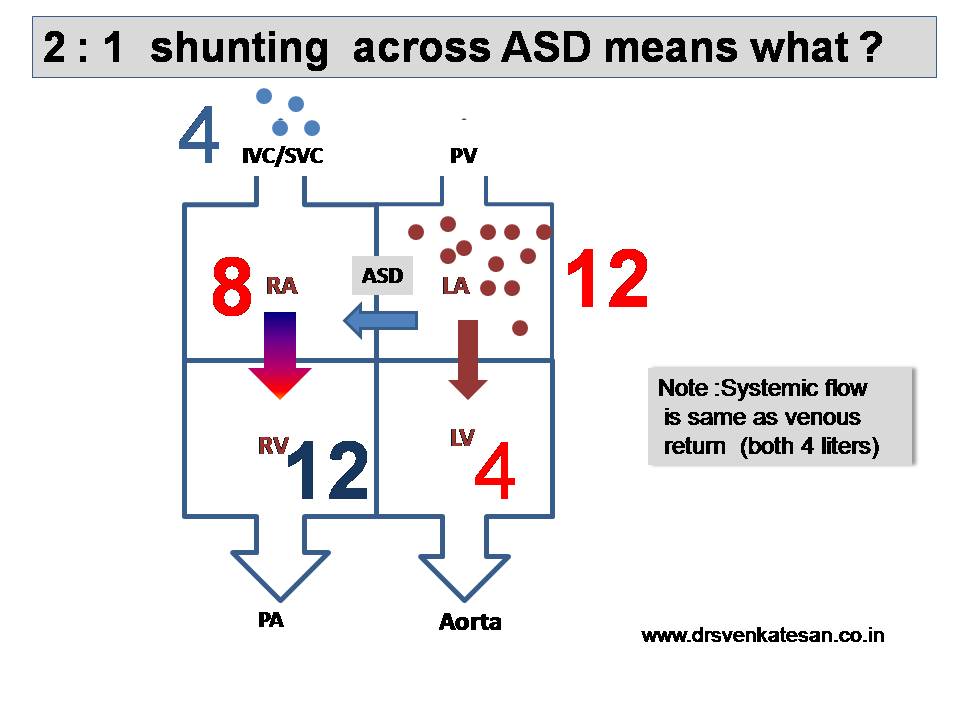
There was a big debate in one of my classes with cardiology fellows regarding the shunt quantification of ASD . We were talking about the significance of ASD shunting . We suddenly realised 2:1 left to right shunt is not a simple equation to comprehend . I was thinking 2:1 shunt would mean pulmonary flow would be twice the systemic flow . It was not to be !

Is the ratio of shunting and Qp/Qs convey the same thing ?

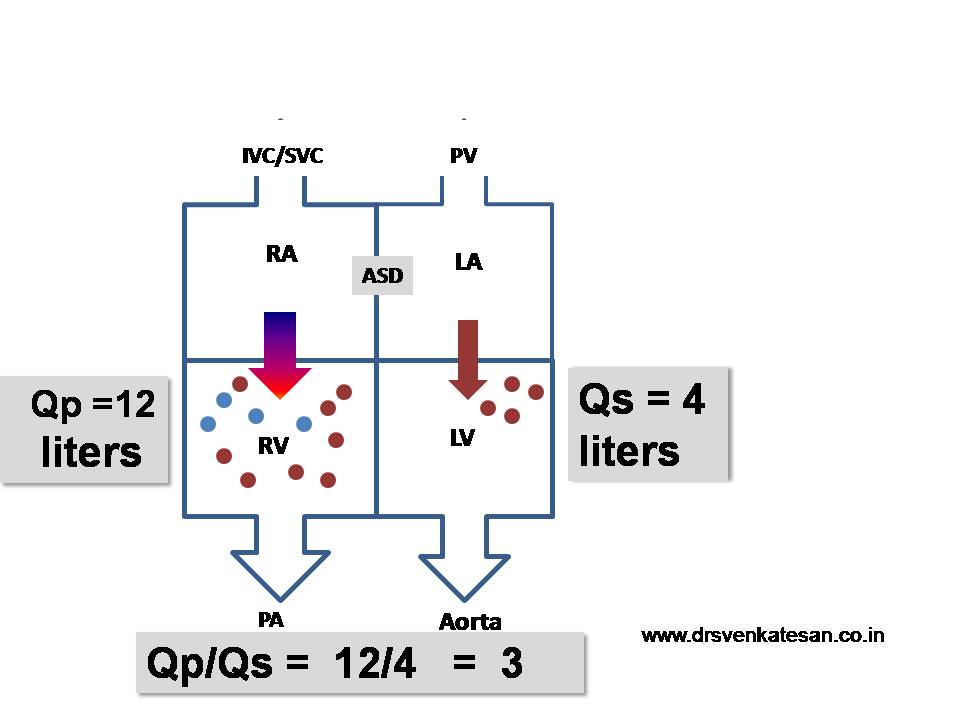
No . Qp /Qs is the ratio of pulmonary to systemic blood flow flow . When we want to quantify shunt we express it in two different ways .

1. The amount of blood shunted form left side to right side of the heart .

2. The amount of pulmonary blood flow to systemic blood flow in absolute terms .

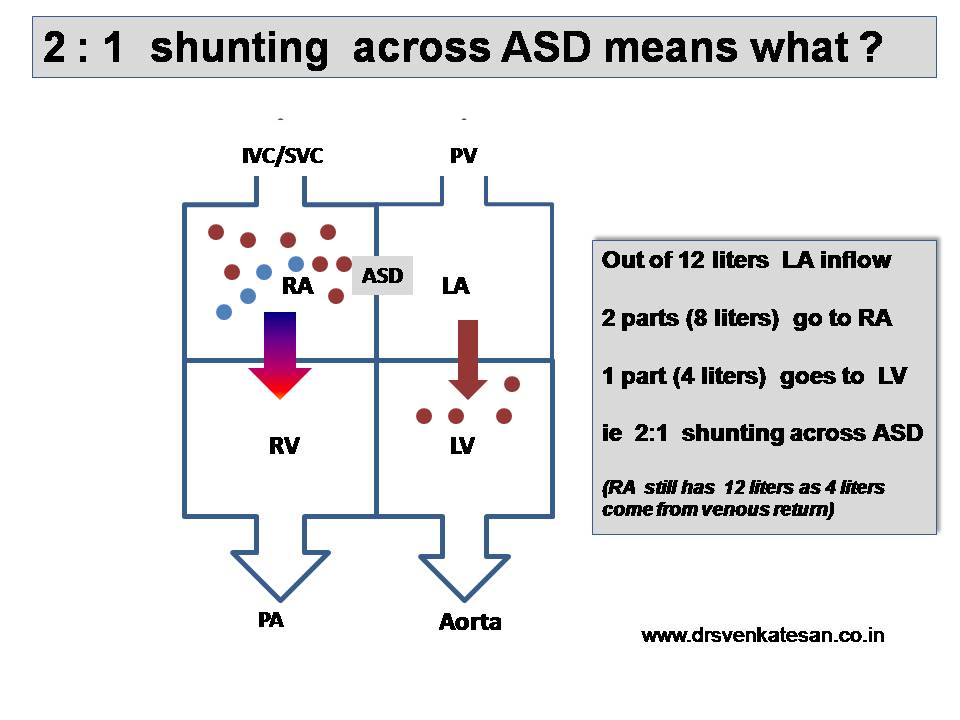
Though both are closely linked entities they do not denote the same meaning . When we say 2: 1 shunt we refer to the shunted blood across the defect but when we calculate pulmonary blood flow we take into account venous blood which does not take part in the shunting .

The confusion arises because we use both terms interchangeably.The following illustration will try to prove A 2: 1 shunt would actually correspond to a qp/qs of three (Pulmonary flow is 3 times the systemic flow !)

Let us begin with a hypothetical ASD patient who has systemic cardiac output of 4 liters.

He shunts 2 : 1 from left to right . ie he shunts 2 /3 of three parts into RA (66% ) .

A patient who delivers 4 liters from LA in the presence of 2;1 ASD shunt would mean he would receive 12 liters from the lung as pulmonary blood flow.

Final message

I am still not fully convinced about the above reasoning . I guess it is correct. I argue the fellows to give further insight into this equation. The complexities in bi- directional shunt and effective pulmonary blood flow in Eisenmenger syndrome is going beyond my heads !

Answer found after a decade

All the above cartoons are wrong

The word shunt itself has been mis interpreted by us . Shunt at the level of ASD is different from Qp/ Qs ie excess flow to pulmonary circuit.

Correct explnnation for a 2:1 Shunt:

  • Right Atrium (RA): Receives 1 unit (venous return) + 1 unit (shunt) = 2 units total, which goes to the right ventricle and lungs (Qp = 2).
  • Left Atrium (LA): Receives 2 units from the pulmonary veins, of which:
    • 1 unit (~50%) crosses the ASD to the RA.
    • 1 unit (~50%) passes through the mitral valve to the LV (Qs = 1).
  • Pulmonary-to-Systemic Flow Ratio: Qp/Qs = 2/1 = 2, confirming the shunt ratio.

Read Full Post »

I stumbled upon this image from the Heart journal. A good depiction of  IAS aneurysm in three dimension.

Image courtesy  : Heart 2012;98:79-88   Three dimensional echocardiography in congenital heart disease   by  Joseph John Vettukattil

Further  reading

Clinical implication of IAS aneurysm

Read Full Post »

Who is the father of interventional cardiology ?

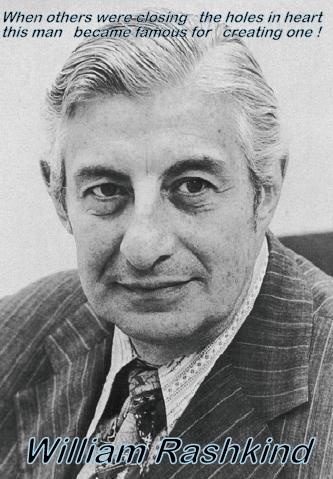
William Rashkind a cardiologist from Children’s hospital, Philadelphia in 1966  probably is the first person who thought it was indeed possible to use a wire and balloon as cardiac therapeutic intervention .When surgeons were groping in dark with  sick cyanotic new borns with dTGV , He along with Miller executed their idea.

It was published in JAMA

How the Rashkind  has revolutionized  our approach to congenital  heart disease  is evident from the current guidelines in 2011.

The procedure has since evolved with improving hardware and we are able to ferry a blade into the IAS for cutting .

Current  recommendations for Atrial  septostomy

It is primarily useful

1. Atrial septostomy  to enhance atrial  mixing (eg, transposition of the great vessels with restrictive/intact atrial communication) or to decompress the left atrium
2.During Extra corporeal membrane oxygenation (ECMO)   to decompression   of left atrial hypertension

3.If there is poor cardiac return from ECMO  circuit  low venous saturations  (Class 1 Evidence  C)
It may also be tried in  (Class 2 )
1.  Hypoplastic left heart syndrome  with  restrictive atrial communication.

2.  Static balloon dilation of  l synthetic / bioprosthetic  IAS  (eg, Gore-Tex)

3. Tricuspid atresia with restrictive atrial  communication

4 .Pulmonary atresia with intact IVS

5. TAPVC with  restrictive atrial communication.

6. Primary pulmonary hypertension / Eisenmneger VSD/PDA .(Occasionally useful )

Reference

http://circ.ahajournals.org/content/123/22/2607.full.pdf+html

Read Full Post »

Most  cardiologists  are familiar with  “Circulation” . We know  it  is a top  cardiology  journal with highest impact factor.  Few of us are  aware  of  a journal called  “Circulation  research” ( I wonder  why it is named  like that ,  as if  the regular   circulation journal  does  not carry research stuff  !)

It is one of the  path breaking   journals that regularly  churn out state  of  the art , often  mind  boggling research stuff.  Once in while we should get a feel of  basic science  research  as it  happens.

How else we are going to know an  atrial cell is to be bio engineered  shortly to behave like a  SA node  in patients with sinus node dysfunction. (Biological pacing )

This team from academic  medical  centre Amsterdam   should be credited   for  publishing   this gem of  an  article   from  a  study  involving the  measly mice !

It  deals elaborately  about the embryonic basis of AV nodal  disorders  . Specifically it  explains  the genesis of  WPW syndrome and how AV rings get muscularised  .

(It  is  due to   error in  bio-genetic forces ,which  affect the    incorporation  of AV nodal tissue  in the  fibrous  skeleton .This   results  in ectopic  junctional  tissues appear   any where along  the AV ring . This is the basis of  accessory AV pathway and   clinical  re-excitation.)

Final message

Once in a while  we should develop the habit of reading  tough  journals  like circulation research . After all ,   if a cardiologist  is not reading   these stuff who else  . . . will  ?

Reference

http://circres.ahajournals.org/content/107/6/728.full.pdf+html

Read Full Post »

Before answering the above question ,  there need to be a correction to the question itself . PDA is persistence of ductus arteriosus . In pulmonary atresia ductus itself is not formed .So  the question should  ideally be  Why  ductus  is absent in pulmonary atresia  with VSD  !

Ductus  is formed from the dorsal portion of left 6th arch  .The sixth arch also gives raise to  right and left pulmonary artery.This can happen only if everything from aortic arch and pulmonary artery development is normal

Ductus  has to connect aorta with left pulmonary artery  , when pulmonary artery itself is  poorly developed or not developed   how can the  ductus  connect to  LPA ?

Pulmonary atresia is essentially a defect in the development of pulmonary arterial tree (Please note pulmonary valve and  MPA  is formed  from different  structures in different times and it  would  get  docked  with developing LPA,RPA  and  subsequently to the rest of the  pulmonary tree .)

In fact , one of the terminologies used for pulmonary atresia with VSD  is ,  total anomalous pulmonary arterial connection(TAPAC)  .In fetal    life,   blood flow in ductus is from RV  to  pulmonary artery  and then to  descending aorta  through the  ductus . When RV is disconnected with pulmonary artery( Rather there is no pulmonary artery )  ductus can not be  formed  for  both anatomical and physiological reasons . Some consider the  left 6th arch  in these patients  would become  a poorly   identifiable  minor Aorto pulmonary channel .

A Link to  3D vedio  of aortopulmonary collateral

Embryology of major aorto pulmonary collaterals.

  • The lung perfusion in patients with pulmonary atresia is important only after birth,  as fetal  lung is largely non functional.
  • In patients with pulmonary atresia with  intact IVS this becomes  critical and  usually death ensues unless intervened.
  • If VSD is present it allows the baby to survive as the  lung gets perfused by major or minor aortopulmonary collaterals.
  • These collaterals can range between extensive and   sparse.  Hence the  symptoms can  also vary from volume overload  /cardiac failure to  severe oiligemia  and recurrent  hypoxic spells.*

MAPCOS ,  if present can connect directly the aorta  to  hilar pulmonary artery or indirectly  from the branches of  aorta (subclavian /LIMA/RIMA etc) . These arteries  supply  with or without  a central confluence . It may enter the lung through the hilum or  away from hilum .The MAPCOS can be located anywhere from the arch of aorta to descending thoracic aorta.It is very rare in the ascending Aorta .

There is also  strong argument for MAPCOS are  nothing but dilated bronchial arteries.(Link to Full text )

*The  natural history  directly depends  on  extent of aorto pulmonary collaterals and its anatomical patency .

Final message

Embryologically   both  the  major  arteries of thorax  Aorta and Pulmonary artery have  the  same parent structure namely the dorsal aorta and its six  arches.Hence there  is no surprise  ,  when these embryological  divisions and fusions   goes awry ,   pulmonary artery fails to get  carved out from  the dorsal aorta  in the normal fashion .The randomly formed pulmonary  arteries continue  to have link  with   the parent -dorsal aorta .These are manifested in various ways as major aorto pulmonary collaterals .

(It is to be noted  in pulmonary atresia  , VSD is an offshoot developmental defect  . Embryologically  VSD   is not linked to the primary defect of pulmonary artery development . This is the reason many would consider   PA with VSD as a  distinct entity with that of TOF (Which is a cono truncal anomaly) This also explains the lack of MAPCOS in true TOF .

Read Full Post »

 Inter atrial septum(IAS)  is a delicate structure , formed by a  “curious IAS  embryological process”  , when  two septums ,  two ostiums  cross each  other .They  fold  and unfold  like  curtains  in different times ,  ultimately result in a  single membrane separating LA and RA  with a  central physiological   hollowness called foramen  ovale .

All along this process ,  blood has to shunt  from  RA to LA  untill the baby comes out ,  when the direction reverses that  result in the flap  of foramen ovale locking  against the septum secundum with raising LA pressure . So , basically the genesis of  IAS is all  about growing,   resorbing  and  sticking of two septums . This starts in utero and continues well after birth. One can imagine  complexity of  the factors that determine the thickness of IAS.

The IAS thickness varies between 2mm to 4  mm . With increasing use of trans esophageal echocardiography and also the need for cardiologists to puncture the IAS , it is becoming important to study the anatomy of IAS in detail.

A new  cause of  thickened IAS  is reported recently .

 This is refered to as Double Inter atrial septum,  fused like a sandwich  with a  potential space  in between  .

The embryological basis is not clear. (A septum primum and secundum fusion ?)

The PFO   is an  oblique orifice in many .It is some times refered to as tubular PFO . A large tubular PFO can mimic a double IAS.

An  aneurysm of IAS  may get  fused to appear like a double septum

or Is it  IAS dissection which  give an appearance like double IAS ?

Personal perspective

  • It is very difficult to embryologically  explain the concept of double IAS .  I would think  , it is  double layer  of single embryological  septum   with a  potential  space  in between .
  • It is possible an intra mural hematoma (Spontaneous or acquired ) may cleave the septal plane and mimic a double IAS   when the   thrombus gets dissolved later.

Other causes of thick IAS

Septal thickness an issue during transeptal puncture . During PTMC and left heart catheterization a thick septum may be a hurdle.

Infiltrative  myopathies especially amyloidosis is known for a very thick non -puncturable IAS  

Reference

1.http://ejechocard.oxfordjournals.org/content/9/5/707.full

2. http://www.ncbi.nlm.nih.gov/pubmed/16950474?dopt=Abstract

Read Full Post »

Patent foramen ovale (PFO) is the new generation hole in the heart for  21st century  cardiologist. Present in about 20% of population  , would correspond to 140 crore  “man holes”  as  on  2012   in this planet. PFOs are embryological remnants across the inter atrial septum.

These minute  holes measuring few mm  are largely a  benign finding .In the recent  decades , it is being increasingly debated these holes  may  not  be innocent after all .Extensive  use of echocardiography in recent times   has contributed to  the awareness  as well as anxiety.

Evidence  is mounting  linking PFO to

  • Migraine,
  • Stroke and
  • Peripheral embolism.

While the above   observation may be true  ,  the  fact that >100 crore people have this entity   , raises  a serious question ,  as labeling  all of  them as heart disease will create chaos among the already health obsessed   population .

So , the main purpose should be ,  to identify the high risk subsets* of PFO population .(This will be a <5 %  at the most). People with PFO may  carry  a mental  stigma because it is referred to as a hole in  the heart by the  general  public .For many  the sense of living with a hole in heart is often more damaging than the hole itself ! (Incidentally , many develop  migraine only after reporting about this hole !)In a strict sense  PFO  is not a hole , rather  it is a communication it may be tunnel  or  slit like .It is argued physician should avoid calling PFO as a hole .

*What is a significant PFO ?

  • Large PFOs >5mm
  • PFOs that shunt blood
  • PFOs with septal aneurysms
  • PFOs with documented stroke or embolism
  • PFOs with atrial chiary network
  • PFO in  persons with systemic pro-coagulant states (Except probably in  pregnancy )

Final message 

PFO is a common residual congenital  atrial septal  anomaly . Usually  benign  . One can  live with it perfect harmony. Only occasional patients  are  at risk.

So the prime job of cardiologists is to not diagnose and create panic about  this entity. rather reassure  them (Is it better do not reveal to them if it is found incidentally ? Patient empowerment group would call  this a  foul !  I do not support blind empowerment  )

At the same time our main  aim is to identify the  high  risk subsets who are prone for events.

Closure of   PFO with device is required in a fraction . (*By the way ,  if   PFO is really dangerous ,  why It is never an indication for surgical closure ?  )

Reference

Your  search for best information  on PFO  would end here .  Here is  land mark   article  in JACC  by  Hara   also contributed by  Renu Virmani . A US  Japan  combines initiative  : A must read by every cardiologists

http://content.onlinejacc.org/cgi/reprint/46/9/1768.pdf

http://www.anesthesia-analgesia.org/content/93/5/1137.full

Read Full Post »

Management of  severe  pulmonary hypertension continues to be a difficult task .Medical therapy is not definitive, in-spite of the new prostocyclins, endothelin antagonists and  sildenafil analogues.Natural history  depends mainly on  the presence of  any treatable cause ( Especially ,connective tissue disorders)  ,  supportive management along with anticoagulation.

Ultimate  strategy  would involve a   plan  for a “Lung “or  “Heart -Lung”transplantation  , if feasible. Last decade saw an innovative modality of creating an  artificial inter atrial  shunt to decompress the right heart .This had varied response in the  real world  , still  most  showed some benefit .In fact , in 1998 the world symposium on PHT ,  formulated guidelines for BAS (Balloon atrial septostomy)

Principle of  Balloon atrial septostomy (BAS)  and mechanism of benefit

The symptomatology  of  pulmonary HT  is largely  determined by mean RA pressure .

Puncturing  the  IAS and diverting blood  flow into left atrium would decompress the RA ( or even the RV )  and reduce the Mean RAP.

The resultant  right to left to shunt  can   increase the cardiac output  only  slightly ,  still  good enough to  provide   relief from the fatigue.(Though at the cost of  desaturation.)

What is the risk involved in the BAS.

Procedural risk of  a cath study in a sick  patient with hypertensive lungs (Can be really high !)

In some patients  even a small  fall in systemic  oxygen saturation can be counter productive.

What is the balloon used ?

Mansfield or Tyshak balloons are good choices .

Balloon diameters are between 5 -14 mm

Technique

Involves standard Brockenborough needle /Mullin sheath /Guide wire in pulmonary vein.

Atrial anatomy to  be well  analysed prior to BAS  . (Please note even though it is similar to PTMC , anatomically we encounter a large right atrium rather than left atrium .)

Fluroscopy with  TEE guide optimal

Pulmonary angiogram might help.

Intra-cardiac  Echo may be  ideal.

Blade septostomy may be preferred if hardware is available

The endpoint of procedure

  • Size of ASD > 5mm
  • Fall of arterial saturation < 80 %
  • Sustained atrial fibrillation with hypotension
  • Any  disabling complication

Hemodynamic impact

  • Cardiac output increase by 750 ml to 1 liter
  • It is expected ,  RA  mean pressure  would fall at least 5mmhg from  the baseline value.
  • PA pressure , no significant impact expected.
  • Tricuspid regurgitation regresses.
  • RA,RV size marginal reduction observed.

Follow up and outcome

  1. Greatest  relief is from syncope.
  2. Functional class improvement  in >50% .
  3. One year survival benefit is substantial (75-90%)  .Beats the  natural history (40%) convincingly.
  4. Late deterioration  can occur as ASD gets closed in few.

When  BAS is contraindicated ?

  1. Critical RV failure
  2. Patient in class 4
  3. Mean RA pressure > 20mmhg
  4. Pulmonary vascular resistance index> 55 Wood units / sq.meter

* BAV should not be considered as a  live saving  procedure  in any dying patient with PAH.  It needs to be  selected early and carefully .In fact,  the very high procedural complication  rate is related to late selection of patients.

Natural foramen  PFO better than BAV ?

We do not know yet.It is highly possible  natural opening up of PFO is good thing to happen for patients with severe pulmonary hypertension.

Reference

1 . SS Kothari  et all  Indian heart journal 2002

2. http://content.onlinejacc.org/cgi/reprint/32/2/297.pdf

3. http://www.ncbi.nlm.nih.gov/pmc/articles/PMC484602/pdf/heart00028-0066.pdf

  4. http://erj.ersjournals.com/content/early/2011/02/24/09031936.00072210.abstract

Read Full Post »

« Newer Posts - Older Posts »