In HCM every myocyte is genetically made defective . Myofibrils are in disarray every where . Still , can we identify some vulnerable zones that acts as arrhythmic focus ? If that is possible , we have a opportunity to abate that focus .
In HOCM , which is the most stressed area ? LVOT ? Septum, ? When we say stress , it can mean either mechanical or electrical .

Does electrical instability involve the same zone as mechanical stress ?
How often VT originate from LVOT in HCM ? For this we have good clinical model _, the patients who underwent alcohol septal ablation.
What happens to the incidence of VT post septal ablation ?
“It is reported post septal ablation the incidence of SCD becomes equal to general population” (Read the paper below )
If that is true , it is obvious the arrhythmic focus is also ablated along with LVOT myocardium .
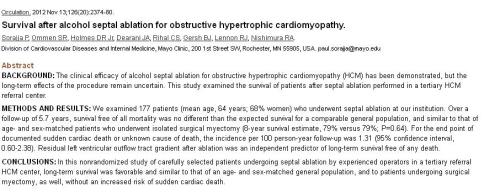
Though many studies claim so ! It fails to convince us . HOCM is a diffuse disease of myocardium. Even a cluster of myocyte disarray with fibrosis can be a future focus irrespective of it’s location .
However , it is always possible relieving the mechanical stress of the LV can definitely reduce the likelihood of an electrical event .(Even if the arrhythmic focus is intact elsewhere !)
* We know RVOT is developmentally arrhythmia prone zone . We also know HCM involves RVOT (After all , IVS is legally shared by both ventricles ! ) . Some of the monomorphic VTs with LBBB morphology may originate from RVOT in HCM .
Management of recurrent VT in HOCM
- Drugs (Amiodarone/ Calclum blockers/ Beta blockers/Disopyramide)
- ICD- (Probably mainstay )
- Very rarely ablation (If localised focus is well documented )
Reference
1.A case report for successful ablation of VT in HOCM http://www.ncbi.nlm.nih.gov/pubmed/9255687
2.http://www.ncbi.nlm.nih.gov/pubmed/23076968
//



 Dr.S.Venkatesan MD