Feeds:
Posts
Comments

Posts Tagged ‘right heart catheterisation’

Today , we  post cases for coronary angiogram , just like sending clients to breakfast table ! Close your eyes. Think for a moment. It is heartening to know how cardiac catheterization grew from a humble beginning . We know , Forssman , Cournand  and Richardson  who shared the Nobel price  for Inventing  cardiac catheterization in 1930s .

Soon after it’s  invention it was criticized by most, few ridiculed it outright , few others wondered about it . One man from the iconic  Grady memorial hospital  , attached to Emory silently  adopted this  procedure and almost single-handedly  did more than 1500 cardiac catheterization procedure. (Between 1940-50s)

How many of us know this man  from  Atlanta ,Georgia  ?

Some times history appears unkind. He is Dr Steads . . . to be precise Dr.Eugene Anson Stead Jr. ( 1908,  –  2005)
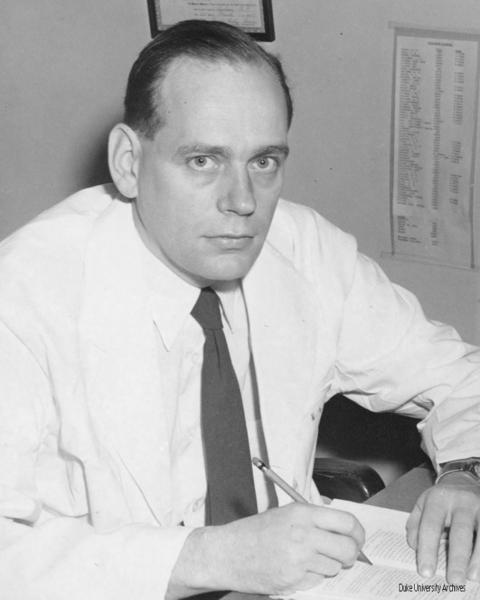
stead_eugene

Born in a humble background in the suburbs of Atlanta , became a great medical teacher , researcher and educator . He is one of the founding  fathers  of cardiac catheterization . Defined it’s usage in  clinical cardiology . The other major  achievement was his strong conviction that  medical science is indeed simple  but made complicated by complex concepts .This  thought transformed  in him ,  as he found the concept of physician assistant . He believed focused medical knowledge in young and enthusiastic  mind can make huge  difference in the way medical knowledge  is disseminated, applied and consumed .What a stunning truth even today !

grady_hosptial_pc

The legacy of Grady continues which is one of the largest public hospital in USA with special affinity to poor and low-income population.

The lab which Dr Stead worked was later taken over by Dr  Noble O Fowler* , another great cardiac physician continued the research and wrote the famous book on cardiac diagnosis and treatment.( * I think it should be in early 1950s when Dr Stead left for Dukes)

Final message

Invention of a concept is one thing . Accepting it , trying it ,  improving it ,  disseminating it , is an equally important  contribution to science. Dr Stead did exactly that .He remained  a positive force in  propagation of medical knowledge, made it  available for those  people who need it .

He passed away on June 12, 2005 at the age of 96 leaving behind a huge legacy .It will be  an  error if we don’t teach our  young students history of such great men , in medical  schools today  !

Read Full Post »

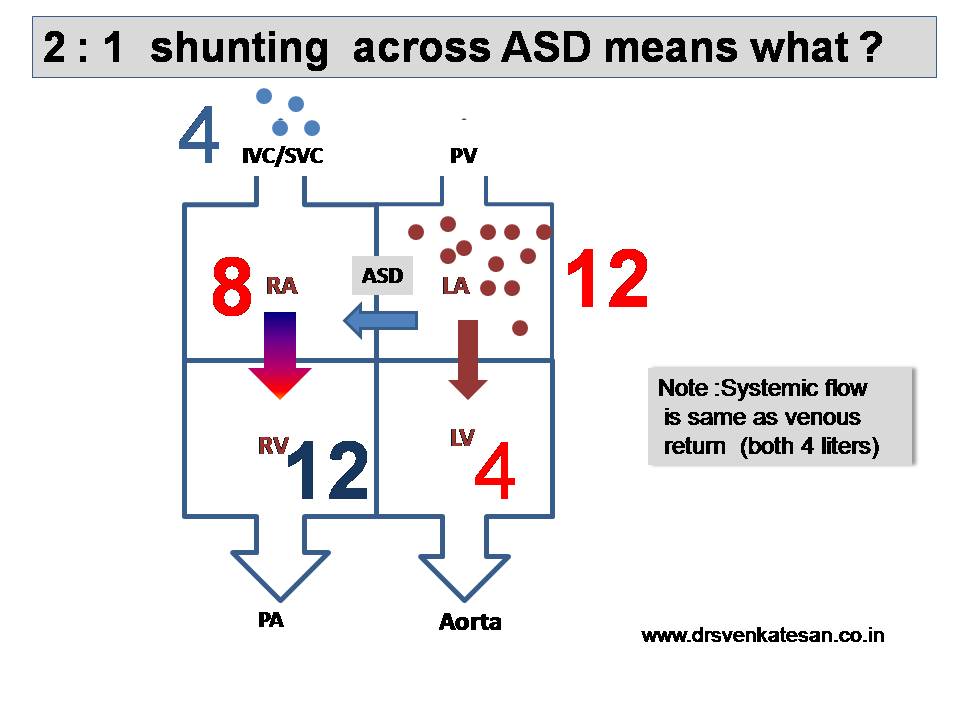
There was a big debate in one of my classes with cardiology fellows regarding the shunt quantification of ASD . We were talking about the significance of ASD shunting . We suddenly realised 2:1 left to right shunt is not a simple equation to comprehend . I was thinking 2:1 shunt would mean pulmonary flow would be twice the systemic flow . It was not to be !

Is the ratio of shunting and Qp/Qs convey the same thing ?

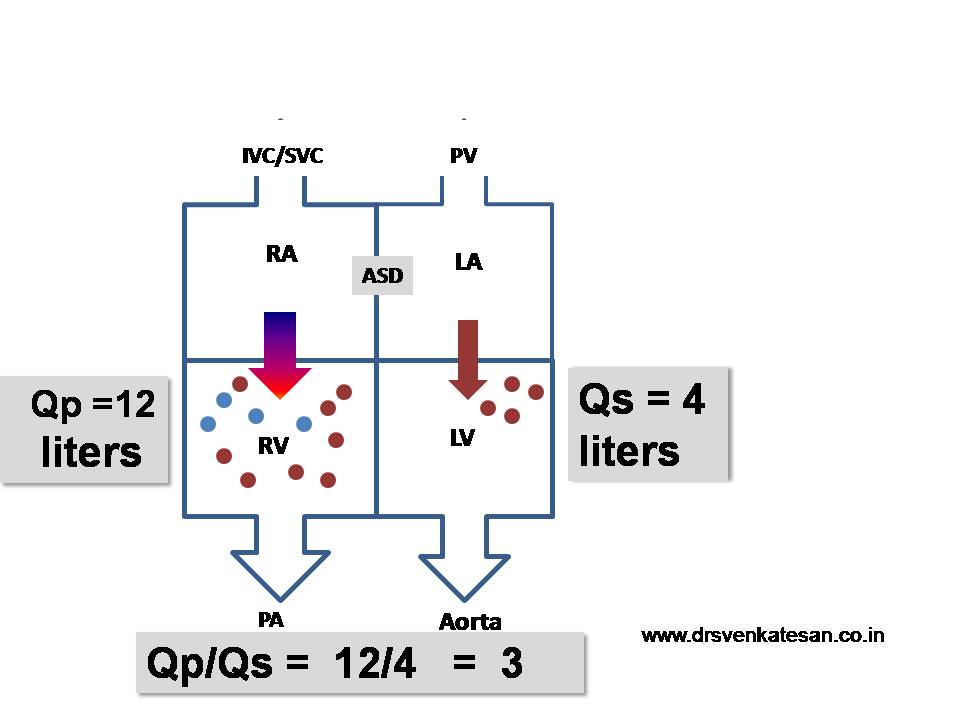
No . Qp /Qs is the ratio of pulmonary to systemic blood flow flow . When we want to quantify shunt we express it in two different ways .

1. The amount of blood shunted form left side to right side of the heart .

2. The amount of pulmonary blood flow to systemic blood flow in absolute terms .

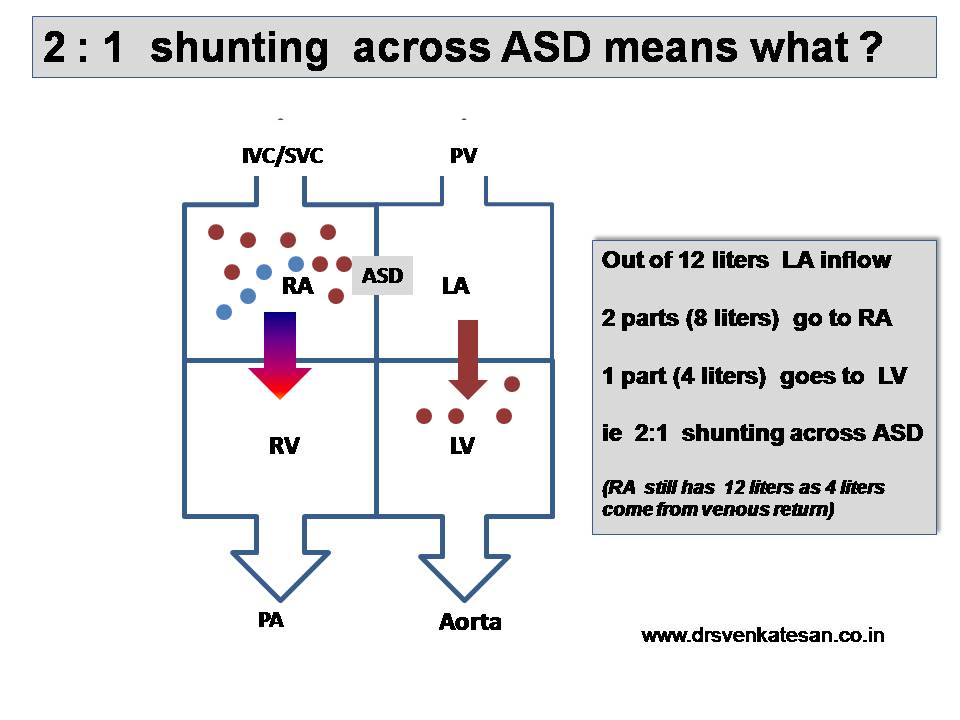
Though both are closely linked entities they do not denote the same meaning . When we say 2: 1 shunt we refer to the shunted blood across the defect but when we calculate pulmonary blood flow we take into account venous blood which does not take part in the shunting .

The confusion arises because we use both terms interchangeably.The following illustration will try to prove A 2: 1 shunt would actually correspond to a qp/qs of three (Pulmonary flow is 3 times the systemic flow !)

Let us begin with a hypothetical ASD patient who has systemic cardiac output of 4 liters.

He shunts 2 : 1 from left to right . ie he shunts 2 /3 of three parts into RA (66% ) .

A patient who delivers 4 liters from LA in the presence of 2;1 ASD shunt would mean he would receive 12 liters from the lung as pulmonary blood flow.

Final message

I am still not fully convinced about the above reasoning . I guess it is correct. I argue the fellows to give further insight into this equation. The complexities in bi- directional shunt and effective pulmonary blood flow in Eisenmenger syndrome is going beyond my heads !

Answer found after a decade

All the above cartoons are wrong

The word shunt itself has been mis interpreted by us . Shunt at the level of ASD is different from Qp/ Qs ie excess flow to pulmonary circuit.

Correct explnnation for a 2:1 Shunt:

  • Right Atrium (RA): Receives 1 unit (venous return) + 1 unit (shunt) = 2 units total, which goes to the right ventricle and lungs (Qp = 2).
  • Left Atrium (LA): Receives 2 units from the pulmonary veins, of which:
    • 1 unit (~50%) crosses the ASD to the RA.
    • 1 unit (~50%) passes through the mitral valve to the LV (Qs = 1).
  • Pulmonary-to-Systemic Flow Ratio: Qp/Qs = 2/1 = 2, confirming the shunt ratio.

Read Full Post »

Here is one of   the  very good resource   for  all those basic questions we often ask  in pediatric cardiac catheterisation. Mind you ,  great books do not come free of cost .

Have a preview . Thanks to Google books

Click on the book to enter  , if  you are lucky you will get the  information you need   free  . . .

Read Full Post »