Feeds:
Posts
Comments

Posts Tagged ‘rv dysfunction’

1.What is the response of RV to pressure overload ?

A. Dilatation

B. Hypertrophy

C Both occur together

D. Hypertrophy is the Initial response, followed by dilatation

Answer :

Since we believe RV’s behavior is generally opposite to that of LV , many would tick, dilatation as the first response. This may be correct when there is acute raise in RV after load, as in PE. However, It is surprising even in chronic pulmonary hypertension , the degree of RVH is not constant and homogenous .This is because , different parts of RV chamber has different wall thickness .Further, the pressure distribution from PA to RV is uneven. The co-existing TR confounds the loading conditions. It is not yet clear, how the RV would respond to raised PA pressure. In the bed side, we are seeing both flight(dilate) ot fight (RVH) reactions from RV (more often the former than the later) It is possible RV behavior is be pre-programed and built into the genes of the contractile proteins.

It is worthwhile to note, RVH is constant feature in non pulmonary hypertension related “after-load” conditions as in valvular or sub valvular PS. This is more to do failure of regression of RV mass early after birth, rather than the actual effect of high after load. Another point is purely technical. RVH is measured in RV free wall, in subcostal view in diastole and inspiratory phase.(upper limit is 4mm) Many of us could miss RVH in routine echocardiography unless specifically looked for.

2.Which is the first echocardiographic parameter to get impaired when RV fails ?

A. RV FAC (Fractional area change)

B.TAPSE

C. RV Ejection fraction

D.RV longitudinal strain

E. RV S

Answer : I am not very sure about the right answer , but TAPSE is last to get Impaired .(Still, we celebrate it like anything is a different story) Many believe transverse functional Indices like FAC is impaired early. and is less influenzed by the spurious spill over of Left ventricular contractile force in transannular plane (Which augments longitudinal functional Index like TAPSE),

The following illustration (From Ref 2 ) summarizes all RV functional parameter in a succinct fashion. Fellows must be familiar with at-least half of them.( RIMP is less practical and error prone can be ignored)

Reference

1.Gorter TM, van Veldhuisen DJ, Bauersachs et al Right heart dysfunction and failure in heart failure with preserved ejection fraction: mechanisms and management. Position statement on behalf of the Heart Failure Association of the European Society of Cardiology. Eur J Heart Fail. 2018 Jan;20(1):16-37. doi: 10.1002/ejhf.1029. Epub 2017 Oct 16. PMID: 29044932.

2.Harjola VP, Mebazaa A, Celutkiene J, Bettex D, ET AL  Contemporary management of acute right ventricular failure: a statement from the Heart Failure Association and the Working Group on Pulmonary Circulation and Right Ventricular Function of the European Society of Cardiology. Eur J Heart Fail 2016; 18: 226

Read Full Post »

A female child aged 14 was referred for progressive breathlessness  and  abdominal distension

Abnormally dilated right atrium with significant pericardial effusion .www.drsvenkatesan.com

Can you guess the diagnosis ?

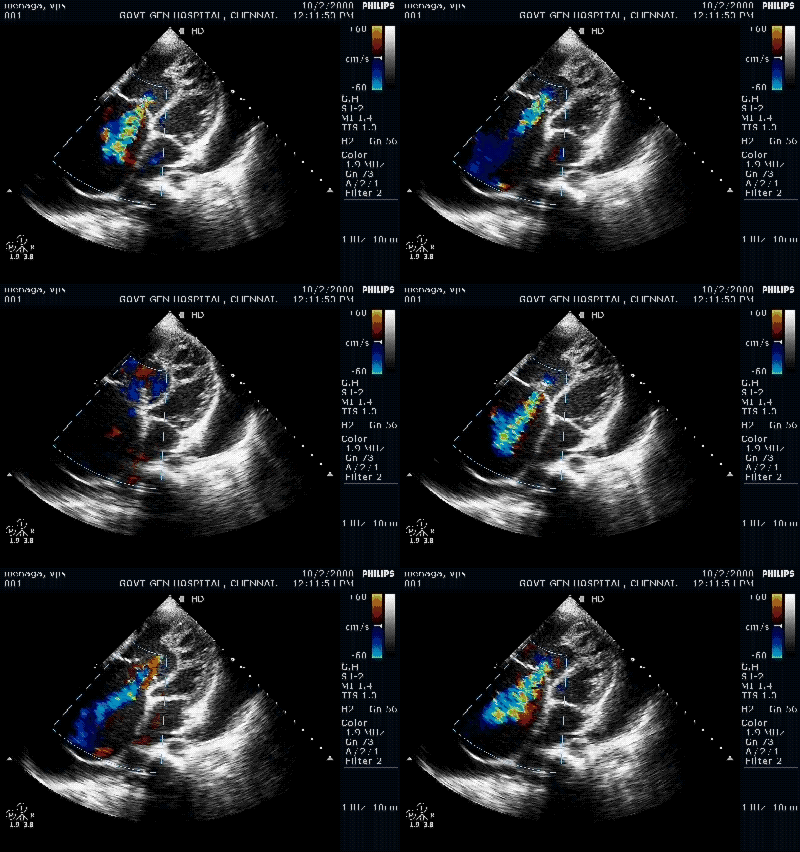
Apart form RA ,RV dilatation , the RV apex is seen filled with coarse treabeculations.This is believed to be a type of non compaction http://www.drsvenkatesan.com

Still difficult to conclude  ?   Look at the following Image.

Tricuspid regurgitation is significant . http://www.drsvenkatesan.com

If you have thought  . . .

  • ASD with TR
  • Severe PAH/COPD
  • RV cardiomyopathy

All are  acceptable  differential diagnosis

But the real diagnosis is none of the above .

Need  more time  . . . the following   Doppler tracing  will settle the issue !

Doppler velocity in RVOT at 88mmhg. http://www.drsvenkatean.com

The final diagnosis was . . .

  • Severe valvular pulmonary stenosis
  • Marked RV,RA dilatation
  • Acquired non compaction of right ventricle
  • TR -Moderate
  • Pericardial effusion -Moderate
  • This patient also had dilated IVC, Hepatic veins that  lead to clinical ascites.

Here , RV functional assessment becomes vital , but it is difficult many times. A simple clue is , as  the RV is able to generate 88mmhg pressure it implies ,   the   contractility  should be near normal .

RV EF %,  RV Dp/Dt , Tricuspid annular motion by  tissue Doppler are additional measures. Cine MRI can be a useful investigation prior to intervention.

Final message

  • VPS is a common acyanotic disease. Most are benign  and  milder  forms are the rule.
  • Dysplastic valves preclude balloon valvotomy. (In late stages   little  difference between dysplastic / non dysplastic VPS is noted  )
  • Severe progressive VPS  , like in this patient needs immediate balloon dilatation or surgery.
  • Long term outcome  is excellent except in advances cases where irreversible RV dysfunction sets in.

Read Full Post »

This is a 15 year old post, written in 2010 , just when, now famous TAPSE was introduced for RV function assessment.


Throughout the  history  of  echocardiography Right ventricular functional assessment  has received  less attention and suffered a  step motherly concern. There are innumerable parameters to assess LV function  , but we have  very few for RV !

LV ejection fraction continue  to reign supreme  in spite of the inaccuracies  and fallacies.RV ejection fraction by echo ,  never got into the main stream   cardiology literature as a tool for  RV function  assessment.

(The major reason for this  is ,  lack of  a “mathematical shape” for RV !)

RV is  formed by , a  horizontal inflow , an elongated and  wedged apex ,( in)conspicuous  body and an  ubiquitous RV outflow .No one  really knows , how  much  these  parts contribute  individually to the conductive  and contractile function of the low pressure venous ventricle.

(Of course, MRI and radionuclide derived RV EF can be accurate but doing these tests solely to measure  RV EF defies clinical sense !)

In this scenario,

Two parameter can be considered simple and accurate to estimate the RV function.

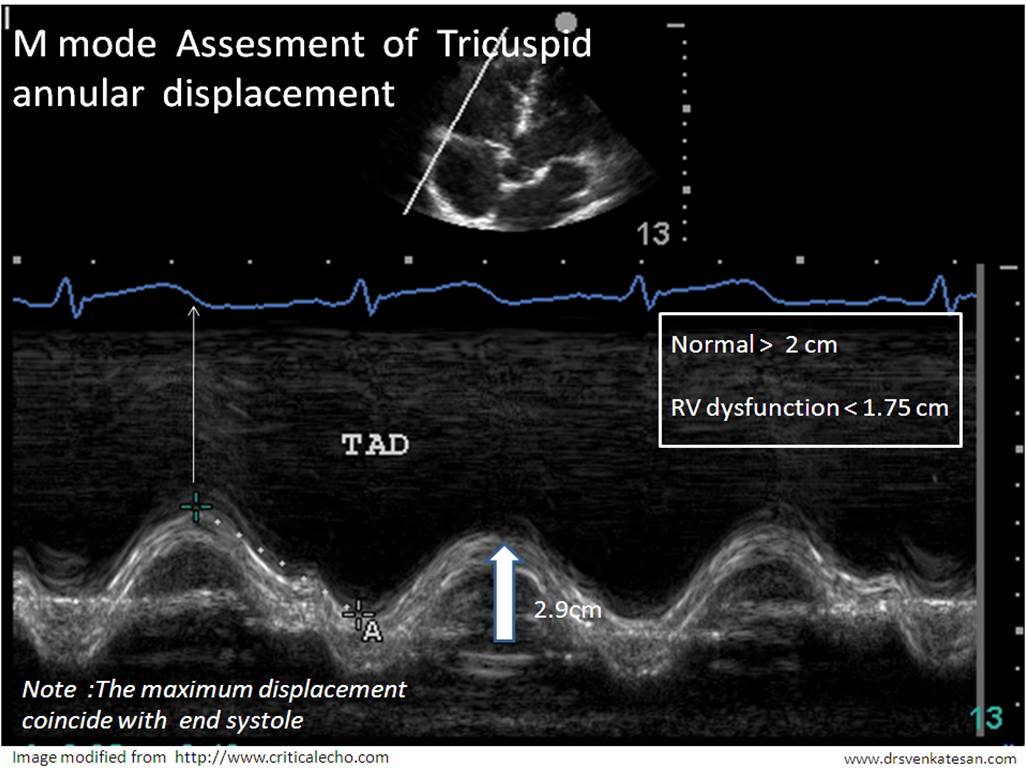
Tricuspid annular displacement (TAD)


This is a simple m-mode derived  parameter ( much ridiculed by  modern  day echo-cardiographer !)

M-mode echo in apical  4  chamber   view across lateral tricuspid annulus .

  • Normal displacement  >2 cm
  • RV dysfunction < 1.5cm
  • Borderline  RVD between    1.5 to 1.75 cm

The other parameter to measure tricuspid  motion is

Tricuspid Annulus peak Systolic velocity (TAPSV)*

  • This , in-fact linearly correlate with TAD.
  • Normal TAPSV is > 10cm/sec
  • Anything less than 8cm/sec is usually associated with RV dysfunction.

TAPSV – http://onlinelibrary.wiley.com/doi/10.1111/j.1540-8175.2006.00305.x/abstract

* One need not be  depressed if  tissue Doppler  is not availablein their  echo machine  , TVD by M mode is good enough in most situations.

Situations where RV function is impaired include

  • Severe forms of  dilated cardiomyopathy.
  • Primary (or secondary ) pulmonary hypertension
  • RV infarction
  • COPD -terminal stages
  • ARVD
  • RV dysfunction with VVI pacing
  • Following CRT

Final message

It is often  said there will  always be a simple solution for any  complex problem .  But,  it is  recognised late.

In our quest for ideal RV functional  parameter , we were entangled in the complexities for decades ,  only to realise  an obscure  M -mode  parameter in apical 4 chamber ,  could be   an  accurate way to exclude significant RV dysfunction.

Read Full Post »