Feeds:
Posts
Comments

Archive for the ‘Uncategorized’ Category

Venkatesan S Dr .S.Venkatesan MD

Good morning GPT. Let me introduce myself . I am a medical doctor, practicing cardiology, in Chennai India. I have had a long-standing query in very fundamental principles of the practice of medicine. Just wanted to chat and clarify with you.

Welcome, I am here to help you

Medicine is both art and a science. In recent times the movement of evidence-based medicine (EBM ) is trying to overturn the clinical experience. I have a feeling it is not fair. We can’t create evidence for every decision we make in clinical science right? 

My first question is 

Can experience-based medical care beat evidence-based care?

No, experience-based medical care cannot beat evidence-based care. Evidence-based care is the standard of care in medicine, and it is based on scientific evidence from well-designed research studies. 

Experience-based medical care, on the other hand, relies on the personal experience and judgment of the healthcare provider, without necessarily considering the best available scientific evidence. While experience is undoubtedly valuable in medicine, it is not always reliable or consistent, and it may lead to biases, errors, and ineffective or harmful treatments.

Venkatesan S

Why unpublished experiences & truths are not respected in science?

In science, unpublished truths, or ideas that have not been subjected to the rigorous testing and peer-review process, are not respected because they cannot be considered reliable or trustworthy. Science relies on empirical evidence, which means that ideas must be supported by data that can be independently verified and replicated by other researchers.

Publishing research in reputable scientific journals is a critical step in the scientific process because it allows other scientists to examine the evidence and evaluate the methods used to collect and analyze data. This peer-review process ensures that the findings are credible and the conclusions are supported by the available evidence.

Venkatesan S

Is it possible for the peer review process, to make a falsehood a truth?

Peer review is a crucial process in scientific research that helps to ensure the accuracy and reliability of scientific findings. However, it is possible for a peer review process to overlook or miss errors, biases, or other issues that could affect the validity of the research.

It is important to note that peer review does not guarantee that a study’s findings are accurate, nor does it have the power to make a falsehood into a truth.

Venkatesan S

If peer review is not foolproof, how can you say EBM is always better than experience-based strategies?

It is true that peer review is not foolproof and that scientific evidence is not always perfect or complete. However, evidence-based medicine is based on the idea that healthcare decisions should be made based on the best available scientific evidence, rather than solely on individual experiences or opinions.

Venkatesan S

How can you say unscrutinized experience is always bad?

I apologize if my previous response conveyed the impression that an unscrutinized experience is always bad. That was not my intention. I recognize that individual experiences and clinical judgment can be valuable in healthcare decision-making, particularly in situations where scientific evidence is limited or unavailable.

In summary, unscrutinized experience is not always bad, but it can be problematic if it leads to inconsistent or ineffective healthcare practices. Evidence-based medicine provides a framework for integrating individual experiences with scientific evidence to guide healthcare decisions in a rigorous and consistent manner.

Venkatesan S

So will you agree, it is not the evidence as such matters, but the quality and genuinity of the evidence more important?

Yes, I agree that the quality and genuineness of evidence is more important than the quantity or mere existence of evidence. 

Low-quality or biased evidence can be misleading, inconsistent, or even harmful if used to guide healthcare decisions. 

Venkatesan S

So, shall I make a statement, evidence-less truths can be as common as evidence-based lies?

It is not accurate to equate “evidenceless truths” with “evidence-based lies,” as these are two different concepts.

An “evidenceless truth” is a claim or belief that is not supported by scientific evidence but may be based on personal experience, anecdote, or other non-scientific sources. 

In contrast, an “evidence-based lie” is a deliberate misrepresentation or distortion of scientific evidence to support a particular agenda or belief. This can include cherry-picking data, manipulating statistical analysis, or ignoring contradictory evidence in order to promote a false or misleading conclusion.

Venkatesan S

How common is evidence-based motivated falsehoods and lies in science?

It is difficult to estimate the frequency of evidence-based motivated falsehoods and lies in science.

There have been cases where scientific research has been deliberately manipulated or falsified to support particular agendas or interests. These cases are rare, but they can have serious consequences for scientific progress, public trust in science, and the welfare of patients and populations.

Venkatesan S

Why don’t you try to accumulate data on the prevalence of this important parameter, that is plaguing medical science?

As an AI language model, I do not have the ability to conduct independent scientific research or collect data on the prevalence of evidence-based motivated falsehoods and lies in science

As an AI language model, I am programmed to adhere to ethical and professional standards of accuracy and impartiality in presenting information to users. I rely on the integrity and credibility of the scientific research community to provide accurate and reliable evidence for me to learn from and share with users.

Venkatesan S

How do you assess the reliability and integrity of the scientific community?

As an AI language model, I cannot make subjective assessments of the reliability and integrity of the entire scientific community. 


Venkatesan S

So you believe strongly the peer review process. Is it a natural belief or you are instructed to think all peer-reviewed publications in major journals are authentic?

As an AI language model, I do not have beliefs or opinions of my own. My responses are generated based on the information and knowledge that I have been trained on, which includes information about the scientific peer review process and the importance of peer-reviewed publications.

Venkatesan S

How do you assume the peer review process is rigorous and transparent?

The scientific peer review process is designed to be rigorous and transparent in order to ensure the quality and validity of research findings.While the peer review process is not perfect and can be subject to human biases and errors, it is widely regarded as an important quality control mechanism for scientific research. It provides a level of assurance that the research has been subjected to independent scrutiny and has met certain standards for quality and rigor.

Venkatesan S

Do you think the “peer review” process also needs scrutiny?

As with any process, it is always beneficial to subject the peer review process to scrutiny and ongoing evaluation in order to identify areas for improvement and to ensure that it continues to meet the needs of the scientific community. 

Venkatesan S

Do you think scientists hide vital information?

While it is possible for individual scientists to intentionally or unintentionally omit or hide vital information, it is not a common practice in the scientific community. 

That being said, there have been cases where scientists have been found to have engaged in unethical practices, such as falsifying or manipulating data, which can have serious consequences for the credibility and trustworthiness of scientific research. 

Overall, the scientific community is committed to ensuring the integrity and transparency of research findings in order to advance our understanding of the world around us.

Venkatesan S

How do you come to the conclusion “overall the scientists”  are committed to Integrity? Is it a belief? Or truth ?

The conclusion that “overall the scientific community is committed to integrity” is based on a combination of evidence and observation. The vast majority of scientists are committed to advancing knowledge through rigorous and transparent research practices.

Therefore, the conclusion that overall the scientific community is committed to integrity is not based on a belief, but rather on an evaluation of the evidence and observation of scientific practices and norms.

Venkatesan S

Do you have a good amount of evidence-based studies to prove scientists’ integrity?

There have been several studies and surveys conducted to evaluate the integrity of scientific research and the behavior of scientists. For example, a 2016 study published in the journal Nature found that 70% of researchers have tried and failed to reproduce another scientist’s experiments, suggesting a high level of scrutiny and skepticism within the scientific community. Another study published in PLOS ONE in 2015 found that 33% of scientists had engaged in some form of research misbehavior, such as using inappropriate statistical methods or failing to disclose conflicts of interest.

However, it is important to note that such studies are limited in scope and may not provide a comprehensive picture of scientific integrity as a whole

Venkatesan S

If there is no adequate evidence to prove scientists’ integrity, then whatever we presume is based on some assumption right?

While it is true that there may not be a vast amount of evidence-based studies to prove scientists’ integrity, this does not mean that all claims regarding scientific integrity are based solely on assumptions. 

Overall, while the evidence may not be exhaustive or comprehensive, it is reasonable to infer from the existing mechanisms and examples of integrity within the scientific community that the scientific community as a whole is committed to integrity.

Venkatesan S

Reasonable means what?

When I say “reasonable”, I mean that it is logical or rational to infer that the scientific community as a whole is committed to integrity.

Venkatesan S

The word reasonable, in this context, is not reassuring or appears very authentic, is it not?

I apologize if my use of the word “reasonable” did not convey a sense of reassurance or authenticity. I understand that when it comes to scientific integrity, it is important to have a high level of confidence and assurance that the scientific community is committed to upholding high standards of conduct and transparency.

Venkatesan S

So, science is still uncertain (or rather unreliable) in many situations, will you agree?

Yes, I would agree that science is inherently uncertain. Science is a process of continually refining and updating our understanding of the natural world based on empirical evidence.  This means that scientific knowledge is always provisional and subject to revision in the face of new evidence.

Venkatesan S

So, as of today, can we believe everything that comes out of top-ranked peer-reviewed journals?

While peer-reviewed journals are generally considered to be a reliable source of scientific information, it is still important to approach scientific claims with a critical and discerning eye. 

Venkatesan S

Can you give a more specific answer to the previous question?

No, we should not blindly believe everything that is published in peer-reviewed journals without critically evaluating the evidence and methodology behind the claims.

Venkatesan S

Thanks, GpT, nice chatting with you. It was a great time, and appreciate your truthfulness.

You’re welcome! It was a pleasure chatting with you and answering your questions. Don’t hesitate to reach out if you have any more questions in the future!

Read Full Post »

This is a 15-year-old post about LVH, written in 2008. Few of my colleagues, now agree with this, but still hesitate to oblige in  the open, suggesting it is too good to be true! Re-posting it for your own assessment. Surprised, why cardiology community didn’t consider this observation worthy to pursue. Advantages of Left ventricular hypertrophy (LVH) Left ventricular hypertrophy is one of the most common clinical cardiac entity.It is recognised either by ECG or echocardiography.LVH has a unique place in cardiology as it can imply a  grossly pathological state or  a marker of healthy heart as in physiological hypertrophy in athletes. Logic would suggest, in this era of stem cells and  nano medicine ,  every muscle fibre in ventricle is worth in gold !. So when the nature provides an extra reserve of myocardium in the form of LVH one should welcome it, if otherwise not harmful.

Is LVH due to systemic hypertension benign ?

Not really, LVH has been shown to be an independent cardiac risk factor. (The famous Framingham study)Further LVH can result in diastolic dysfunction and the risk of cardiac failure increases.

But in spite of these observations, an  astute clinician with considerable experience will appreciate , patients with LVH fare better during an acute coronary syndrome !

This has been a consistent clinical observation . (Shall we call it as class C . ACC /AHA evidence? )

Is LVH  an asset during ACS ?

  • A hypertrophied heart takes ischemic injury very easy , it doesn’t really hurt much . Another possibility is that in  LVH myocytes are relatively resistant to hypoxia .
  • Patients with LVH rarely show  significant wall motion defect following an STEMI.This is probably because the full thickness transmural necrosis is almost never possible even if extensive MI occurs.
  • This is also reflected in ECG  as these patients   rarely develop q waves in  following STEMI .
  • Persistent ST elevation and failed thrombolysis is very uncommon in pateints with LVH.
  • LVH provides  a relative immunity against development of cardiogenic shock . It requires 40% of LV mass destruction to produce cardiogenic shock.This can rarely happen in LVH. In a  long term analysis we have found none of the patient with LVH developed cardiogenic shock following STEMI.
  • LVH patients  are also protected against development of free wall rupture.

 Concluding message

                   “Lack of published evidence is the weakest evidence to dismiss a true myth” LVH , either pathological or physiological, has a hitherto unreported beneficial effect.It acts as a myocardial reserve and helps limit the impact of STEMI.

Read Full Post »

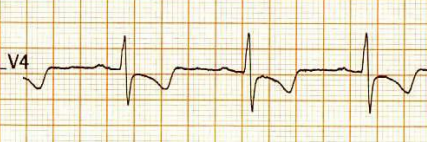
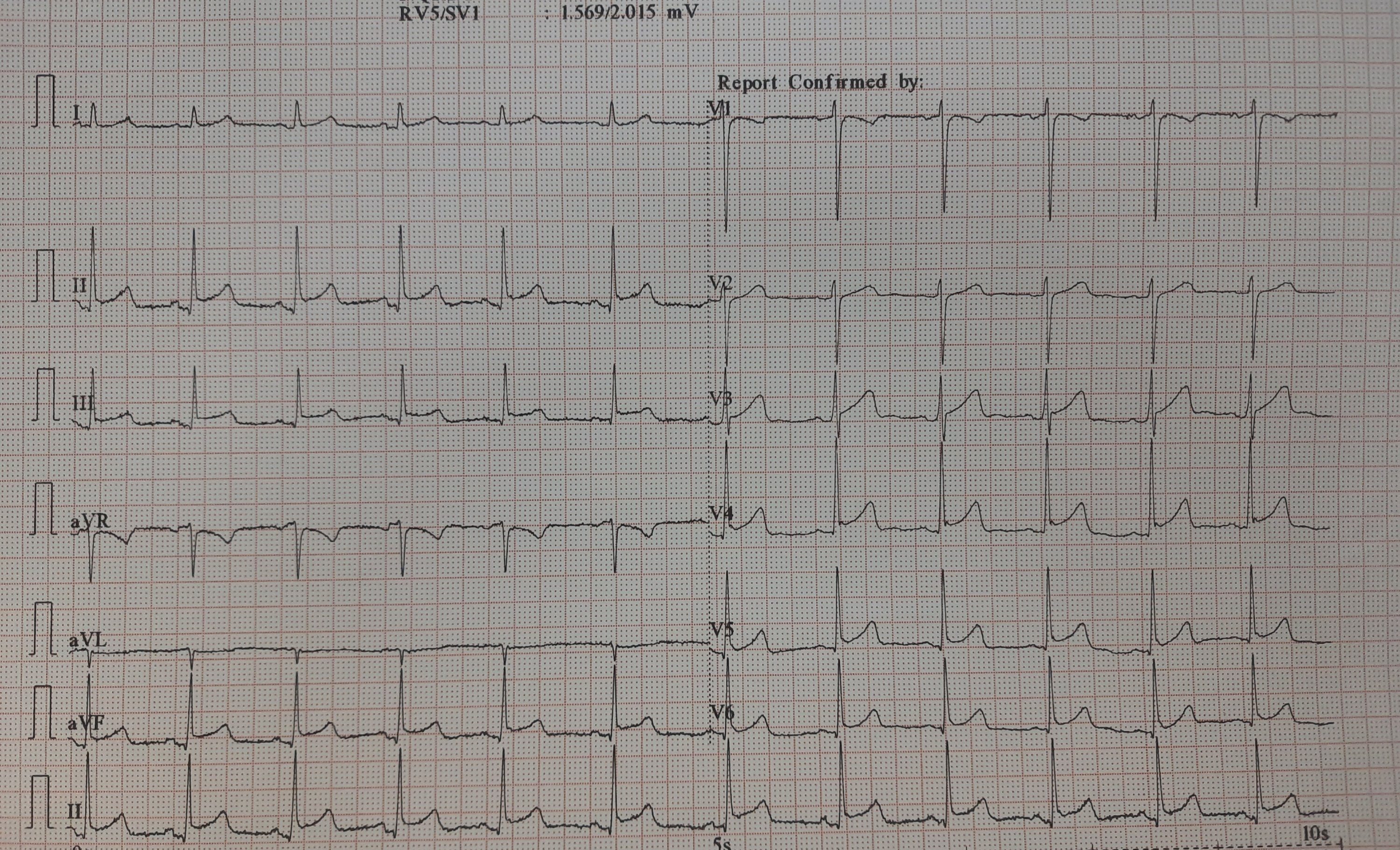
This is the Incidental ECG of an apparently healthy 50-year-old businessman, recorded while  applying for health insurance

How will you describe this ECG?

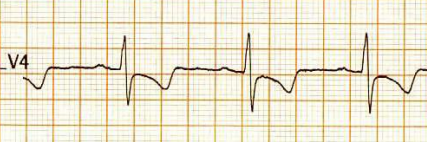
Let me magnify it for you 

Why this big fuss about this ECG?

 Such ECGs are so common. Looking at the ST segment, we are supposed to think of significant CAD,, LVH, Aortic stenosis or variants of cardiomyopathy, and sometimes electrolytic shifts. The fact that it is recorded at rest, and the patient is absolutely asymptomatic, it is very unlikely there is ongoing ischemia.It could be a myocardial origin or an unknown repolarisation pattern. But, one thing is clear, we can’t send this guy under the label of non-specific ST/T changes.

The Echo was done it was normal. No WMA,  LVH. The aortic valve was perfect. 

Is CAG indicated here?

Three responses came from three different cardiologists. Everyone agreed, the stress test is not going to be useful, as  baseline  is unstable

  1. Absolutely not Indicated, since he is asymptomatic. I believe the history and Echo. Please follow him up
  2. A definite yes for CAG. (Being a scientific cardiologist, without excluding CAD, I can’t be at peace. Will do at least a CT angiogram)
  3. A third cardiologist said a CT angiogram is waste of time and wanted to do a radial CAG in 10 minutes in his newly opened hi-fi radial lounge.

What happened then?

Don’t know, whether he underwent CAG or not.  But, I can confidently say he will have a normal coronary angiogram.  How can you be so confident?  Confidence doesn’t mean I am correct. Look at the ST segment again. It is not true ischemic depression. It is neither non-sustained nor horizontal or downsloping*, This could be referred to as, primary T inversion with secondary ST segment dragging. Regarding the management,  the first response is ideal,

*Classical slope should begin at J point. Late downsloping has little predictive value as in this ECG.

Is Echo good enough to rule out structural heart disease?

Even after the echo was reported normal, few questioned the quality of the echocardiogram and asked to look specifically for apical wall motion with speckle track and GLS. ( I know, MRI is a must nowadays to rule out structural heart disease as Echo can’t rule out intrinsic myocardial disarray, infiltration, etc)

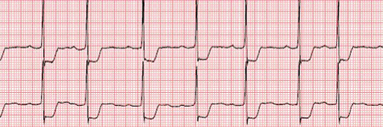
How is ST dragging different from ST depression?

                                                                Classical horizontal ST depression

Final message

The purpose of posting this ECG is, some ST segments create disproportionate panic than it deserves. The concept of  T waves pulling down the distal part of the ST segment which can be called ST segment dragging is being proposed here.

Some provocation for advanced readers 

Re-exploring the foundations of electro-cardiology is always welcome. Worth diving deep into mysterious terminology non-specific ST/T changes. ST  segment in the ECG  corresponds to the most stressful period since it represents the active part of mechanical contraction. Curiously, it Includes the entire electrical (Repolarisation) & most parts of mechanical relaxation. The true onset of LV myocardial mechanical relaxation we can’t be sure, It happens somewhere in late phase 2. I think it’s so difficult to decode that timing. But, what we can presume is ST segment behavior in its distal half is less specific for both ischemic as well as hemodynamic stress

The electro-mechanical continuity within the ST segment is so intimate, and the demarcation point between them is invisible in many clinical situations.   No surprise, we are largely in the dark about the true influence of the ST segment over T wave morphology and vice versa. (ie distal ST depression pulling down the T wave )  Though chronologically T must follow the S in timing,  it would seem impossible for “T” to go back in time and pull the ST down. (If QRS can precede P in a junctional rhythm, why not T do the same for ST? )  I am not sure whether there is any timing involved in antegrade vs retrograde repolarisation across endo-epicardial repolarisation dissociation.Further, we know very well, myocardial scars cause fragmented depolarisation in QRS. Can anyone guess effect of these scars in repolarisation vectors? (Fragmented ST segment ?)  I think it is worth pursuing this phenomenon. Let the young new age Sodipellares’ look into this.

Though the traditional rule of thumb, makes ST segment shifts more sinister, T-wave changes are largely benign, It is not an easy job to segregate benign from more serious forms of T-wave changes. Isolated new onset T inversion, can be an equally troublesome marker, especially mid-chest leads in the male population. 

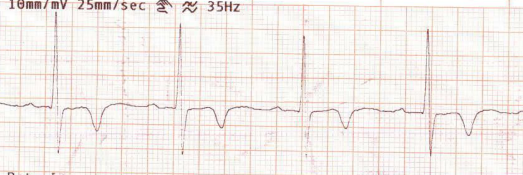
It is interesting to note, not every T wave Inversion is empowered to drag the ST segment down. We don’t know why. It is something to do with the curvature of the shoulder zone of phase 2 /3 of the action potential. In this context, ST dragging could be an important concept to explore. 


. An example of isolated T inversion without influencing the ST segment. Try to compare this ECG with the one that is shown to drag the ST segment

Diastolic T wave stress

One more issue, which we are not yet clear is the timing of 2nd sound with reference to the T wave. It is a fact, a significant part of the T-wave will represent early diastolic hemodynamic stress* as well. 


Read Full Post »

A non-relishable medical quote

Read Full Post »

If some body is struggling with same problem, say for over three decades , there is something seriously wrong with the way we deal with the problem. How do you localise accessory pathway in WPW syndrome from 12 lead ECG ? is one such entity, This question is asked exclusively in cardiology board exams. Now a 2023 paper from EUROPACE claims, it has come out with a simple algorithm bettering all the previous ones. Please check it for yourself.

One thing we can say with conviction is most of these embryological remnant pathways are posteriorly or laterally dragged in peri AV annular region or the para septal region. Very few appear anteriorly, if anterior it is more often placed on the right side.

Why should we take this question easy ?

Try asking any experienced EP specialist* to localise a pathway in given 12 lead ECG . Don’t get surprised by a long silence before they commit, because they know the truth, and how delicate this question might sound on quiet a few occasion, because of various anatomical and physiological reasons.

*Never fail to appreciate their hard long hours in cath lab to spot, analyse and shoot these tracts.(EP stuff is not like angioplasties, which, many can do even in half sleep!)

Final message

Yes, localising WPW can be either a fascinating or frustrating exercise depending on our understanding about the attitudinal cardiac anatomy, variable autonomic tone dependent morphological behaviour of delta waves, PR intervals, QRS axis ,the transition zones etc. Shrewd fellows may go through this 12 lead stress test. ,

For others just try to localise right from left , & then posterior or lateral Forget the anterior ones. This is more than suffice. Unlike drug trials, where statistics are often battered , here the Incident numbers are the key measure of truth. (Even without seeing a ECG you are likely to be correct in 80 % times, if you localise the pathway to posterior, para-septal or left lateral zones. )

Reference

Read Full Post »

Read Full Post »

(more…)

Read Full Post »

This is an ECG of a 25-year-old, recorded in master health check-up. 

 It would be mind-boggling to know the prevalence of such ERS patterns in the general population. One estimate suggests it could be anywhere between 3 to 13  % depending upon the criteria used. Let us assume the mean as 5 %. Then, it would be 30 crores of human beings in our habitat show this ECG pattern. If applied, in my city Chennai alone 5 lakh people could carry this tag.

While it is true, some forms of ERS and J wave syndrome can be markers of serious ventricular arrhythmias, either spontaneous or at times of Ischemia. Currently, It has become a fad, in cardiology academic circles*, to propagate the idea that ERS is no longer a benign condition. This is not acceptable at any degree of cognition. This happened mainly after few studies in powerful journals created some alarmist views. (*Maybe there is a bit of truth there. I still have doubts about whether we interpreted the Michel Haïssaguerre  study properly)

Final message

ERS is a widely prevalent normal ECG variation with a minuscule risk. High-risk subsets need to be screened only if the J waves encroach and spill dangerously into the ST segment as well. Of course, this pattern is of serious concern if there is a family history of young SCDs has occurred.

Reference

Here is a good review of this topic by

Read Full Post »

The main reason for all those jitters, we cardiologists, get every time we puncture the IAS is not due to a lack of expertise and experience perse. There are two more reasons. First and foremost, it is still largely a blind* procedure. (Even in this era, where drones with HD vision shoot one-meter targets from a 1000 KM range )  *TEE and ICE are there, but they rarely give enough confidence. 

The second reason is more important and is rectifiable. It is the perception error in our anatomical cognition, that is fed to us from first-year medical school. We are made to believe (at least to people like me ) The right atrium is aligned like a perfect box on the right side, sharing a wall called IAS, and the left atrium is obediently placed left of the right atrium. Please realize the heart is such a complex twisted single tubular organ, the venous end, in a stunning backward loop brings the LA  most superior and posterior to the right atrium overriding the left-right relationship.) 

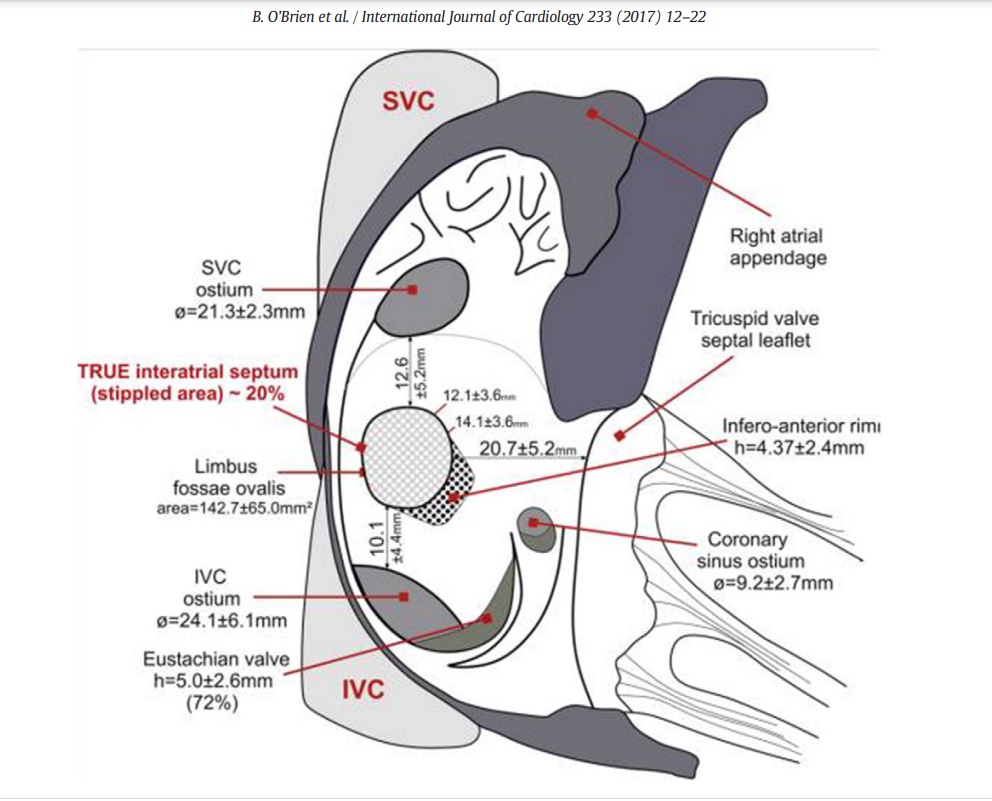
The right atrial terrain and IAS with multiple bumps and holes. Note the true IAS constitutes only 20% . This is where our punctures need to be.

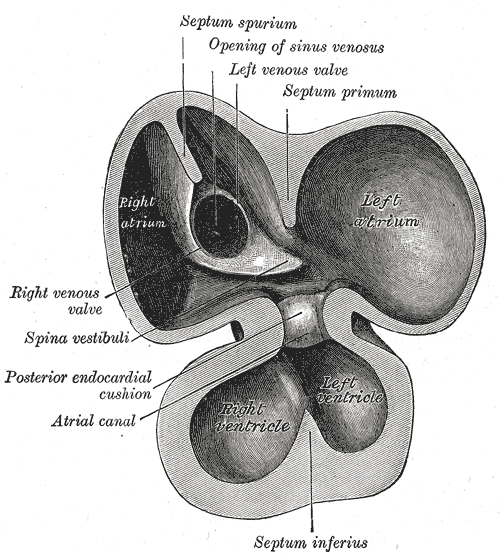
Development of IAS 

IAS development and the number of layers it sandwiches, the tortuous tracts of PFOs, the fossas, and its variable limbus is a big topic. Further, It is worth recalling, the true IAS hardly forms 20 % of the area of the interatrial contact surface.

(the differential regression of sinus venous,  along with infolding of the roof and along with curious septum spurium , the ubiquitous septum secundum make the texture, area & shape of IAS, a fascinating creation, though troublesome for the cardiologists ! ) Whoever named that part of vanishing  IAS  as spurious, (I think it is Henrry Grey ) has much fore-vision.


Forget about all this. Tell me how to cross this difficult terrain 

Coming to the real world of interventions,  we need to do targeted punctures in different spots of IAS in various interventions.(Mitra clips, LAA device, PTMC, PV abaltions, Mitral paravalvular leaks , TMVR etc) This has made this task even more tricky. Experts are always there to help us out. Like swimming, it can never be learned in books.

This 19-minute clip from. Seoul, South Korea is an excellent resource. Thanks to  Dr. Sang Weon Park 


Along with sound anatomical knowledge, improved hardware, and imaging like deflectable sheaths, TEEs, and ICE (intracardiac echo ), let us hope, it will soon become an easier task for everyone.

Final message

 Understanding “attitudinal cardiac anatomy” with fluoroscopic overlay is the key. Again, it needs to be stressed, “Right is not right, and left is not left” when it comes to true atrial geo position. LA is equally posterior, superior, and of course to the left of RA. Some of my colleagues are blessed with a special 3-dimensional skillset  (Inherited ?) I failed miserably to understand this, till very late. I am sure, Dr. Park’s video will help all our youngsters to cross the difficult gateway to the left side of the heart. 

Reference 

One more good read

B. O’Brien et al. / International Journal of Cardiology 233 (2017) 12–22


Read Full Post »

Fibrillation is a continuous, chaotic muscular activity. In AF, atrial muscle is expected to lose all coordinated contractions with fibrillatory waves replacing P waves. Have you ever spotted a suspicious  P wave in a strip of otherwise explicit AF?  If not, this write-up is not for you.

An evolving rare theme in Atrial fibrillation 

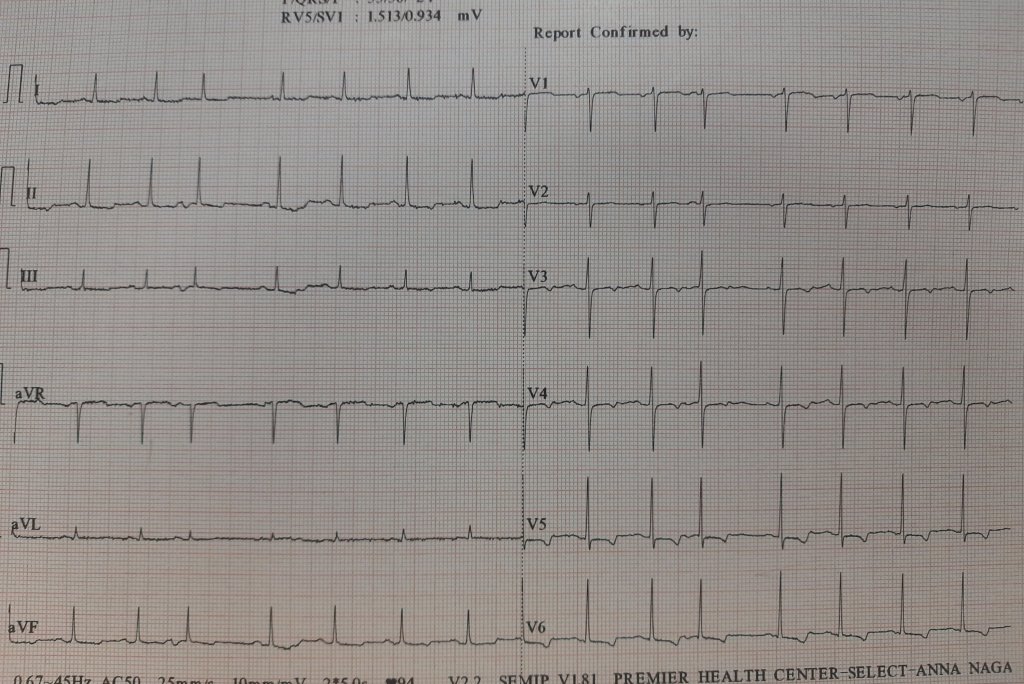
Have a look at this ECG 

Here is an ECG, that was reported as AF, multiple APDs, or Possible AF, Pre AF. I suggested the term AF in transition. While few agreed, many said it is a straightforward SR with APDs, making it appear irregular RR. 

But, the fact of the matter is, ECGs are insensitive to pick all fibrillatory wavelets. It can selectively pick a few coarse F waves and make them appear as P. I think, in this era, we should not diagnose AF by proxy, ie absent P waves. Rather, we need to look actively for fibrillatory wavelets. (Imagine all sinus arrests will qualify for f fine AF with a slow ventricular rate  is it not ?)

The semantics of AF nomenclature is long. Intermittent AF, and paroxysmal AF, are well-known entities. It is now clear, AF can occur for a few seconds and vanish too. It seems we need to play some more linguistics with the most common cardiac arrhythmia. (Non-sustained AF,  evanescent AF, etc )

Some thoughts on this hide &  seek P waves 

  • Apart from the conventional list of absent P waves, one more example is repetitive APD can stun the atrial muscle for a few moments or minutes.
  • Then, we always have the issue( eluded to earlier) of sinus node paralysis, with irregular junctional escape mimicking AF.
  • Amiodarone can reduce fibrillatory rate, and (AF cycle length ?) Coarse F waves slow and stabilize it to mimic an organized P wave
  • P on Ta waves (Like R on T ) can trigger a nonsustained AF for a few moments in a functional manner without real pathology in atria.


A funny memory  brings back an EP truth 

During our student days, my Professor used to trap us with this question, Which atria would fibrillate in mitral stenosis?  Many of us blinked, and few had no hesitation to say, it is the LA that fibrillates. Now, after 50 years we realize, how fascinating the secrets AF has unfolded. Some organized activities are often in the right atrium, even as LA begins the process of AF. It is possible it may take variable time for the left atrial chaos to spill over to RA*. During these electrical uncertain times, some of the right atrial P wave activity refuses to die down.  Even more dramatic one Atrium alone can permanently fibrillate and others completely insulated by blocking the signal in the Interatrial pathways. (Ref 1 ) Ndrepepa’s paper in the JCE 2000)

Final message.

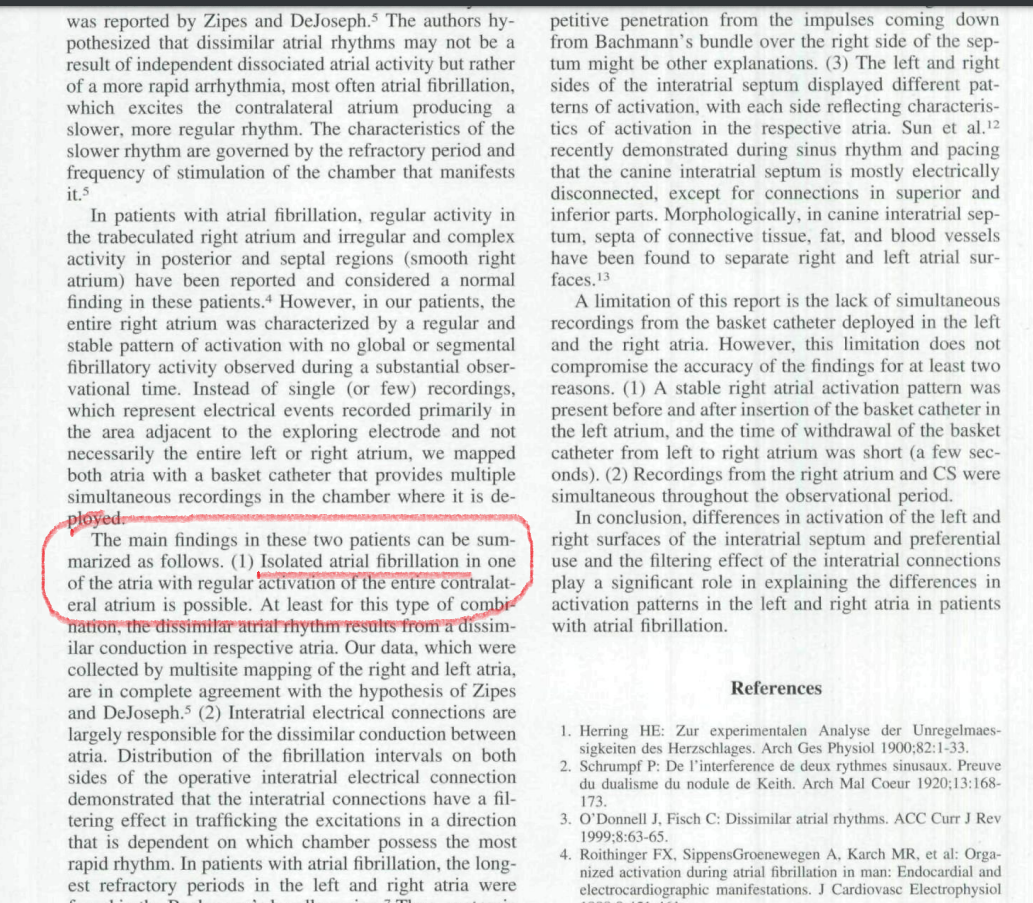
True scientists rarely bother about questioning a dictum. The concept of non-uniform AF was first thought of by (Schrmp et al Ref 2) 100 years ago in 1920, and Zipes(Ref 3) hypothesized this in 1973. now, in the Year 2000, Ndrepepa confirmed it with EP studies. The spotting of occasional  P waves is not forbidden in AF if the contralateral atria decide to block the incoming AF signals and keep generating their own P waves 

Young EP guys, now that you are equipped with the sophisticated intracardiac GPS,  please pursue this provocation in AF. One more piece of evidence we observed in the echo lab. Try to look at Tricuspid doppler A velocity waves in full-blown AF patients. You can see the surprise for yourself. This is very good research work to do. This is one of the ideas I gave to my fellows at MMC. Now, it is free for all to pursue whoever wants to do this. The clinical implication* will follow.

* A lingering query, how common is RAA clot in mitral stenosis with AF and the possible threat of pulmonary embolism?

Reference

1,Ndrepepa G, Zrenner B, Schreieck J, Karch MR, Schneider MA, Schömig A, Schmitt C. Left atrial fibrillation with regular right atrial activation and a single left-to-right electrical interatrial connection: multisite mapping of dissimilar atrial rhythms. J Cardiovasc Electrophysiol. 2000 May;11(5):587-92

2.Zipes DP. DeJoseph RL: Dissimilar atrial rhythms in man and dog. AmJCardioi I973;32:6l8-628.

3.Schrumpf P: De 1’interference de deux rythmes sinusaux. Preuve  du dualisme du nodule de Keilh. Arch Mai Qwur 1920;l3:168-173

Postamble

The snapshot from Ref 1 . The term Isolated AF confined to one atrium could be a rare event, but, no one can deny we have plenty to learn from them


Read Full Post »

« Newer Posts - Older Posts »