Feeds:
Posts
Comments

Like coronary blood flow, intra-cardiac electricity must flow in a pre-designated path at a specific time interval with absolute  discipline. Any deviation or trespassing results in arrhythmia. While, minor aberrations are accepted, major deviations due to structural or functional reentry within the ventricles presenting as VTs (Scars, Infiltrates, etc) need immediate or at least early attention.

The term, VT mapping has been in vogue in clinical electrophysiology for more than half a century, right from Dr.Josephson and Wellens’ days. While , treating VTs with drugs is still a choice, permanent solutions by defining the VT circuit and ablating them, is the new norm. However , the difficulty is, demarcation of the VT circuit is still a tough job, especially since the VT circuit plays a mysterious hide-and-seek game during diastole. The current challenge is to draw the complete blueprint of the VT, especially the diastolic VT circuit.

The tracts that carry the diastolic electrical flow are located sub-endocardially, sub-epicardially , over right ventricular aspect, or finally through the ubiquitous concealed intramural paths.

Unless, we eliminate the entire circumference of the circuit the chances of recurrence is higher (This is contrary to the past belief that a one-time interruption of the VT circuit at some point of the circumference was considered good enough. (This is what DC shocks do for temporary reversion to sinus rhythm )

How to localize the diastolic pathways?

We must thank the technological innovators in the electro-anatomical mapping system, who are continuously upgrading and providing the best to us. The following image and video clip is one such demonstration of ablating hidden diastolic paths between the entry and exit points.

Diastolic blind spots between the entry & exit points of VT can be deep & dark


The final message

It’s very clear, that I can never be able to understand the technology and nuances behind the mapping and ablation. But, just wanted to share a simple thought with the general cardiologists after going through the above article. Like hemodynamics of blood , an “electro-dynamic” flow cycle exists that is critically important both in physiology and pathology . The learning point is that, in VT ablation, looking for anatomical diastolic tracts and its electrical activity becomes a key exercise.

How can we remember this EP lesson easily ?
We can take a cue from the vintage clinical auscultation classes, where we ask the medical students to look for MDM (mid-diastolic murmur) in mitral stenosis in the left lateral posture in expiratory phase. Now in modern electro-physiology, it is time to teach young cardiology fellows a new rule of thumb, always look for the (mid )diastolic electrical flow in any scar-induced VT.

Reference
Alexios Hadjis , Antonio Frontera. Luca Rosario Limite , et al Complete Electroanatomic Imaging of the Diastolic Pathway Is Associated With Improved Freedom From Ventricular Tachycardia Recurrence Circ Arrhythm Electrophysiol. 2020;13:e008651. DOI: 10.1161/CIRCEP.120.008651

Next question in the queue

Can a VT occur without an exit point ? (I have been looking for a long time for an answer)

This is a condensed video version of PPT slides of my recent presentation.Please pardon, there is no audio as of now. Will make a voice-over and post soon.

Topic : AI in cardiology

Occasion: Prof Rathnavelu Subramanian memory oration. Cardiological Society of India Chennai.

Date : 8-06-2024

Acknowledgment & Courtesy: Images and videos from open source

“Half-baked knowledge is not better than fully-baked Ignorance

LDL is portrayed as villain de-chief of Atheroscerlois and CAD. But, LDL with a 100 to 160 mg concentration, is in constant circulation, in a smooth manner serving other physiological vascular functions.

The forcible evidence that LDL can pierce an Intact endothelium is so huge no one can have the courage to dispute it. But, it doesn’t happen in the majority is the mysterious truth.

Electron microscopic picture of 20nm sized LDL molecules in circulation. They are not as frightening molecules as they are portrayed

What factors induce LDL to enter the endothelial gap junctions.?

Some facts

The diameter of LDL particles is about 20–30 nm which is much larger than that of gap-junctions (3–6 nm) between adjacent cells in continuous endothelium (Iuliano, Micheletta, & Violi, 2001). Hence, the only way for LDLs to cross the endothelium is through a process called caveolae-mediated transcytosis.

Contrary to the shout-out, LDL is not a true villain in all patients with CAD. It is something else, we aren’t aware of that keeps the LDL either passive or promotes its penetration.

There are at least five important factors.

1. Baseline Endothelial Integrity & vascular aging

2. Accelerated caveolae formation,

3,The shear stress of flowing BP .

4 .The associated diabetic basement membrane dysfunction.

5. Finally, the aggressiveness of native LDL molecule (Absolute levels of LDL are less important than we think . Please note, the much-researched South Asian metabolic syndrome has near normal LDL )

What we fail to acknowledge is the fact that our understanding of endothelial lipid interaction is based on poor-quality data . Meanwhile, the concept of endothelial-friendly LDL can’t be eliminated totally.

Final message

How many molecules of LDL enter endothelial breakpoints?

I am sure, no one can answer this question. In fact, this question need not be answered. Still, the PCSK blockers, the Inclisirons are the new armed weapons in anti LDL industry waiting hungrily to Invade the vasculature. What if these agents swallow good LDLs ?

Let us first clarify, the true invading potential of LDL before falling for these costly semi-annual subscription-based drugs. Meanwhile, HDL dysfunction with its Apo A2 interaction defects may be a more concerning issue than LDL-mediated injury is coming up.

Reference

1. Francesca Luchetti, Rita Crinelli, Maria Gemma Nasoni, Serena Benedetti, Francesco Palma, AlessaLDL receptors, caveolae and cholesterol in endothelial dysfunction: oxLDLs accomplices or victims ? British Journal of pharmacology.
https://doi.org/10.1111/bph.15272

Leriche syndrome (1948, Annals of Surgery, College de Paris, France) is a famous eponym in Aortic vascular emergency, where a saddle-shaped thrombus folds across the Aortic bi-furcation resulting in bilateral lower limb vascular insufficiency.

Though such vascular emergencies can occur in any bifurcation point in a vascular tree, it is not often thought about in acute coronary syndrome.

Large thrombus burden in LAD or LCX is so commonly visualized, while in a stump left main, we often fail to recognize the fact, that it is almost the same as “saddle embolus” sitting across both LAD & LCX bifurcation.

Most such patients do not reach the hospital. If the thrombus migrates to one of the branches, it might evolve either as LAD STEMI, LCX STEMI, or a combination of both. We have seen a few lucky Left main STEMIs in the cath lab, with some spontaneous canalization.

Final message

De-novo Coronary Leriche syndrome is a real entity. For many of us this may appear, just an acute coronary curiosity, since most of the time it results in silent sudden deaths and escapes from our vision. However, primary PCI Interventionalists need to be aware of this concept, as meddling in this critical arena with high thrombus load can rapidly evolve into an acquired Leriche syndrome, for which the operator becomes squarely responsible.

Reference

1.Leriche R, Morel A. The Syndrome of Thrombotic Obliteration of the Aortic Bifurcation. Ann Surg. 1948 Feb;127(2):193-206. doi: 10.1097/00000658-194802000-00001. PMID: 17859070; PMCID: PMC1513778.

Link 2

1. Wrap around LAD true Global MI

wrap-around-lad


2. RCA-dependent LAD circulation through collaterals

RCA dependent lad circulation


3. True bifurcation STEMI with static thrombus  (Carinal trapping of thrombus  ,Coronary Lerish sydrome )

4. Embolic  STEMI with showers of emboli  into both LCX and LAD

thrombus leriche syndrome equivalent in coronary

Simultaneous or sequential Anterior and Inferior STEMI

5. Mid or Proximal LAD lesion with proximal thrombus build-up

Further possibilities 

 Mimickers: Distal LAD lesions -Inferior ST elevation due to sparing of diagonal

 Wrong diagnosis -ERS pattern, pericarditis etc.

We have more than solid evidence, that rate control is good enough or even better than rhythm control in the management of AF , for more than two decades. Studies that showed either equipoise or rate control was marginally superior in certain clinical parameters are.

1.AFFIRM (2002)

2.RACE

3.STAF(2003)

4.HOT-CAFE (2004)

Now, in 2020s with modalities like ablation, the choice is being pushed toward Pro-rhythm control. (Of course with evidence).Some of these studies are,

1.EAST-AFNET (2020)

2.CASTLE AF(2018)

3.RAFT AF (Again equivocal)

With emerging new technologies, scientists are trying whether more safer methods like cryoablation or pulse-filed ablation would beat the rate control with drugs. Still, rhythm control strategy is finding it tough to win over the apparently less scientific rate control strategy. (Why? The reason is discussed elsewhere )

How can rhythm control be inferior or non-superior? Something is wrong. We can’t leave it like that. Let’s do a meta-analysis”

Even meta-analysis couldn’t help out rhythm control strategy.(Caldeira, Daniel et al. “Rate versus rhythm control in atrial fibrillation and clinical outcomes: updated systematic review and meta-analysis of randomized controlled trials.” Archives of cardiovascular diseases 105 4 (2012): 226-38 .)

Now, what shall we do? , Let us do another meta-analysis. A fresh one is released just a few days ago in 2024 . This mega meta-analysis with almost similar data, clearly vouchs for the superiority of early rhythm control with some form of ablation. It is gratifying that, with this study, we could sustain some confusion, in the management of this most common cardiac arrhythmia.

When will this fight for Rate vs Rhythm control in AF end?

Answer: It will not stop as long as an entity AF exists. Research, as the name implies, we need to search again, & again for truth. However, In the case of AF, I think, a different game is being played in the EP arena. It looks like, we are fighting with an established truth, not fighting for the truth.

Reference

1.Stefanos Zafeiropoulos, Ioannis Doundoulakis, Alexandra Bekiaridou et al Rhythm vs Rate Control Strategy for Atrial Fibrillation: A Meta-Analysis of Randomized Controlled Trials J Am Coll Cardiol EP. May 08, 2024. Epublished DOI: 10.1016/j.jacep.2024.03.006

(This is supposed to be a poll. Sorry, readers, you can’t select the answer. WordPress is not kind enough and suddenly made the poll service payable extra. I am already paying nearly a $100 fee to maintain this site. I can’t afford any more.)

We have been taught Bi-Atrial enlargement is the rule in AF .It is still true in most situations. But, we rarely dispute it , & ask which atrium dilates more in AF ?

Let us see few factors.

  • Both atria develop from a combination of the primitive atrium, sinus venous, and pulmonary veins.It is logical to presume there must be a hidden morpho-electrical continuity.
  • The baseline RA dimension is a few mm more than LA. Further, it is thin-walled, more compliant and can distend depending on volemic status.
  • When atrial fibrillation (AF) begins, it can start with a single focus, degenerating to multiple wavelets, and it spreads throughout the entire surface area of both atria. A fibrillatory wave that occurs at a rate of more than 600 beats per minute can cause fatigue in the long run, leading to atrial dilation.
  • In all probability, this dilation is a form of atrial tachycardia and atrial cardiomyopathy. However, underlying lesions such as hypertension, mitral valve disease, COPD, ASD, and TR greatly influence the degree of atrial enlargement.
Spatial relationship of sites for atrial fibrillation drivers and atrial tachycardia in patients with both arrhythmias July 2017 International Journal of Cardiology 248(3)
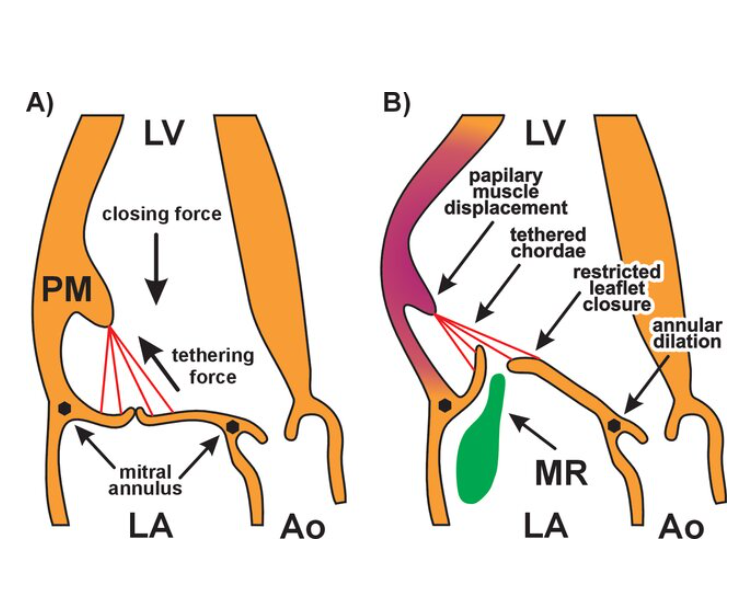
  • AF begets AF. This is similar to MR begets MR. Atrial functional MR occurs when the lower part of the atria stretches the mitral annulus. It is important to recall that a small area of the posterior aspect of the LA is a part of the mitral valve apparatus. Therefore, AF begetting MR and MR begetting AF should not be considered a funny rhyme, but rather a realistic possibility.
  • Histopathological specimens of atrial tissue in chronic AF can present with surprising results. The atrial muscle can be entirely normal, or the interstitium can be infiltrated with lipids, fibroblasts, amyloid, etc.
  • Regarding the issue at hand, it is widely known that in cases of mitral stenosis with AF, the left atrium (LA) is larger than the right atrium (RA) due to the obvious reason that the baseline LA was larger at the onset of AF. However, in cases of lone AF, AF in hypertension, or chronic AF, both atria tend to dilate equally..

Implications for electrophysiologists.

In contrast to other tachycardias, with atrial fibrillation (AF), the focus is often speculative, and ablation attempts are made accordingly. Pulmonary veins have been the primary target for ablation for many years, yet the success rates remain inconsistent. To determine if the AF focus is non-pulmonary venous, such as right atrial, septal, or involving the inferior vena cava (IVC) or superior vena cava (SVC), several techniques are employed to provoke and localize these non-pulmonary vein triggers

Localized atrial fibrosis and interatrial blocks can result in differential fibrillatory counts across the atria. (RA fib-rate can be more than LA, and vice versa.) Is there proof for this, or just an academic gossip? We know atrial flutters can be confined to one atrium. (Pierre Jaïs Circulation 2000) When such flutters transform into fibrillation, how does the spillover of signals occur to the contralateral atrium? On a personal note, we have recorded good E & A Doppler signals across the tricuspid valve, in RHD mitral stenosis, and AF. No published proof as such. I strongly suspect the right atrium can resist the tsunami of approaching fibrillatory waves from engulfing its chamber in at least some patients. An appeal to the new generation EPs who have special flair in AF should look into this and either prove or disprove it.

Final message

My answer to the question is either D or E. Atrial size in AF is not a trivial thing to ignore. This question pushes a simple idea. In primary or lone AF, just by having a look at the RA to LA size ratio, one might get a reasonable guess,about the Initial focus, trigger & pathology of the AF.

A request to all the high profile stake holders involved in the science of PV ablation (either with Ice or fire). Think about all the possible right-sided or septal focuses, before going overzealously for the jugulars of Pulmonary veins, especially if the RA significantly larger than LA . This will save time, effort & of course our reputation.

References

Nil

,

As the medical literature expands exponentially, the quality and intent of the research questions sound awry. There are only a handful of journals like JAMA that are bold enough to ask some tough and pragmatic questions in this glitzy world of medical extravaganza.

The current issue wants to set the pace for an important debate, on a topic that is rarely discussed.

The question is

Link to the article

Check whether your answers concur with this crucial query from Harvard Medical School and Massachusetts General Hospital. Three questions this article wishes to address.

1.What is the reason it is happening?

2. What are the implications?

3. What can be done for it?

My thoughts

“It is indeed over diagnosed. Once labeled, a chain reaction is set in. The cost, and resource consumption that follow a misdiagnosis are nearly identical to that of a true MI. More than that, the adversities of the tense investigative protocol can convert a misdiagnosis into a real one because that sadly includes even an overzealous poking right at the mouth of the coronary artery just o exclude a non existing MI . and ICU-related anxiety stand apart in this scientific comical game of ruling out a cardiac emergency.

The paper seems to blame mostly on the powerful screening test high sensitivity Troponin, Everyone will agree it has a major role in this. But, the more important reason is the cardiology community’s vigorous adoption of a universal definition of MI criteria (which is never intended to apply at the bedside) .Next factor is probably more important. The fear of missing a potential MI and legal consequences thereafter. I wish, the experts who sit on medical juries need to learn few extra lessons in the art of medical uncertainties.

Medical jurists, need to take some Intellectual cues from their criminal courts. How is it that, even well-planned criminal murders are successfully allowed to be argued and won in courts,…while inadvertent events such as missing an inconsequential MI by doctors are rarely pardoned?

How to avoid over diagnosis of MI ?

In this scenario, It is sad, that only very few cardiologists have the guts to ignore this omnipotent molecular sub-fraction of cardiac muscle Troponin, with their clinical skills. What we can do, at our level is to incorporate a new term “benign or micro myocardial Infarction” – akin to lacunar infarcts or TIA equivalents of the brain in the heart. We need to de-list the vast majority of chronic ischemic,non-ischemic, or systemic causes of Troponin leaks from the myocardial infarction chart. Physicians must realize, that protocol violation should not be deemed a crime always, rather it has a sure potential to benefit your patient if it is done properly and intelligently.

Final message

Recently one cardiologist in a sub-urban center was thrashed both physically and in social media ,for missing an ACS , which was subsequently recognised and treated well and good.

Doctors should be legally allowed,* (rather forgiven) to make permissible levels of errors in the medical decision-making process ” like any other profession .However, we must ensure our constant pursuit towards zero error, which may not be possible always. This should include overlooking apparently positive lab results if they have reasonably applied their clinical acumen. *Until this happens, the unquantifiable suffering of our patients* due to over-diagnosis and inappropriate interventions can not be reigned in.

*Maybe, this sounds more controversial statement in my 15 years of writing. Beloved patients shall note, it is a rare for me to make what probably, look like an anti-patient statement. Till now, I have been blamed my many of our colleagues, as self slandering my own profession for too many errors in many of the posts. Nothing can be done for this. When you search for truths , you need to tolerate all these.

Reference

1.McCarthy CP, Wasfy JH, Januzzi JL. Is Myocardial Infarction Overdiagnosed? JAMA. Published online April 24, 2024. doi:10.1001/jama.2024.5235

2.Shah  ASV, Sandoval  Y, Noaman  A,  et al.  Patient selection for high sensitivity cardiac troponin testing and diagnosis of myocardial infarction: prospective cohort study.   BMJ. 2017;359:

This image comes with courtesy of the Journal of SCAI Jai Parekh, Vikram Sharma, Jared Robl,et al Journal of the Society for Cardiovascular Angiography & Interventions 3 (2024) 101310

What is your diagnosis ?

I thought, it was pacemaker extrusion. It was indeed a close answer, still terribly wrong. It is an intentional exterior placement of a permanent pacemaker generator mimicking an extrusion due to pocket infection. Here is a patient, where a permanent pacemaker was kept temporarily for a few weeks or a month in high-risk reversible complete heart block situations. This typically occurs after an inferior posterior myocardial infarction, drug-induced CHB.

Currently, with the arrrival of TAVR, CHB has beceome a glamorous complication and is getting wider attention. This happens due to the anatomical uncertainties where the inferior landing zone of TAVI is pre-destained and is beyond our control. This is more true in the self expanding Core valve platform . When the lower edge treaspass the non-coronary cusp- membranous septal junction, it hits perfectly the compact post-penetrating bundle of His, confering a high risk of CHB.

Still, the good thing is some of them recover as the pressure edema regress .Putting a PPM in all such patients was considered mandatory or even a vanity in the past. Now we realise it is an additional metallic luggage in an already strained heart, Temporary-PPM the oxymoronic innovation is perfect option in this setting.

Final message

A typical external temporary pacemaker can be kept for up to 2 weeks maximum. (We have kept it for a month or so) It’s done via the jugular, subclavian, or even femoral. If the underlying condition demands more time for recovery of CHB, many do a regular permanent pacemaker.

Now , we have this unique option of using PPM as TPM. This is not a new concept though. It was used few decades ago .Has come back in more centers .Thanks to TAVI and its specific complications.

Reference

1.Rodés-Cabau J. Ellenbogen K.A. Krahn A.D. et al. Management of conduction disturbances associated with transcatheter aortic valve replacement: JACC Scientific Expert Panel. J Am Coll Cardiol. 2019; 74: 1086-1106.

2. Leong D, Sovari AA, Ehdaie A, Chakravarty T, Liu Q, Jilaihawi H, Makkar R, Wang X, Cingolani E, Shehata M. Permanent-temporary pacemakers in the management of patients with conduction abnormalities after transcatheter aortic valve replacement. J Interv Card Electrophysiol. 2018 Jun;52(1):111-116. doi: 10.1007/s10840-018-0345-z. Epub 2018 Mar 12. PMID: 29532275.