Feeds:
Posts
Comments

TGV is the most common cyanotic heart disease to present at birth.The outcome is dismal unless it is intervened at the earliest .It becomes a real  emergency if the dTGA is associated with intact IVS and IAS. (Though foramen ovale /ductus  may help for a while prolonging the survival . Often times , it is restrictive and demands immediate septostomy if primary arterial switch correction is not attempted )

Presence of VSD provides vital time interval to plan  surgery in a less emergent fashion. Otherwise , arterial switch if  contemplated one has to do it before 2-3 weeks (Rarely up to a month ) .The principle is to reverse the circulation before the  systemic left ventricle regress its myocyte function as it is exposed to low pressure pulmonary circuit .

Hemodynamics

We know , dTGA  has two parallel circuits in a bizzare hemodynamic disconnect .The right sided  pulmonary circuit sustains  the systemic blood flow with deoxygenated blood.The left sided systemic circuit recirculates oxygenated blood into pulmonary circulation again and again.

Survival depends upon , the anatomical communication between two circuits and the effective quantum (Deoxygenated)  of blood flow to the lungs .

Which communication is best for survival d TGA ?

The key is to understand   what we mean by “mixing  vs  shunting”  and the effective pulmonary blood flow (ie quantum of truly deoxygenated blood reaching lungs  vs oxygenated blood recirculating  the lungs in a hemodyamically wasted loop

It appears both atrial  ventricular level  mixing is good for maintaining adequate O2 saturation than PDA .

What does PDA do ?

Ductus is expected to persist in  dTGA  when  IVS and IAS are intact  . It is not clear  what determines the persistence of duct  in dTGA with intact IVS. Principles of natural  hemodynamic adoption would argue , all patients with dTGA should never close their ductus and foramen ovale. While , In reality it may be true for PFO to persist, ductus often gets closed on schedule* , aggravating  the hypoxia .(Both flow mediated myogenic resposne, O2 content of ductal blood and size are the determinants of ductal closure)

The ductal circulation in dTGA can be complex . It initially  acts as a channel to mix both arterial and venous blood flow .It can become a liablity  if its large , as the pulmonary vascular resistance falls,  blood is shunted from aorta to pulmonary circulation and potentially precipitate failure .Please note,  this shunting  also can  improve  the saturation as it diverts aortic blood into lungs ,still the ultimate usefulness will depend upon intermixing  at some other level  other than ducuts , ie either atria  or ventricle .One should  realise  ductus can never bring  good admixture as it happens outside the heart .It is obvious intra cardiac  mixing  with ASD and VSD  is always better and devoid of providing differentially saturated blood  to the extremities  , which is an inherent feature  PDA mediated  mixing .If ductus  is the only means of mixing and shunting  the lower half of the body has  an advantage as it is perfused continuously by oxygenated blood .This  may manifest as  reversed differential cyanosis in few combinations of TGA physiology. (Relatively pink  lower limbs and cyanosed upper extremity )

Summary

Ductus can be a double edged friend or single edged foe  in dTGV . It depends upon the size , quantum of shunt and associated  channels of mixing like ASD and VSD . If it occurs with  intact IAS and IVS it plays a role of  life sustainer.

Presence of ductus is definitely useful  initially.It can either help by mixing, intermittent bi-drectional shunting  or committed left to right shunting .This is why we attempt to  preserve its patency or even recannalise it by stenting  in such situations .The later can be used to buy time and train the regressing LV .However ,large ductus can be counter productive  if additional shunts are also present where one should even contemplate closing it .

Reference

1.
pda in dtga ductus ductal flow in tga2.Transposition of the great arteries with intact ventricular septum and patent ductus arteriosus. Waldman JD, Paul MH, Newfeld EA, Muster AJ, Idriss FS.Am J Cardiol. 1977 Feb;39(2):232-8.

Beta blockers(BBs)  have become  key drugs in  management of CHF .It helps by blocking  toxic effects of inappropriately  elevated   catecholamine  , which is actually a  compensatory response(A fight and survival reaction )  from the sympathetic system  to a failing  heart . This process becomes a liability in the long run  as the  adrenergic receptors either down regulate or even promote apoptosis and cell death .Along with  RASS-ACE  it affects every cell in the body promoting neuro- humoral catabolic state.

By trial and error  methodology we have found blocking the sympathetic system by BBs confer  consistent benefits in CHF .This is in contrary to the days we were ignorantly stimulating the beta receptors with positive inotropic  agents and  wary to give BBs in cardiac failure .This is one the most dramatic 180 degree turn around in the annals of clinical cardiac therapeutics last century.

Is all BBs  same ? Is it the class effect ?

It is tempting to think  all  BBs are  equal and to conclude they simply represent a class effect.But carvidilol  seems to be the flag bearer , for whatever  reason . (Apart from the outcome of  landmark studies , there is a pharmacological basis for it’s superiority COMET/COPERNICUS)

What is the secret of carvidilol’s superiority in CHF than other BBs ?

We know CHF is a systemic syndrome as do the  sympathetic activation .Hence , In CHF , it would require a non selective , systemically acting beta blocker to reverse and reset the adverse  effects of  catechlamine.surge.(Does that mean Propronolol (Inderal ) could be the best ?)

Carvidilol being a non selective BB  fits  perfectly  for the job . Of course , additionally  it has alpha blocking action that reduce the  after-load  reliving he LV wall stress during systole enabling further lowering of MVO2 and   promoting  regression of LV size as well.

Having said  that  prototype cardioselctive agents  like  Metoprolol , Bisoprolol are also  backed by robust evidence  for survival benefit in CHF . How to explain this paradox ? (CIBIS/MERIT )

“Thinking wildly(Evidence  would come later ) it is possible the benefits  from cardio selective agents are  accrued much  later as the dosage is titrated upwards . I would believe the  “inflection point”  of benefit could be same time they lose the cardioselectivity”

Final message

Cardioselectivity is  boasted as a gifted property of BBs .It may be true  in HT, arrhythmia and angina , but  in cardiac  failure it plays a different  ball game .The simple logic is the target  receptors need to be blocked  in systemic fashion.

 Reference

2. http://www.jfponline.com/fileadmin/qhi/jfp/pdfs/6402/JFP_06402_ClinInq1.pdf

Syncope is a classical feature of LVOT obstruction especially with valvular aortic stenosis.The mechanism of exertional syncope in Aortic stenosis is traditionally attributable to the fixed obstruction .This fixed obstruction is not able to cope up with increased cardiac output as demanded by the exercising muscles . But exercise  induced reflex as well as local vaso-dilatation mechanism is intact . The consequence is predictable. A critical fall in SVR amidst a obstructed LVOT precipitating a syncope.

However , If the above mechanism is the sole reason for syncope in Aortic stenosis , we have a problem to explain why syncope is  rare even in critical mitral stenosis which is also fixed LV inflow obstruction ?

Is there some thing unique in LVOT obstruction that causes syncope ?

No, it is nothing to do with LVOT .To generate a true pathological syncope, reduction in cardiac output per-se may not be enough . It appears there should be an inappropriate systemic vasodilatation as well to precipitate a syncope.This can happen only if the parasympathetic system gets activated by some means . The trigger is located in the mechano- receptors of left ventricle . Hypertophied left ventricle with high Intra cavitory pressure (Often above 200mmhg) generated due to LVOT obstruction activates the syncope circuit.The same rule may apply for RVOT as well .One could get syncope with critical valvular PS or severe pulmonary hypertension when RV mechanical receptors get a triggered.

What happens in mitral stenosis ?

In mitral stenosis , LV is under- filled ,  wall thickness is normal .There is little likely-hood of LV mechno-receptors to get stimulated as the LV wall stress is normal. This is the reason syncope is less common in mitral stenosis. However , this is not  absolute rule , syncope can still occur in severely narrowed orifice of mitral valve due to low flow state alone or a ball valve thrombus and paroxysms of arrhythmia .

Stenting, an attractive nmedical term, that involves deploying a coil or tube (metal or non-metal)  inside the human biological system that supports and scaffolds vessel wall, tracts, cavities and prevents it from closing again. Conceptually it could be termed as the simplest innovation in an otherwise complex industrial world. Originally used in various biological tracts like ureter, bile duct, esophagus, and others. In fact, the concept is so simple it can be effectively used wherever there is a tissue level occlusion which interrupts a biological function.

No wonder It has become revolutionary modality especially in cardiovascular disease and it is the most common intervention done where stents are used to keep vital coronary arteries open. While 9 out of 10 stents in cardiology would be in adults  within the coronary arteries there are some unique indications for stenting in infants and children in various congenital heart disease.

In congenital heart disease stents are used within chambers, outflow tracts, or septal orifices or even across valves to maintain or divert or maintain blood flow.

1. Coarctation of aorta

2. Right ventricular outflow tract (RVOT) conduits.

3. Maintenance of patency of the Arterial duct in  duct-dependent circulation,

4. Maintaining patency of stenosed aortopulmonary collateral vessels or obstructed shunts.

5. Stenting a PFO / ASD is also possible to maintain patency of intracardiac communications in TGV and related entities

6. Recently Interatrial flow regulators are used in in HFpEF. (EuroIntervention 2019;15:403-410. DOI: 10.4244/EIJ-D-19-00342)

The list is incomplete and can be used anywhere when you feel the flow is obstructed and that needs to be opened up.

Reference


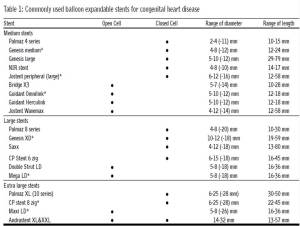
stenting in congenital heart disease stents used in congenital heart disease maxi ld cp stent omnilink mega ld genesis herculink

http://www.annalspc.com/temp/AnnPediatrCard213-7979559_220955.pdf

Click to access AnnPediatrCard213-4776139_131601.pdf


Femoral artery puncture is still the default technique for cardiac catheterization even as the radial access has gained huge popularity in recent years.Though patient  comfort and access site complications are clearly low in radial approach, complex procedures still demand femoral access. The true draw-back of  the obsessive  adaptation of radial access could be the  gradual loss of expertise in the fine art of femoral artery puncture.

It’s true femoral artery puncture can be troublesome at times by palpatory method .How to get into a difficult femoral artery with a poor pulse either due to anatomical reasons, extreme obesity or a compromised hemodynamic status ?

There are times, blind puncture based on anatomical guess could work. Alternate ways do exist. One can access the femoral artery by ultrasound guiding  with or without  smart needle system . More practical is the empirical  puncture based on surface anatomy  over the head of femur in fluoroscopic screen.The later method is not really crude as some would  think !. It was suggested by Grossman and popularized by none other than father of Interventional radiology Dr Dotter in 1970s .(Radiology Apr;127(1):266-7.Fluoroscopic guidance in femoral artery puncture.)
By fluroscopy , in AP view the head of femur can be divided into 5 zones.(Huggins) Zone 1 and 5 or superior and inferior to head of femur.The zones 2,3,4 are divided into upper, mid and lower third.
Where does common femoral artery bifurcate ?
The bifurcation of the CFA occurred in zones 2, 3, 4 and 5, which was 1%, 9%, 43% and 47% of the time, respectively, and thus occurred within the lower third of the femoral head or below the lower border of the femoral head in 90% of patients.

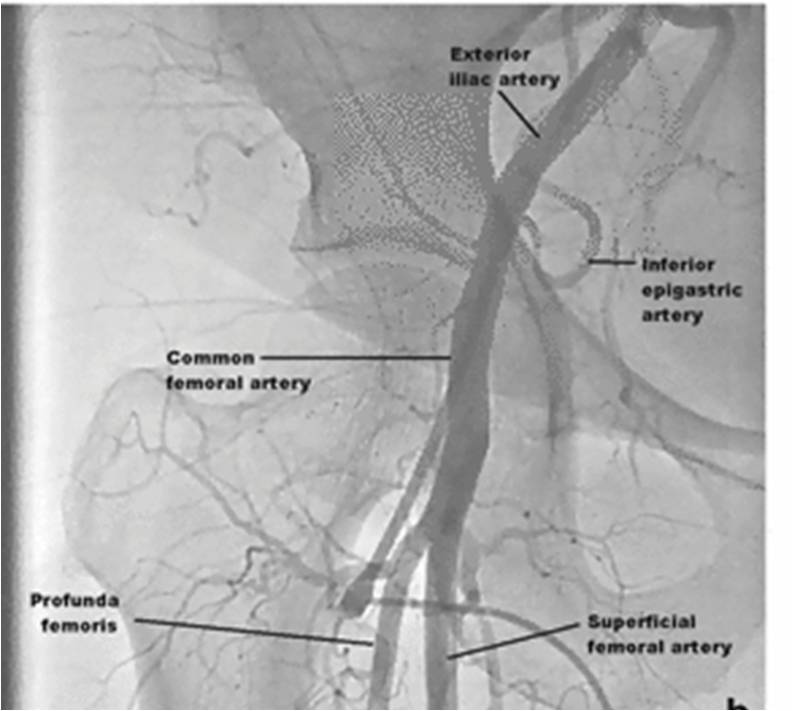
femoral artery puncture by fluroscopy

Image source Cardiovascular Intervention and Therapeutics January 2014, Volume 29, 18-23 Madjid Chinikar

femoral artery puncture by fluroscopy 2

Image source Cardiovascular Intervention and Therapeutics January 2014, Volume 29, 18-23 Madjid Chinikar

How to approach ?
A 18 G needle could be ideal
Puncture the skin at zone 5 inferior border of head of femur. Enter the artery at mid point in the Zone 3.
The chances of hitting the femoral artery is near 95 %

Reference

1.Fluoroscopic localization of the femoral head as a landmark for common femoral artery cannulation. Garrett PD1, Eckart RE, Bauch TD, Catheter Cardiovasc Interv. 2005
Jun;65(2):205-7

2.Fluoroscopy vs. traditional guided femoral arterial access and the use of closure devices: a randomized controlled trial. Abu-Fadel MS1, Sparling JM, Zacharias SJ, Catheter Cardiovasc Interv. 2009 Oct 1;74(4):533-9
3. Fluoroscopy guided vascular access: asking the right question, but getting the wrong answer? Turi ZG. Catheter Cardiovasc Interv. 2009 Oct 1;74(4):540-2

4.Imaging or trusting on surface anatomy? A comparison between fluoroscopic guidance and anatomic landmarks for femoral artery access in diagnostic cardiac catheterization. A randomized control trial. Madjid Chinikar, Azam Ahmadi, Abtin Heidarzadeh, Cardiovascular Intervention and Therapeutics January 2014, Volume 29, 18-23

5.A Prospective Randomized Clinical Trial of the Use of Fluoroscopy in Obtaining Femoral Arterial Access Chadwick E. Huggins, MD, Michael J. Gillespie, MD, *Walter A. Tan, J INVASIVE CARDIOL 2009;21:105–109

6..Puncture of the popliteal artery using a Doppler-equipped (SMART) needle in transpopliteal interventions.Kluge A1, Rauber K, Breithecker A, Rau WS, Bachmann G.Eur Radiol. 2003 Aug;13(8):1972-8. Epub 2002 Nov 22

Heart transplantation  as a treatment modality was conceptualized  by Christian Barnard in 1967 . Still considered as an  “Act of God” this  surgery is regularly performed worldwide by dedicated  transplant team consisting of cardiac surgeon , physician , Anesthetist , pathologist and others .Unlike other organs , heart transplant cannot have a “live donor” .Though  started  half a century ago, the real  pace has  picked up only in last 2 decades .Currently it is  “globally accepted  standard” intervention in terminal cardiac failure (Including pediatric heart conditions)

How are the survival rates ?

HEART TRANSPLANT SURVIVAL

  • Now, many centers  are able to reach the  bench mark Stanford- statistical rates with a consistent  five  year survival rate crossing   75% .
  • The median survival rates is 10.5 years
  • One of the estimate indicate , If they cross first year, median survival reach 13.5 years
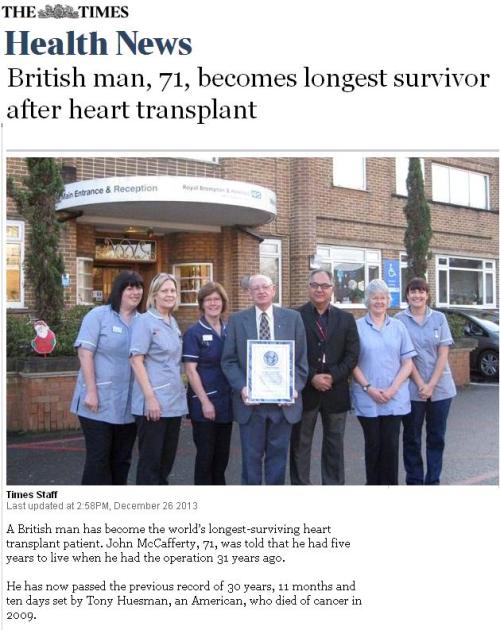
  • There has been many living survivors who have  crossed 30  years.

Looking at these numbers  , there is dramatic impact  in terms of global disease burden and the life gained.Statistically  speaking  successful treatment by heart transplant is equivalent to overwhelming  many  cancers in a human body !

Can these  results reproducible in all centers ?

These excellent outcome is  the reward to highly dedicated teams with  pioneering work culture . One should be cautious to start new transplant center without proper facility and expertise.Unregulated heart transplant  centers is vested with risk of pulling down the excellent  statistics of this unique form of human organ exchange.

Newer developments

Patient  selection criteria and  strategies to prevent rejection is being streamlined .The major  issue is availability of donor heart and how to optimize organ procurement and increase transport survival time .Transmedics has deviced a state of the art organ transport system . The other exciting thing expected to happen is potential (Ironical though !) heart donors from  even cardiac  /circulatory deaths . (Dhital KK, Iyer A, Connellan M Lancet. Adult heart transplantation with distant procurement and ex-vivo preservation of donor hearts after circulatory death: a case series.2015 Jun 27;385(9987)

What about artificial hearts ?

As of  now biological heart has definite edge over  artificial heart.Meanwhile rapid development of LV  assist  device and near total artificial  hearts may  end up with destination therapy rather than bridge to transplant. The “INTERMACS ” data are very promising and let us wait for the day artificial heart  can  score over the biological  ones.

Reference

1. The Registry of the International Society for Heart and Lung Transplantation: Twenty-eighth Adult Heart Transplant Report–2011.Stehlik J1, Edwards LB, Kucheryavaya  J Heart Lung Transplant. 2011 Oct;30(10):1078-94.


2.
heart transplantation
longest survival after heart transplanation
longest survivor of heart transplant

Aortic stenosis is diagnosed by 2D valve morphology, area ,and pressure gradient across the aortic valve.Though anatomical 2D images and indices are good enough to diagnose severe AS , we are obsessed *  with pressures  which are subjected moment to moment hemodynamic and contractile variables. To record a good gradient we need a normally contracting ventricle and good flow across the narrowed LVOT. If any one of the is critically compromised  gradients can’t be picked up by Doppler.(A new entity of AS was recently included , which fails to generate the gradient in spite of good LV function and the AS being significant.)

So ,whenever one records a “Low gradient AS” there are 4 distinct possibilities.

  1. Truly mild AS
  2. Technical inadequate Doppler alignment , with possible true moderate /severe anatomical  AS .
  3. Low gradient AS due to LV dysfunction, with true moderate /severe anatomical AS
  4. Low gradient AS with Low flow but normal LV function, with true anatomically moderate/severe AS

Echocardiographer should rule out 1 and 2 before going to the complex world of low gradient severe AS.In my personal opinion , the entity of Low flow , Low gradient with Normal LV function appear  redundant ( or is it beyond my understanding ) .One should look at the valve morphology and decide in such situations.

Then , one will shortly bump into this query  is it 2 or 4 ?

How to differentiate a  technically defective  recording  of low gradient AS  from  true low flow due to narrowed LVOT.(Low gradient for me , high gradient for my professor !)

Now, basic readers  may please leave ,

Few inquisitive may ask   ( naturally though)

Does the ” low flow -low gradient AS”  is an exclusive phenomenon  that can occur only with normal LV function  or can it  occur in  dysfunctional left ventricle as well ,  who also have small cavity size and narrow LVOT  ?  (Within the low gradient AS due to LV dysfunction subset ,  How much is attributable  due to anatomial low flow  and how much is related to depressed LV contractile force ?)

Another googly . . .

Why can’t  Doubutamine* stress test  routinely  undertaken in the subset of patients with  with subjects with Low gradient /normal LV function to augment the anatomical low flow and find whether it is true  low flow or not ? *This would mean , a most impractical situation wherein every patient  with even mild AS should need to undergo dobutamine testing to rule out significant AS.

Final message

As of now ,this new concept   “Low flow , Low gradient, with Normal LV function” appears an  intellectual excess with little impact on patient outcome.The proposed new entity ultimately increase the likelyhood of over diagnosing  severe AS.Iam still expecting  more clarity  on the issue. ( or else for the moment forget the pressures and  simply fall back on  a meticulous assessment of 2D valve morphology and take a call , you will be surprised how often we get into man made scientific traps. )

Reference

1.Low-flow, low-gradient aortic stenosis with normal and depressed left ventricular ejection fraction.Pibarot P1, Dumesnil JG.J Am Coll Cardiol. 2012 Nov 6;60(19):1845-53

Prosthetic valve obstruction is becoming a common clinical issue .It can be either acute, sub-acute or chronic . The pathology is usually thrombus formation , scar tissue growth (Pannus) or rarely a mechanical defect. Echocardiographic differentiation of thrombus from  pannus can be difficult .Generally , pannus is smaller , linear (less round) ,encroach from the periphery to central , mean gradients are consistently lower  than thrombus mediated obstruction. Clinically  pannus related obstruction present less acutely and occur in-spite of good compliance of anticoagulant medication and a well maintained  INR .

Trans thoracic (TTE)  , Trans-esophagel (TEE ) echocardiography , and real time 3D TEE are useful imaging modalities .The value of cine fluroscopy should be never underestimated and it is probably still the the best way assess the struck metallic leaflet.

Though the pathogenesis of pannus and thrombus are considered different there  is no reason they can’t  occur in a given patient at the same time.We know at least  one patient who had been referred to surgeon for mitral valve obstruction due to failed thrombolysis  had showed heavy load of thrombus  attached over a well formed pannus originating in medial sewing ring.

FInal message

However intelligent one may be , human brain often  tends to get skewed when confronted with a sudden query like  “What is your diagnosis , This or that  ?  Pannus or thrombus ? .Most will  go with  any one of it ! However, cardiac physicians must be aware  both pannus and thrombus can occur overlaid simultaneously in a given patient .The exact incidence  of such “combined thrombo-pannus”  is not known  but bound to be higher as we look for it. In fact , many of the residual gradients after lysis is attributable to undiagnosed pannus.  There is also a  suggestion scarred  , injured  ,  rough surface of the pannus could be the initial trigger for thrombus formation .

Reference

1.Differentiating thrombus from pannus formation in obstructed mechanical prosthetic valves: an evaluation of clinical, transthoracic and transesophageal echocardiographic parameters  John Barbetseas,  Sherif F Nagueh,  Christos Pitsavos, ;J Am Coll Cardiol. 1998;32(5):1410-1417. 

We know right from our pathology days in medical school , Atherosclerosis , the killer human vascular disease has a predilection for branch points. It’s no surprise around 30-40% of coronary stenosis has some degree of involvement of branch points .

PCI essentially involves palliative metal bracketing of this inflammatory cum degenerative process of the vessel wall.Tackling bifurcation lesions (BFL) requires special expertise , hardware and technique as carina and two ostia (In fact three !) are exposed to complex hemo-rheological stress de-nova and more so after the metal invasion.

The complication rate as well as long- term patency are considerably more  in BFL than regular lesions. This is why a “4S strategy “ (simple single stent strategy ) is the preferred default strategy in most BFL.

There are about dozen strategies  to tame  the BFL with  stents.One such modality is dedicated BFL stent.Various designs have been proposed in both balloon and self expansion platform.

The ACCSEES is a prototype dedicated BFL stent with DES and  a self expanding system

Reference

Degenerative Aortic stenosis occur with either normal  or congenitally malformed/ bicuspid valve.This contributes to the major chunk of  aortic valve surgeries and interventions (TAVR) in elderly population  . The optimal  timing of aortic valve replacement in patients with AS is debatable inspite of  well formed guidelines.

Three factors determine it .Symptoms , severity of aortic valve narrowing  and the tactness of LV function .The last parameter is a tricky one .We used to think in the past , severe LV dysfunction is a contraindication to aortic valve surgery. Now we realise ,however severe the LV dysfunction may be , relieving the obstruction will benefit  the patient and  the LV function is  also  likely to improve.

Cardiac physicians  face a dilemma when confronted with a patient  with low gradient and severe LV dysfunction .In this situation they are advised to do doubtamine stress Echo and watch for the gradient .If the gradient  increases that would  imply true fixed stenosis . (In pseudo aortic stenosis increased contractility opens the aortic valve and gradient will fall )

While this concept appears simple .There  are few  important issues that goes unaddressed  as we have not yet fully understood the  mechanism of LV dysfunction in aortic stenosis .(Link to mechansim of LV dysfunction in Aortic stenosis.)

At what degree of aortic stenosis LV goes down fighting and fail to generate the required  gradient ?

Myocardial function  and behaviour at times of hemodynamic stress can be highly  variable and most of us believe it is determined primarily by the genetic switches of myosin and other contractile elements .This is naturally proven at times of hypertensive left ventricular failure (Only in a fraction of the hypertensive population  LV is set to fail  when BP acutely raises.)

Proposed concept

Considering the complexities in cardiac mechanics , hemodynamics (and not to forget the vast control exhibited by genetic imprints over the hemodynamic behavior of LV) , it seems highly plausible even mild degrees of Aortic stenosis can inflict significant myocardial dysfunction in certain patients . Hence the phenomenon of pseudo aortic stenosis needs further critical analysis If this is proven to be true there could be a realistic indication for aortic valve intervention even in patient with low gradient / true Mild AS with LV dysfunction.
A word of caution is required .Relying too much (Which we often do ) on gradients in the assessment of aortic stenosis has skewed our common sense. Its wiser to have a  meaningful look at the valve morphology . A normal appearing  valve in 2D can never cause significant stenosis. Pressure recovery phenomenon also is to be given due respect as it over estimates gradient .This will effectively avoid surprises and guilt on table when we find a relatively good looking valve posted for AVR /TAVI