Feeds:
Posts
Comments

Posts Tagged ‘ffr’

History beckons… once upon a time, assessing severity in valvular heart disease was gloriously simple. We used to just a pullback pressure gradient across the aortic valve . Now, history repeats itself, as the same philosophy returns to coronary arteries, offering a surprisingly elegant solution amid a chaos of physiological indices. That is PPG .

What Is PPG*?

Pullback Pressure Gradient (PPG) is a physiological mapping method that evaluates the pressure gradient across a coronary artery using a gradual pullback of a pressure wire . It helps to:

  • Localize ischemia
  • Differentiate focal from diffuse disease
  • Guide a more logical PCI strategy

Rather than a strict binary verdict (ischemic or not), PPG gives us a gradient map — revealing how pressure falls, where it falls, and whether intervention makes sense.

*I would love to call it as plain old PPG. POPP-G . (Sort of POBA equivalent in PCI)

How to Measure It ?

  1. Essentially it is a less glorified iFR or FFR .Same hard ware is used.
  2. Pull back happens in both .But ,here thats is only that happens, that’s devoid of the clumsy Adenosine protocols, Incomplete hyperemia, patient anxiety, or microvascular dysfunction etc.
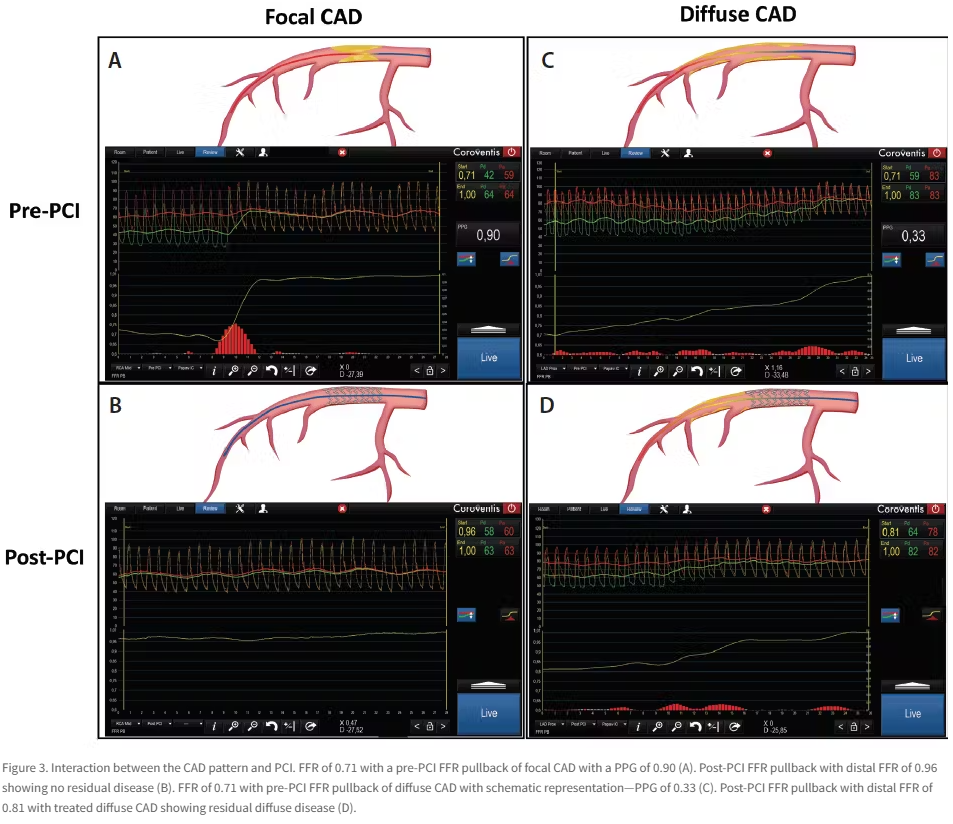
  3. Apart from measurinng pressure drop the rate of fall the gradient slope is also analysed. PPG = ΔP / pullback distance (mm) .If the slope is steep the lesion is probably stentable . If the rate of fall is slow or flat we may avoid stenting.

PPG is a dynamic, localized, gradient-based insight into coronary disease. A focal ΔP over small length ΔL would be a perfect PCI candidate. A flat gradient over long ΔL , would suggest medical therapy .(May be CABG in few)

PPG in bifurcation Lesions

How do you FFR in bifurcation or trifurcation lesions . If you ask this question to any cardiologist, will try to get away from the scene. Such is the complexity involved. Here comes the savior. PPG helps you out in a smart fashion.

  • PPG allows branch-specific physiological localization, Can be used selectively in each branch to map the true pressure loss. This is contrast to the crude FFR that may falsely elevate due to competitive flow or tandem disease.
  • PPG can avoid the unnecessary double stenting and of course make the make the bifurcation club members unhappy in the process. PPG also can help detect ostial branch disease (by inching technique we do in cardiac auscultation,) by very slow pull back.

Image courtesy : Daniel Munhoz CARDIAC INTERVENTIONS TODAY MAY/JUNE 2021 VOL. 15, NO. 3

Is FFR really problematic ? Be aware of conflicting studies

FFR was a great concept when it came in. FAME I study adored It. FAME II questioned PCI’s benefit despite FFR-positive lesions. Then came DEFINE-FLAIR and iFR-SWEDEHEART, questioning the need for hyperemia at all. Still, residual ischemia post-PCI in up to 20% of cases (DEFINE-PCI) even when FFR said “normal.” Confused? So are most cardiologists.

Modern cardiologist’s dilemma: How to cross coronary jungle infested multiple flow Indices ?

The list is long . FFR , iFR, FFR-CT, QFR, RFR, dPR, NHPR, µQFR (there are few more I might have left ) . None are perfect. Some contradict. Some cost too much. Many need drugs. All add layers of complexity to what should be a simple clinical question: Should I stent this lesion? Now, we have the simple plain PPG.

Why should, we fall for PPG ?

Let’s be honest. PPG is not flawless. After all, we take pressure drop as a surrogate marker for restricted flow . Every Indices does that. But unlike other indices It’s intuitive. It’s visual. It tells you where to treat. It gets the pressure data on the spot from ground zero . It can bring reliable info without the need for intracoronary medication , or costly software. Finally, it restores some simple sense in us ,without great knowledge in coronary hemodynamics.

Reference

  1. Kobayashi Y, Johnson NP, et al. “Physiological Assessment of Residual Ischemia After Coronary Stent Implantation Using Instantaneous Wave-Free Ratio.” JACC Cardiovasc Interv. 2019;12(19):1996–2007. https://doi.org/10.1016/j.jcin.2019.04.040
    PPG-based residual gradients predicted poor outcomes post-PCI even when angiographic results looked fine.
  2. Collet C, et al. “Stress myocardial perfusion imaging vs coronary functional assessment with PPG and FFR: A physiologic map approach.” Eur Heart J. 2021;42(10):926–938.
    PPG superior in identifying focal lesions amenable to PCI compared to binary FFR thresholds.
  3. van Belle E, et al. “DEFINE-PCI: Residual Ischemia Post-PCI Detected by PPG and iFR Pullback.” JACC Cardiovasc Interv. 2019;12(20):1991–2001.
    Post-PCI ischemia often missed by angiography alone — PPG reveals it.
  4. Davies JE, et al. “Use of the Instantaneous Wave-Free Ratio or Fractional Flow Reserve in PCI.” N Engl J Med. 2017;376:1824–34.
    iFR non-inferior to FFR .Suggests resting physiology-based PPG.

5.Munhoz D, Collet C, Mizukami T, Yong A, Leone AM, Eftekhari A, Ko B, da Costa BR, Berry C, Collison D, Perera D, Christiansen EH, Rivero F, Zimmermann FM, Ando H, Matsuo H, Nakayama M, Escaned J, Sonck J, Sakai K, Adjedj J, Desta L, van Nunen LX, West NEJ, Fournier S, Storozhenko T, Amano T, Engstrøm T, Johnson T, Shinke T, Biscaglia S, Fearon WF, Ali Z, De Bruyne B, Johnson NP. Rationale and design of the pullback pressure gradient (PPG) global registry. Am Heart J. 2023 Nov;265:170-179. doi: 10.1016/j.ahj.2023.07.016. Epub 2023 Aug 21. PMID: 37611857.

Read Full Post »

1.Is systemic HT an advantage ?so that high pressure head aids in pushing the blood across the lesion. ?

I don’t know whether I can say Yes*, physiologically, the high proximal pressure and low distal pressure help maintain the flow. The distal drop happens due to the tightness of the lesion itself, but that is counterproductive, unless tone of the distal microvascular bed is intact and dilates fully.

*Mind you, IABP during cardiogenic shock, essentially does this – keep the coroanry diastolic pressure high.

However, there are significant caveats.

There is law of diminishing Returns : In a 90% lesion, the resistance is so high that even elevated Pa may not substantially increase flow due to the fixed obstruction. Hypertension increases left ventricular afterload, raising myocardial oxygen demand. In a 90% LAD lesion with compromised flow, this can worsen ischemia, outweighing any flow benefit from higher pressure.

2.What happens to trans-lesion flow during hypotension ?

This has direct implications when a patient with a significant lesion develops hypotension due to a systemic cause like dehydration or postoperative hypovolemia. We have often observed transient ST/T changes in a postoperative patient that may or may not lead to full-blown ACS.

To know what exactly happens across a lesion, we need to understand coronary autoregulation and its limits. Coronary autoregulation maintains stable myocardial blood flow despite changes in coronary perfusion pressure. Its limits and range are as follows. .

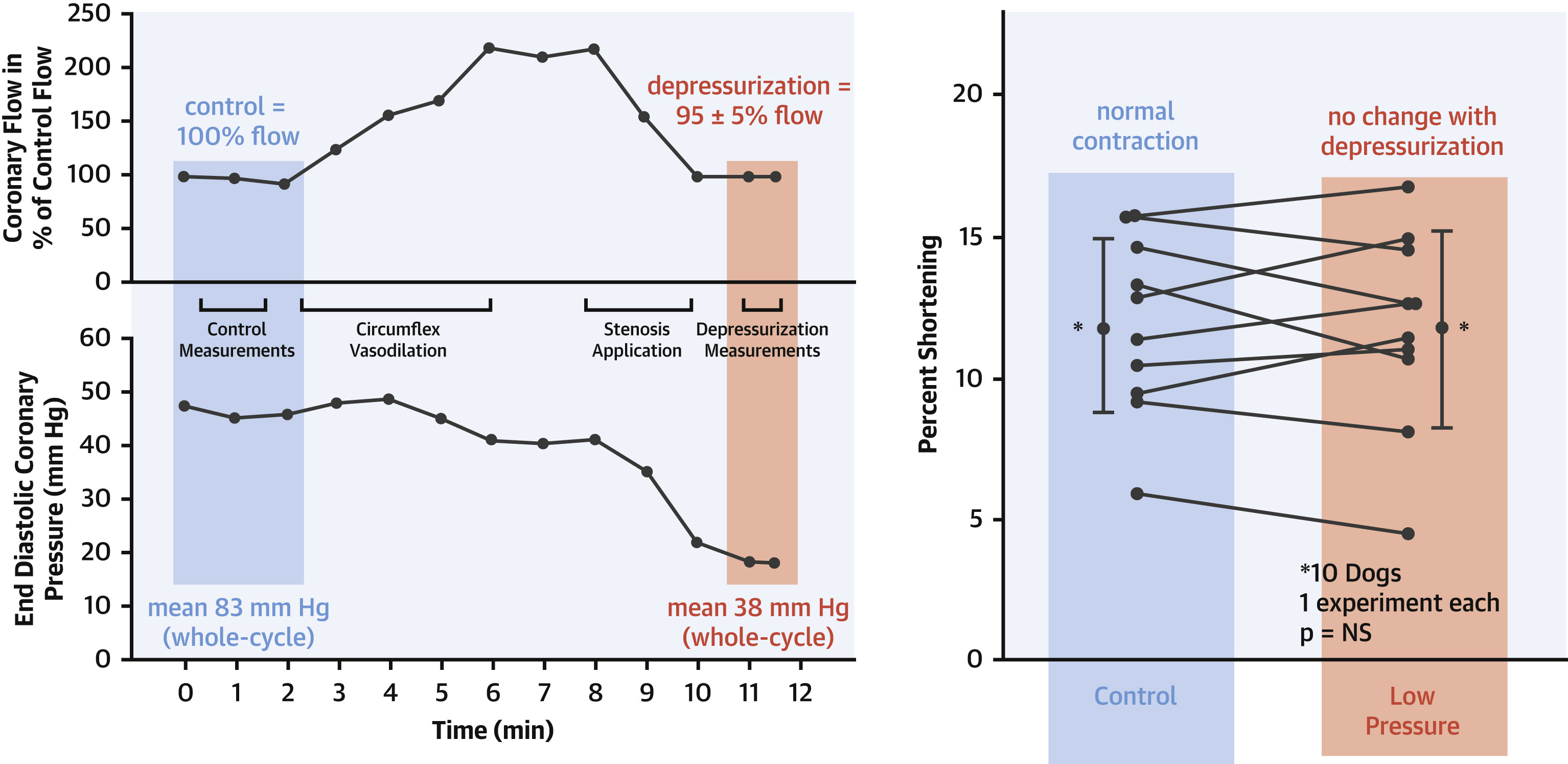
The famous dog experiment on the coronary flow on depressurisation (Ref 2)

Range of Autoregulation: In healthy coronary arteries, autoregulation operates effectively between perfusion pressures of approximately 50–60 mmHg to 120–140 mmHg. Within this range, vascular smooth muscle in coronary arterioles adjusts resistance to maintain near-constant blood flow.Lower Limit: Below 50–60 mmHg, autoregulation fails, and blood flow becomes pressure-dependent. This can lead to ischemia, especially in the subendocardium, which is most vulnerable due to higher oxygen demand.Upper Limit: Above 120–140 mmHg, maximal vasodilation is reached, and further increases in pressure do not significantly increase flow.

However , we don’t know how this autoregulatory biological servo control, is tampered in the presence of a single or a tandem lesions.

3.How does FFR gets altered during exertion in such lesion ?

We have very limited data available on this and are essentially ignorant . FFR during exertion typically decreases compared to rest due to the amplified pressure gradient across the stenosis driven by increased flow demand and limited reserve.However collaterals can mitigate this fall in FFR.

Final message

Putting a stent across 90% lesion surely is a childish task, when compared to understanding complex hemodynamic vortices that happen across it.

Reference

1.Johnson NP, Gould KL, De Bruyne B. Autoregulation of Coronary Blood Supply in Response to Demand: JACC Review Topic of the Week. J Am Coll Cardiol. 2021 May 11;77(18):2335-2345. doi: 10.1016/j.jacc.2021.03.293. PMID: 33958131.

2.Smalling RW, Kelley K, Kirkeeide RL, Fisher DJ. Regional myocardial function is not affected by severe coronary depressurization provided coronary blood flow is maintained. J Am Coll Cardiol. 1985 Apr;5(4):948-55. doi: 10.1016/s0735-1097(85)80438-1. PMID: 3973297.

Read Full Post »

A simple question with mammoth repercussions in the revascularization world.

How was the question ? Was it difficult ?

Don’t worry, it wouldn’t be the same even for elite cardiology experts worldwide. It is not a Himalayan task, though, to find an answer. All it requires is a simple FFR run through pre and post PCI (Now RFR, iFR, QFR). Surprisingly, very few inquisitive minds wanted to do this. I can find 5 related papers. The fifth one is very specific: REPEAT-FFR study. Go through at least that one paper and find the answer yourself.

Cardiology fellows it is worth reading about this important study , might be asked in exams.

Final message

The conclusions from these studies are not really baffling, but demand a lot of academic cleansing of our understanding about the relationship between epicardial patency and microvascular flow.”It is obvious from these studies that epicardial PCI never guarantees good revascularization with a FFR backing “

Every cardiologist should ask this question before they scrub, whether the PCI, they are going to do today, would improve the net-myocardial flow, LV function or symptoms . Are we doing justice to our patient (or blindly practicing science) who is quietly lying on the table, with a mix of anxiety and trust, with a complete belief that what they are undergoing is a life-changing or life-saving procedure.

Further, it is our duty to restore the lost glory to the defamed , stigmatised medical management of CAD & Impress our patients that “All that, doesn’t glitter could be pure gold as well

Reference

1 Pijls NH, Klauss V, Siebert U, Powers E, Takazawa K, Fearon WF, Escaned J, Tsurumi Y, Akasaka T, Samady H, De Bruyne B; Fractional Flow Reserve (FFR) Post-Stent Registry Investigators. Coronary pressure measurement after stenting predicts adverse events at follow-up: a multicenter registry. Circulation 2002;105:2950-4

2. Agarwal SK, Kasula S, Hacioglu Y, Ahmed Z, Uretsky BF, Hakeem A. Utilizing Post-Intervention Fractional Flow Reserve to Optimize Acute Results and the Relationship to Long-Term Outcomes. JACC Cardiovasc Interv 2016;9:1022-31

3. Rimac G, Fearon WF, De Bruyne B, Ikeno F, Matsuo H, Piroth Z, Costerousse O, Bertrand OF. Clinical value of post-percutaneous coronary intervention fractional flow reserve value: A systematic review and meta-analysis. Am Heart J 2017;183:1-9

4. Wolfrum M, De Maria GL, Benenati S, Langrish J, Lucking AJ, Channon KM, Kharbanda RK, Banning AP. What are the causes of a suboptimal FFR after coronary stent deployment? Insights from a consecutive series using OCT imaging. EuroIntervention 2018;14:e1324-31

5.. Azzalini L, Poletti E, Demir OM, Ancona MB, Mangieri A, Giannini F, Carlino M, Chieffo A, Montorfano M, Colombo A, Latib A. Impact of Post-Percutaneous Coronary Intervention Fractional Flow Reserve Measurement on Procedural Management and Clinical Outcomes: The REPEAT-FFR Study. J Invasive Cardiol 2019;31:229-34

For those people who are too busy to click on the link .Summary of REPEAT-FFR study .

Read Full Post »

FFR is the ultimate hemodynamic test that measures the physiological Impact of lesions. Just pass a manometer tipped wire across the lesion and note the pressure drop (with or without Adenosine) All you have to remember is two cut off values  .8 for FFR and .9 for IFR. Abracadabra . . . yes you got the answer , whether to proceed with PCI or not? It’s as simple as that. We are no longer blind to physiology to which many coronary purists often criticize us.

ffr ifr fame study

Coronary physiology simplified

Now , answer this question.

Is FFR heart rate dependent? If yes, how significant it is?

This simple question on coronary physiology caused the maximum distress  to  a large expert cardiologist group

Some of the answers

  1. No, it doesn’t.
  2. I think it may be affected.
  3. Yes for sure, but it’s not significant
  4. Yes, it’s an important limitation

My Answer

It has to be yes, right, however minimal it may be. My interpretation of truth in FFR is, it can have a massive influence* . (*Unless you are sure (we can never be ) about achieving maximum hyperemia or this hyperemia is the same as physiological exercise.) In fact, the whole concept of FFR lies in the fact that it should induce enough HR raise that should be used as a surrogate marker for maximum hyperemia. Ideally, like stress testing, we need to test FFR at maximum heart rate and minimal heart rate. The difference could be documented as FFR max-min. This will throw new light into the physiology of microcirculation.

Should we need to create a heart rate corrected FFR?

Yes , I think we need to do it or else should report at what HR we are reporting the FFR. If FFR falls at a high heart rate and maintains at low it implies a significant lesion. So don’t get fooled with FFR of .9 measured at an inadequate heart rate.

IFR to replace FFR : On what basis?

Meanwhile, new generation coronary flow quantification tool IFR jettisoned Adenosine and simply measure diastolic instantaneous flow at resting state. This makes a mockery of coronary physiology, without a true debate about heart rate dependence of trans-lesional flow.

Impact on clinical practice

Even as we struggle to answer the fundamental question of the influence of Heart rate on FFR, many landmark studies had been done. They have ratified FFR as the most physiological modality to assess coronary lesion. Important guidelines have been written based on these studies. No one will ever know, the true impact on the current cardiology care,  had we included heart rate adequacy /correction as an essential criteria in those FAMEd studies we hype about.

Counterpoint.

All is well with FFR.It has been tested with various heart rates.

FFR at peak hyperemia means there is no further HR rate induced potential microvascular reserve. So a properly administered optimal Adenosine augmented FFR should not bother the HR variability. (But its only theory)

If FFR is ok . . . IFR should not be ok is it not?, For the simple reason, there is no hyperemia in IFR , what is the use of knowing resting flow reserve (RFR)

Reference


Postamble with a slice of History 

FFR is as old as the concept of PTCA. In fact, the original balloons used by the great Gruentzig’s * had a central port for pressure recording through which he measured both proximal and distal pressure curves to guess the significance of obstruction. After each inflation, he checked  whether both curves are drawn together which he speculated to indicate a successful procedure physiologically.

*What a stunning scientific mind the father of Interventional cardiology was blessed with, still inadequate for the Nobel committee to get convinced.

Read Full Post »

Even as we make rapid strides in  conquering coronary atherosclerosis by all those fancy gadgets , the  fundamental coronary  hemodynamic principle   is poorly understood . Hence  there is no surprise  for the  “perennial ambiguity”  in the indication  and effectiveness of  coronary revascularization .

Why the hell ,   reliving  a  coronary obstruction  may  not provide the   expected hemodynamic benefit  or do not prevent future  heart attack  in many ?    One of my patients  asked ?

I told him . Wait , do not get  excited , we also do not know  . . .We are just beginning to understand mysteries of coronary  circulation.

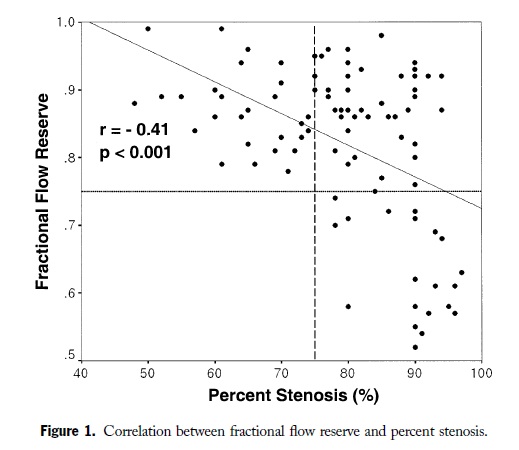
It is a well documented fact  ( but a  debatable )   that  lesser the  severiity of a  lesion more likely it is prone for an acute coronary  event .( Vulnerability , shearing stress or is it a simply a statistical mirage !) While the  vulnerability aspect is  complex , the hemodynamic  impact of  coronary  lesions  is   relatively better  understood. Here is  an important  documentation from Dr B . K  Koo from  Seoul , South Korea  who has elegantly shown the behavior of  fractional flow reserve (FFR ) in various grades of  stenosis  .This study was done in jailed side branches following PCI.

FFR  shows a surprise   relationship  with severity of coronary stenosis  . Even severe lesions showed equal if not more flow  reserve ?

and mild lesions might have lost all its reserve.

 How is it possible ?  Can it be true ?

Yes , it is indeed a  fact . God generally  keeps a stong link between anatomy and physiology  , structure and function . But he adds a rider and keeps  a reserve in every  human cell   meant for  emergency  back up . FFR is  one aspect of this , we have  partially discovered .  When we fail to understand this we are bound to get confused and make a wrong decision in cath lab.

Simply stated ,  flow across a coronary  artery is much more depedent on the status of microvascualture  than the hurdles they face in the epicardial highways !

Link to this original article from JACC .

How to do the FFR procedure ?

http://www.sjmprofessional.com/Clinical-Solutions/Intl/Radi-FFR.aspx

Soon to follow . . .  If less severe lesions are more  dangerous why we are ignoring it in cath lab ?

Read Full Post »