Feeds:
Posts
Comments

Posts Tagged ‘grace registry’

Cardiogenic shock (CS)is the most feared event following STEMI. The incidence is up to 5 to 10% with a mortality rate of around 50-60%. Still, we are finding it hard to bring this down below 50 % .There is one less addressed issue in ACS literature. We tend to perceive CS as an exclusive complication of STEMI. The fact is that NSTEMI can also result in CS is less recognized. The incidence is half of that of STEMI, i.e., 2.5-5%.

Mechanism of CS in NSTEMI

One may ask, how can CS occur in NSTEMI with partial occlusion with a non trans-mural MI. ACS pathophysiology is not that simple. Ischemic LV dysfunction (Global stunning) without necrosis is equally sinister. This is what happens in some high risk sub sets of NSTEMI.

How is CS in NSTEMI different ?

1.Global ST depression (AVR.V1 might show little elevation with considerable overlap of left main STEMI vs NSTEMI )

2.Onset of NSTEMI-CS occurs late (48-72 hrs)

3.Severe multivessel disease is more common (It is likely ,presence fold STEMI , is an important factor that is likely to precipitate CS when a new NSTEMI occurs.

4.Echo is likely to show more of a Global hypokinesia rather than specific coronary territory

5.Mechanical complication, though less common in NSTEMI , Ischemic MR especially with LCX- NSTEMI can be problematic and much commoner than we think.

6. A subset of NSTEMI precipitated by acute severe HT and flash pulmonary edema has excellent prognosis if BP is reduced promptly. (This can be simply a equivalent of HT, with no true supply side ischemia with LVF with global ST depression )

Management

*More or less similar to STEMI with aggressive opening of culprit lesions with few differences. (unlike STEMI, CULPRIT SHOCK trial doesn’t apply here )

*May require CABG more often

*Mechanical circulatory support will be needed in many

*Finally, and importantly, there is more likelihood of systemic factors like sepsis, Anemia, or renal or kidney failure contributing to the CS in NSTEMI than STEMI. In fact, we have observed pre-existing HFpEF can be a contributory factor.

Outcome

There are differing data about prognosis of CS in STEMI vs NSTEMI. Early mortality is higher with STEMI; but, late mortality converges. Ironically, in many patients of CS in NSTEMI, the outcome can be worse than STEMI, as there is no single culprit and myocardial salvage does not appear to be a primary issue. (Ref 2)

What does SCAI guideline say about CS in NSTEMI?

Nothing, yes it is true. Are you surprised ? A search for the word NSTEMI in both these document drew a blank. May I kindly request SCAI team to look in this, CS in NSTEMI deserve better recognition in their guidelines at least in their next edition (Ref 3,4)
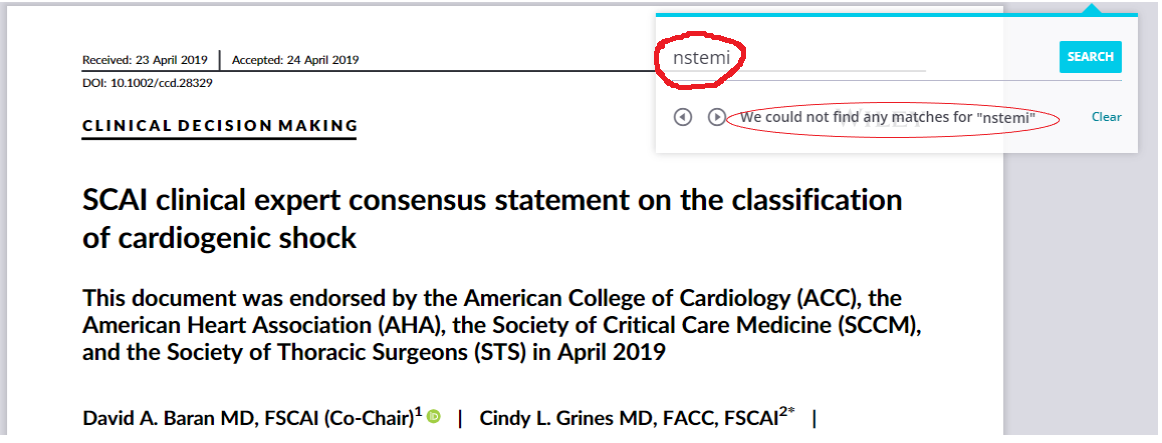
I am not sure why SCAI classification didn’t address CS in NSTEMI as a separate entity.

Final message

Surprisingly , CS in NSTEMI is not a well researched entity in cardiology literature. Fellows are requested to analyse the GRACE registry once again or create their own institutional experience.

Reference
1.Martínez MJ, Rueda F, Labata C, Oliveras . Non-STEMI vs. STEMI Cardiogenic Shock: Clinical Profile and Long-Term Outcomes. J Clin Med. 2022 Jun 20;11(12):3558. doi: 10.3390/jcm11123558. PMID: 35743628; PMCID: PMC9224589.

2.Anderson ML, Peterson ED, Peng SA, . Differences in the profile, treatment, and prognosis of patients with cardiogenic shock by myocardial infarction classification: A report from NCDR. Circ Cardiovasc Qual Outcomes. 2013 Nov;6(6):708-15. doi: 10.1161/CIRCOUTCOMES.113.000262. Epub 2013 Nov 12. PMID: 24221834.

3.SCAI 2019 Catheter Cardiovasc Interv.2019;94:29–37

4.SCAI 2022 consensus update.

Read Full Post »

Apart from  acute  coronary syndrome,    cardiac  failure is   the most common clinical  presentation of  CAD. Cardiac failure ,  classically present with dyspnea on rest or on exertion , while angina is the dominant presentation in ACS.  

What if  ,  both these  occur together in an acute fashion ?

Yesif it occurs  together it is called ischemic cardiac failure . Fortunately , this is quiet uncommon . It has   an adverse outcome,  especially if it occurs  as a companion of NSTEMI . Let us see how . . .(  Most of the episodes of cardiac failure  in CAD  means only  LV failure )

For cardiac failure to occur , there need to be a mechanical contractile dysfunction or defect . In CAD population , this can  occur in  one of the following way.

  • Loss of LV muscle (Acute  Myocardial infarction as in STEMI)
  • Mechanical defects (Mitral regurgitation/VSR etc)
  • An arrhythmia (Commonly VT or AF / CHB )  can precipitate  cardiac failure

Apart from these three , there is  an important mechanism of acute LVF, namely ischemic stunning of major part of LV resulting in severe mechanical dysfucntion.This is a dangerous form of cardiac failure (Pathologivcclaly it is thought to represent  contraction  band necrosis !) this occurs in global ischemic situations manifested as gross global ST depression.

So,  there are two types of  ischemic LVF  .  STEMI   occuring due to infarct( ± ischemia ) Other  one (NSTEMI)entirely due to ischemia.

Logically ,  one  may n’t   refer  STEMI related LVF as  ischemic LVF at all  , as infarct has already occured. While , NSTEMI related LV could be the ” True ischemic LVF “


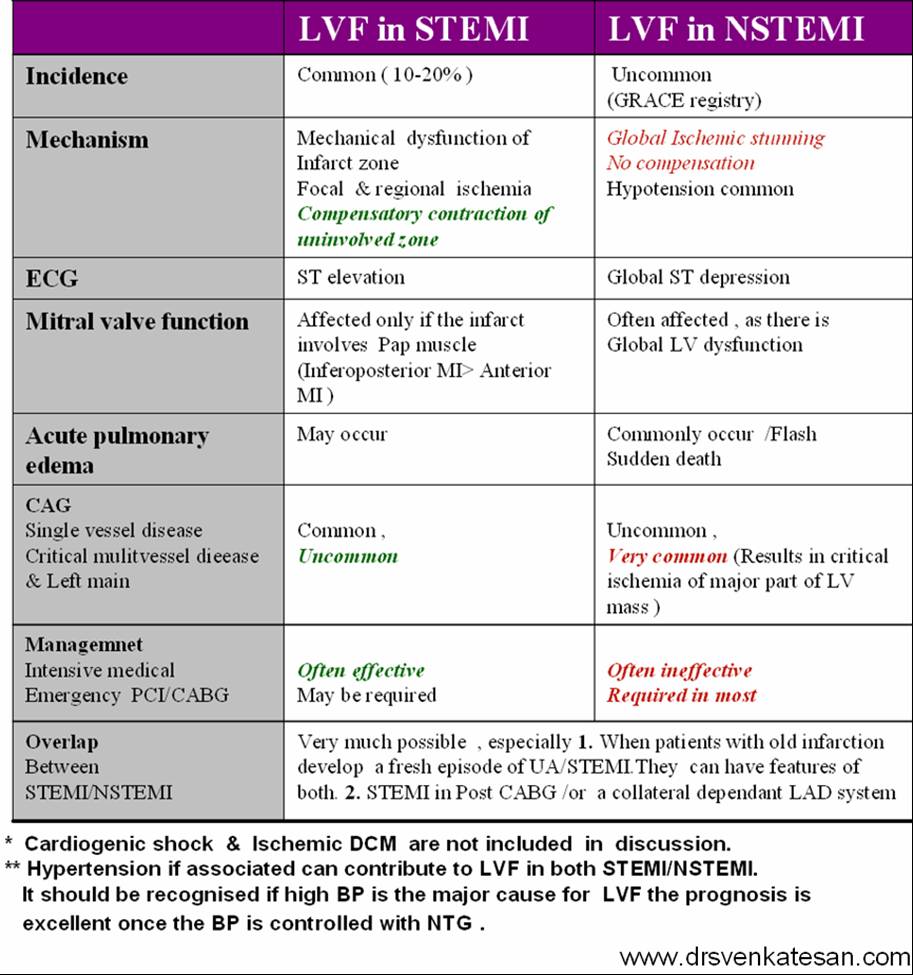
What are the differences between cardiac failure that occur in  STEMI and NSTEMI ?


lvf in nstemi stemi

Is post infarct failure  ( The commonly used terminology  , now out of vogue ! )  a type of ischemic LVF ?

In the strict sense , it is not . Here the dead myocardium , is responsible  for the   failure .To label a  LVF , as  ischemic , ongoing ischemia must  be  documented and further it  should  be shown to  contribute   for the  mechanical dysfunction .

This is of vital importance ,   if you wrongly attribute ischemia  as a cause for  the LVF , the patient may be taken up for emergency  revascularisation .It is not going to help much (Infact , it may  worsen !) as  this cardiac failure is not going to be corrected  .What we require ,  here is an  aggressive medical management  protocol .


Read Full Post »
